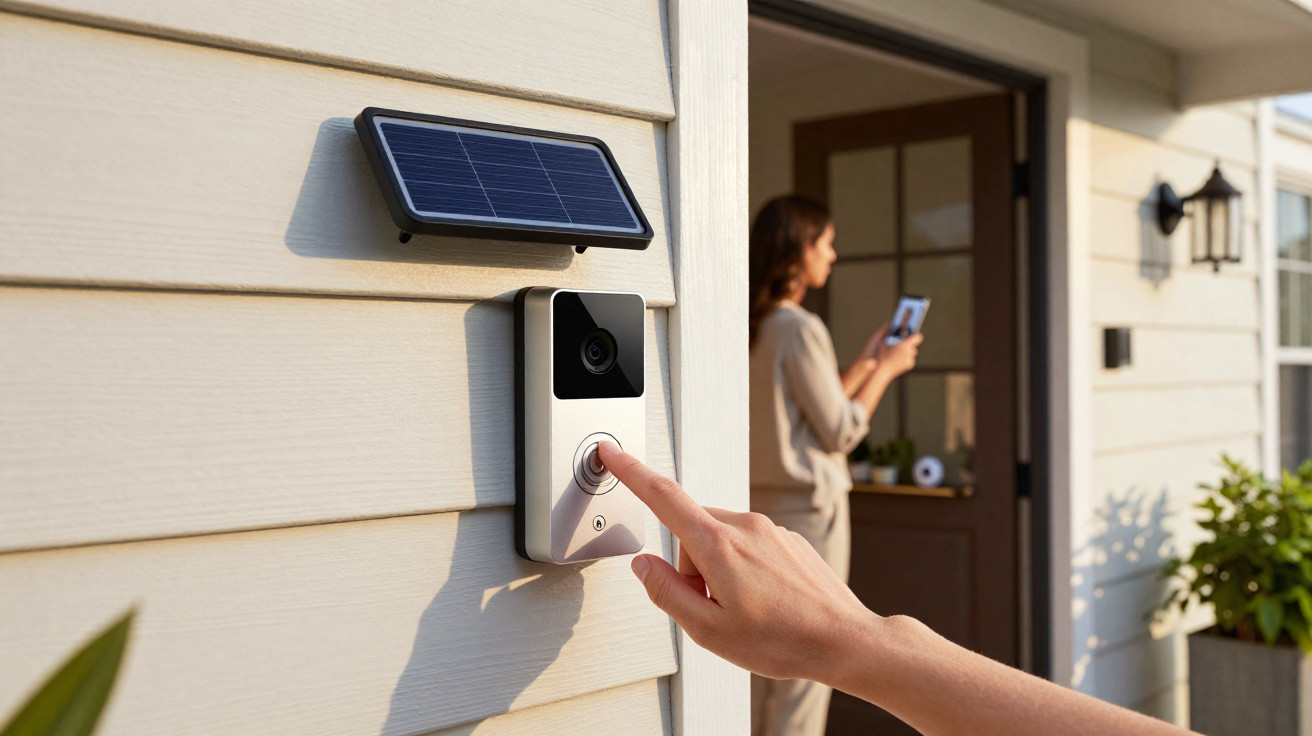
More and more homeowners are upgrading their entrance areas digitally – and Ring is now taking the next step by significantly improving image quality.
Amazon subsidiary Ring has refreshed its entire range of video doorbells, introducing wireless models with 4K resolution for the first time. At the same time, it is launching new 2K devices, an updated Elite version with a network cable, a solar charger and a new indoor Chime. Ring is clearly targeting people who want to see more detail at their front door, whether that means a parcel courier or a suspicious shadow on the driveway.
4K at the front door: Ring’s new range
Until now, 4K was limited to Ring’s premium hardwired models. With this new generation, the higher resolution is also arriving on battery-powered doorbells. At the centre of the line-up is the new Battery Video Doorbell Pro, positioned as a high-end wireless option.
4K Ultra HD at the front door is intended to make faces, number plates and small details far easier to identify – even in poor lighting.
The Pro model includes several features that may appeal to demanding users:
- 4K video resolution, offering substantially greater image detail than Full HD
- Digital zoom of up to 10x
- Updated night vision and improved low-light performance
- A new internal architecture for faster data processing
- A fast-charging battery designed to deliver practical day-to-day runtime
Ring has adopted a new internal design so that the camera can reliably handle the volume of data produced by 4K streams. At the same time, the new battery is intended to stop users having to repeatedly climb a ladder to recharge the doorbell.
Permanent installation with extra power: the Elite version
Alongside the wireless Pro model, Ring is launching a new wired Elite doorbell. It also records in 4K, but uses Power over Ethernet (PoE), with both power and network connectivity supplied through a single Ethernet cable.
In practical terms, this provides:
- no battery concerns thanks to a permanent power supply
- a stable network connection that does not depend on Wi-Fi signal strength
- an ideal option for new builds or extensive renovations
Installation is clearly more involved than with a battery-powered doorbell, but this model is aimed at users seeking a long-term solution requiring as little maintenance as possible. The Elite doorbell includes more precise motion alerts and extensive remote control through the app, including settings for zones and sensitivity.
Solar power for batteries: new solar charger and Chime Plus
To reduce concerns about flat batteries on its cordless models, Ring is introducing a new solar charger. This accessory is installed directly behind the relevant doorbell and continuously supplies power in daylight.
Anyone with a reasonably sunny exterior wall can noticeably reduce the number of times they need to recharge manually by using the solar charger.
Ring is also updating the indoor Chime Plus. It is a conventional plug-in chime that makes doorbell rings and selected notifications audible around the home, without requiring a smartphone to be constantly nearby.
| Product | Function | Guide price |
|---|---|---|
| Battery Video Doorbell Pro (4K) | Premium wireless doorbell | approx. €250 |
| Wired Video Doorbell Elite (4K) | PoE permanent installation for professionals | approx. €500 |
| Solar charger | Trickle charging for battery doorbells | approx. €50 |
| Chime Plus (2nd Gen.) | Indoor chime for notifications | approx. €60 |
Three new 2K models for tighter budgets
In addition to its flagship 4K models, Ring is introducing three doorbells with 2K resolution, covering different installation scenarios and budgets. They are aimed at users for whom Full HD is no longer sufficient but who do not want to pay extra for 4K.
Wireless Plus model with an improved battery
The new-generation Battery Video Doorbell Plus sits in the mid-range. It is wireless, offers 2K resolution, is expected to last longer thanks to an optimised battery, and provides digital zoom of up to 6x. This makes it suitable for tenants and homeowners who do not want to alter their electrical installation.
Basic battery model and conventional wired option
Those looking for an even lower-cost entry point can choose a simplified wireless version with 2K video and fewer features. It is intended for users who want essentials such as a live view, push notifications and straightforward clips, without insisting on numerous extras.
There is also a fully wired 2K doorbell for homes that already have a traditional transformer-powered doorbell installed. Battery considerations disappear entirely here, while installation follows familiar doorbell system arrangements.
- Wireless 2K Plus version: mid-range model offering a good balance between price and features
- Basic 2K battery doorbell: affordable entry point for standard uses
- 2K wired version: sensible where a power cable is already present at the door
Prices and availability of the new Ring range
The complete series is already available to pre-order. The price range is considerable:
- 2K wired doorbell: from around €80
- Basic 2K battery doorbell: just under €100
- 2K Battery Plus: around €180
- 4K Battery Pro: about €250
- 4K Elite with PoE: up to €500
- Spotlight Camera Pro (2nd Gen.) with 4K: also approx. €250
Alongside the doorbells, Ring is introducing a 4K outdoor camera with a floodlight in the form of the new Spotlight Camera. It covers larger areas such as a yard, garage or garden, complementing the doorbells on the exterior of the property.
What does 4K on a doorbell really deliver in everyday use?
The key question is whether the difference between 2K and 4K is actually noticeable at the front door. In practice, the benefit is most apparent in borderline situations. When someone passes briefly through the frame, a face is partly obscured or number plates appear at the roadside, the additional pixels can often provide crucial detail.
There is another consideration: many users do not watch recordings on their phone, instead viewing them later on a large television or PC monitor. Blurry clips can quickly become disappointing in that situation. 4K remains legible for longer when zooming in, provided the network connection can keep up.
Data use is another factor that should not be underestimated. Higher resolution means:
- greater upload requirements on the home network
- more mobile data used when viewing footage away from home
- increased cloud storage needs, depending on the subscription model
Anyone using a relatively weak DSL connection or a limited mobile data allowance should bear this in mind and, when in doubt, opt for 2K instead.
Privacy, neighbours and sensible use
As cameras at home entrances become ever sharper, legal questions are increasingly coming into focus. In Germany, private cameras may only record the owner’s own property; public paths and a neighbour’s garden are off limits. Most Ring models now offer configurable zones so that sensitive areas can be excluded.
Tenants are better off discussing a video doorbell with their landlord and, where appropriate, the wider residents’ association. Conflicts can arise particularly quickly in blocks of flats when residents feel they are being filmed constantly.
Ideally, the technology should be used responsibly: parcel notifications, evidence for damaged deliveries and a view of the entrance while away on holiday can all add convenience without unnecessarily monitoring other people.
Who should upgrade to the new Ring generation?
Anyone who already owns an older Full HD doorbell should realistically assess how much they would gain from moving to 4K. In well-lit entrance areas with a short distance to the door, 2K already provides enough sharpness for many households.
The new range is particularly appealing for:
- homes with a larger front garden or a longer driveway
- commercial properties, holiday lets or blocks of flats with substantial activity
- users who regularly need to pass clips to the police or insurers
- technology enthusiasts who want to keep their smart home fully up to date
Combinations can also make sense: those protecting the entrance with a 4K doorbell while adding 2K cameras to side passages or a garage drive can often achieve a good balance between cost, installation effort and image quality.
Overall, Ring is sharpening the identity of its doorbells considerably with this new generation. Wireless 4K, a PoE option for professionals, a solar charger and Chime are all intended to cover as many living situations as possible and make the move towards a connected front door somewhat more appealing.

















Comments
No comments yet. Be the first to comment!
Leave a Comment