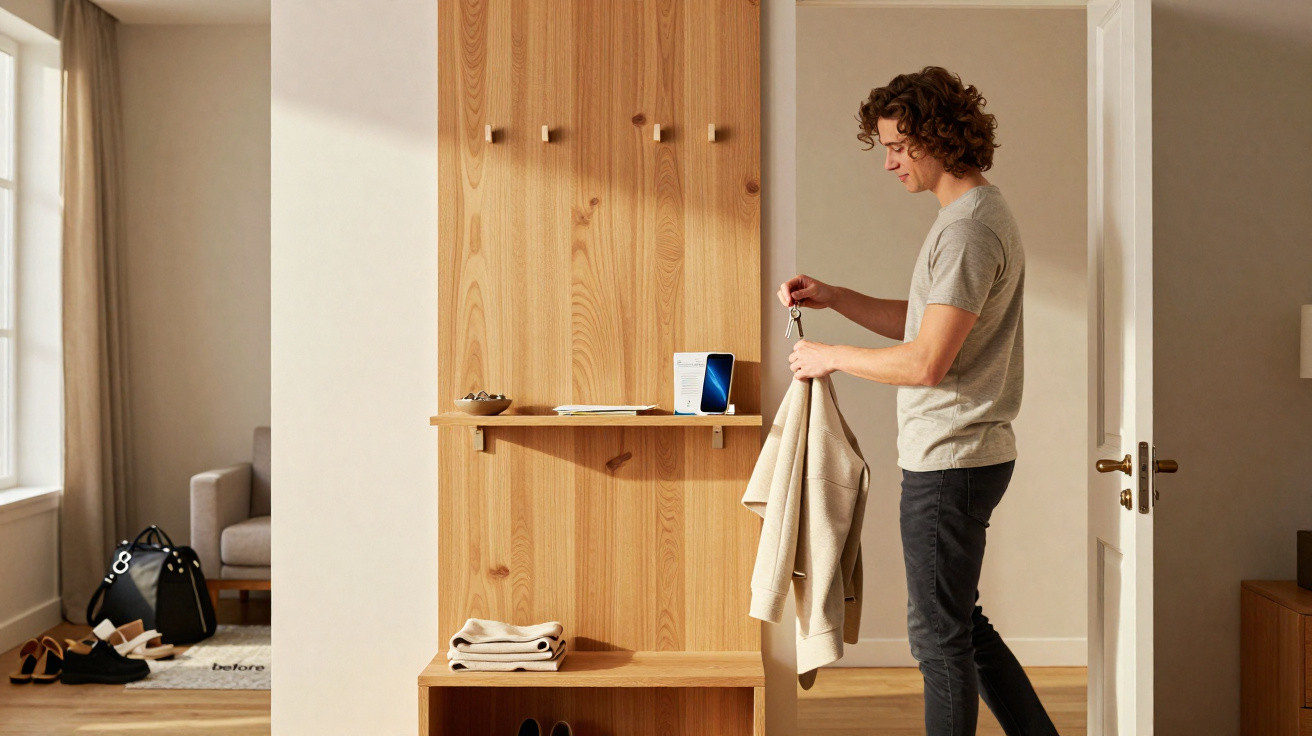
It is 18:42, your arms are full, your keys have vanished into the bottom of a bag, and a pair of shoes is sitting precisely where someone will trip over it. We all know that small burst of hallway chaos: the kind that makes the whole home feel untidy before you have even taken off your coat. The usual instinct is to buy a larger unit, a storage bench or an attractive console table. Yet the most effective change can sometimes fit within a 15-centimetre strip of wall, used vertically. This trick does not aim to hide everyday life; it finally gives it a proper place. The result is genuinely surprising.
The secret is not furniture, but a landing zone
The rarely seen trick behind flawless interior photographs is to create a vertical landing wall immediately beside, or behind, the front door. It is neither a decorative shelf nor a miniature cupboard: it is a dedicated spot for the things that come and go each day, from keys and post to the dog lead and earphones. On a narrow wall, a few hooks, a wall pocket and two small baskets are enough. The hallway then stops being a random dumping ground.
In Léa’s one-bedroom flat, where the entrance corridor is barely 90 centimetres wide, this arrangement replaced a bulky console table. She fitted a hook rail at a height of 1.60 metres, added a hanging catch-all and placed a slim basket for umbrellas; within a week, the kitchen table had regained its real purpose. Depending on the chosen dimensions, this setup will often take up less than 0.1 square metres of floor space. It is almost nothing, yet it changes the atmosphere as soon as you step inside.
This approach works because it matches the way we actually come home. We do not put things away first in a drawer, then a box, then a cupboard: we set them down, take a breath and remove our shoes. A well-designed entrance works with that movement rather than demanding extra effort. Vertical storage keeps belongings in sight without letting them take over the space, preventing the quiet build-up that eventually starts to fray your nerves.
How to fit this discreet storage without redesigning the whole entrance
Start by noticing what genuinely lands near your door over three days: bags, post, shoes, coats, toys, helmets, keys or small purchases that were forgotten about. Then select just one wall, however narrow, and assign functions from bottom to top: shoes or shopping bags at the bottom, accessories within hand reach, and papers and keys slightly higher up. Ideally, keep the depth between 10 and 15 centimetres. This keeps the route clear, even in the tiniest corridor.
The biggest mistake is attempting to store everything in this area. An entrance is not meant to hold every family coat, all ten available pairs of trainers or the month’s administrative paperwork. It should absorb the movement of the past 24 hours. Let us be honest: nobody truly does the perfectly thorough sort after every return home, every single day. Allowing for a small “to deal with” basket prevents imperfection from turning into a mountain.
To ensure the wall remains pleasant to look at, stick to three or four visible categories and give each one a defined container. A fibre basket, a thick fabric pocket or a shallow metal box adds texture without making the wall resemble a cluttered storage area.
“Good storage is not the kind that demands discipline; it is the kind that makes the right action almost automatic.”
- One hook for each person, labelled where necessary.
- A wall-mounted catch-all reserved for keys and cards.
- A slim basket for items that need to go out the following day.
- A small tray for post to be sorted, never for storing it.
This detail also changes the way you come home
A clear entrance is not only about appearance, although the pleasure of opening the door without seeing a heap of shoes is real. It creates a brief pause between the outside world and home: somewhere to put down the day before properly coming in. Children can find their hats without shouting through every room, guests know where to leave their coats, and the morning departure loses some of its urgency. Storage becomes almost invisible because it follows the household’s rhythm.
This idea should also be adapted rather than copied word for word. In a family home, you could install low hooks for children and a pocket for school permission slips. In a studio flat, the back of a door or the side of a wardrobe will often be sufficient. In rented accommodation, good-quality adhesive hooks and a hanging organiser provide a reversible option. The most useful feature is not the material but the proximity: an item needs to be stored in exactly the place where the hand naturally looks to put it down.
There is something rather reassuring about this small change. You do not merely gain a few centimetres; you avoid frantic last-minute searches and the feeling of beginning the evening with an overdue task. After a few days, many people find that their entrance looks larger, even though no wall has moved. The difference comes from what is no longer left on the floor or shifted from chair to chair. Sometimes, the comfort of a home begins with a well-placed hook.
| Key point | Detail | Added value for the reader |
|---|---|---|
| Make use of vertical space | Use a wall or the back of a door with a depth of 10 to 15 cm | Frees up the floor and makes the entrance look larger |
| Create a transit zone | Reserve the space for objects used during the previous 24 hours | Reduces build-up without requiring perfect tidiness |
| Give every container a purpose | Keys, post, accessories and items for the next day each have their own place | Makes departures easier and limits stressful searches |








Comments
No comments yet. Be the first to comment!
Leave a Comment