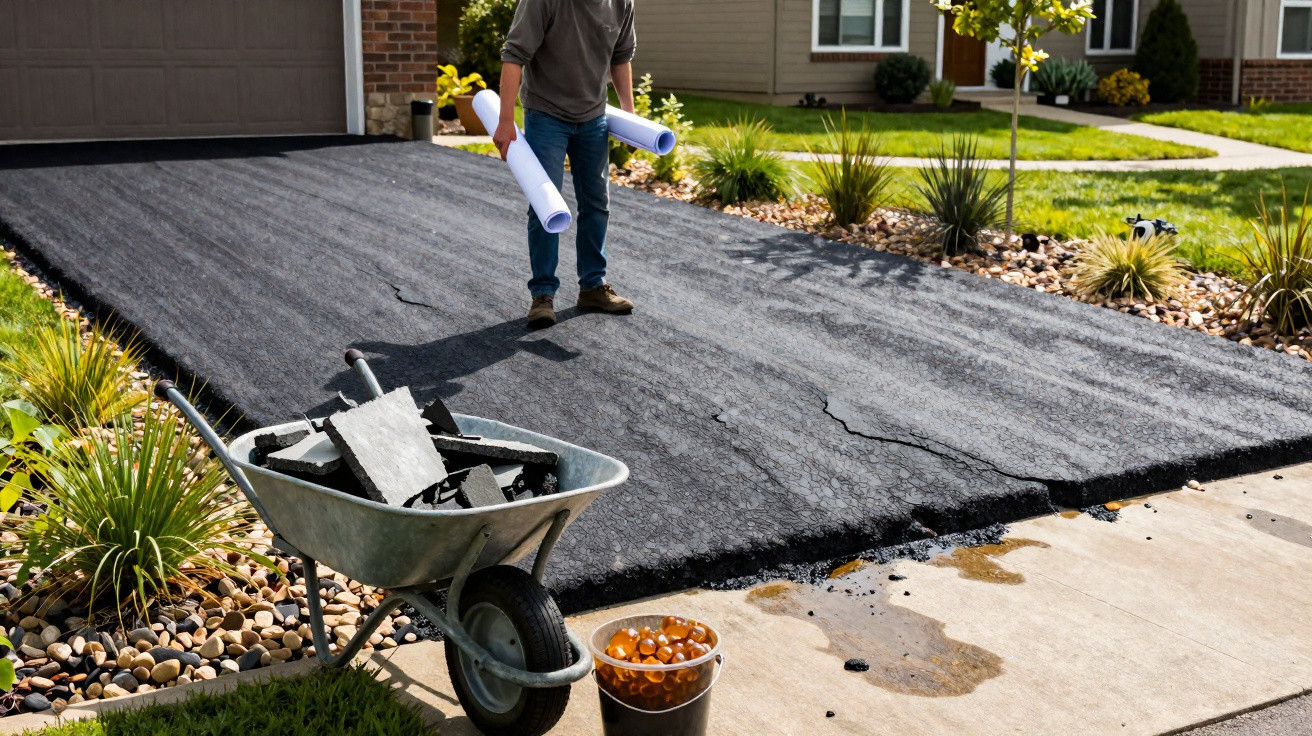
Cracks, puddles and a dull grey appearance: the large concrete slab outside the house has long ceased to feel contemporary. At the same time, towns and local authorities are tightening their rules on sealed surfaces. A recycled, water-friendly surfacing material from road construction is quietly but clearly positioning itself as its replacement – bringing compelling benefits for both household budgets and the climate.
Why traditional concrete driveways are becoming less appealing
For decades, concrete was regarded as the answer for driveways: durable, low-maintenance and “built to last forever”. Reality presents a different picture. In summer, the surface behaves like a hot plate; in winter, it becomes a rigid slab that cracks with frost and ground movement. Minor damage can only be patched unattractively, quickly raising the question: replace the whole thing – and really use concrete again?
There is also the climate issue. Concrete derives its strength from cement, and cement is the major climate culprit in the equation. Cement kilns operate at extremely high temperatures and are fuelled by fossil energy sources. Globally, the cement industry accounts for a significant share of greenhouse-gas emissions in the construction sector.
“Anyone who makes their home more energy-efficient while leaving a large, impermeable concrete slab outside the front door is living with a noticeable contradiction.”
Concrete is also coming under economic pressure. A decorative, good-quality concrete driveway can readily cost between €70 and €120 per square metre. If remedial work is needed later, costs rise further, as repairs are technically demanding and rarely look convincing.
Recycled asphalt surfacing: old road material, a new opportunity
Recycled material has long been routine in road construction. With so-called asphalt surfacing – essentially an asphalt mix – aggregates such as gravel and sand are combined with a bitumen-based binder to form a hard-wearing surface. This principle can be used intelligently for driveways.
The key is that old road surfaces are milled off, crushed either on site or at a plant, and reused as recycled material. Known as RAP (Reclaimed Asphalt Pavement), this material provides the basis for new driveways without requiring every stone and every drop of binder to be produced anew.
“Recycled asphalt surfacing conserves raw materials, lowers production energy requirements and reduces transport distances – without requiring users to make major compromises on stability.”
Illustrative figures from North America show that a driveway based on recycled asphalt costs roughly $7.5 per square foot, equivalent to around €6.9. A comparable concrete surface can cost up to $20. RAP surfaces are stated to last around 15 to 30 years. While concrete often lasts somewhat longer, it is considerably more expensive and more difficult to repair.
What modern ‘green’ surfaces can offer too
The shift is not just towards recycling, but also towards permeable and plant-based bound surfaces. Local authorities are increasingly introducing requirements that limit fully sealed areas. Surfaces should absorb rainwater rather than send it straight into the drainage system.
Draining surfaces mean fewer puddles and more groundwater
Draining asphalt and mixed surfaces have a more open structure. Water passes through the surface and infiltrates into the ground beneath. This cuts down on puddles, relieves pressure on drainage systems and helps more rainwater remain in the soil. This is precisely what many local authorities now increasingly require.
Although such systems often cost 15 to 25 per cent more than basic standard surfaces, they deliver a clear functional and environmental advantage. Anyone who does not want lakes forming on their driveway will notice the benefit.
Plant-based binders instead of purely petroleum-based products
Plant-based binders are another element of this approach. Rather than relying solely on petroleum products, these surfaces use binders that are partly made from renewable raw materials. Combined with 30 to 35 per cent recycled aggregates, they create a surface that requires substantially fewer virgin raw materials.
In daily use, this means the driveway looks like a conventional asphalt route and easily supports cars and bicycles, while generating a lower climate impact during production than traditional solutions.
How homeowners can plan a recycled-surfacing driveway
Anyone replacing a concrete driveway should not simply choose the cheapest contractor. Quality depends entirely on expertise and on preparing the sub-base properly. It is therefore worth selecting firms that regularly work with recycled asphalt and draining systems.
When speaking to a specialist contractor, several focused questions can help identify credible quotes:
- What proportion of recycled material will be used?
- Is the surface designed to be fully sealed or draining?
- How thick will the base course and surface course be?
- How will the ground be stabilised (frost protection, compaction)?
- What service life and maintenance requirements does the contractor expect?
Clarifying these points before signing a contract substantially reduces the risk of settlement cracks, standing water and subsequent remedial work.
Price, climate and comfort: a direct comparison
The main question for many homeowners is simple: does it pay off? A broad comparison can help with the decision.
| Feature | Concrete surface | Recycled asphalt surfacing |
|---|---|---|
| Price per m² (guide prices) | approx. €70–120 | approx. €30–70, depending on construction |
| Service life | approx. 25–40 years | approx. 15–30 years |
| Repairs | complex, visually sensitive | readily manageable in sections |
| Water absorption | usually completely impermeable | capable of infiltration when installed as a draining surface |
| Manufacturing climate impact | high CO₂ emissions from cement | lower, especially with recycled content and plant-based binders |
The table makes clear that concrete's principal advantage is its theoretical service life, but it falls behind on flexibility, repairability and climate impact. Recycled surfacing offers a much fairer overall package when cost, sustainability and water management are considered together.
Where recycled surfaces make particular sense – and where they do not
A driveway made from recycled asphalt or draining surfacing is not equally suitable for every property. For example, anyone with an exceptionally steep approach, highly concentrated heavy loads or constant lorry traffic needs a careful structural assessment. On most residential streets with normal car traffic, however, the surfacing performs without problems.
In shaded, damp locations, dirt can build up more quickly on open-pore surfaces. Occasional cleaning with a brush or low-pressure washer can then help. Maintenance should be regular but not excessive, so the structure is not damaged.
What else homeowners should consider
Many local authorities have their own requirements for access routes, parking spaces and infiltration. A quick look at local building regulations or a call to the planning department can prevent problems before the digger arrives. Draining systems are often expressly viewed favourably.
Combining the surface with planting is also worth considering. Border strips with perennials or gravel beds, small-format grass joints, or an infiltration area at the end of the driveway absorb water and soften the overall appearance. The once hard, hot concrete slab outside the front door can then become a surface that feels far more pleasant – both visually and for the climate.











Comments
No comments yet. Be the first to comment!
Leave a Comment