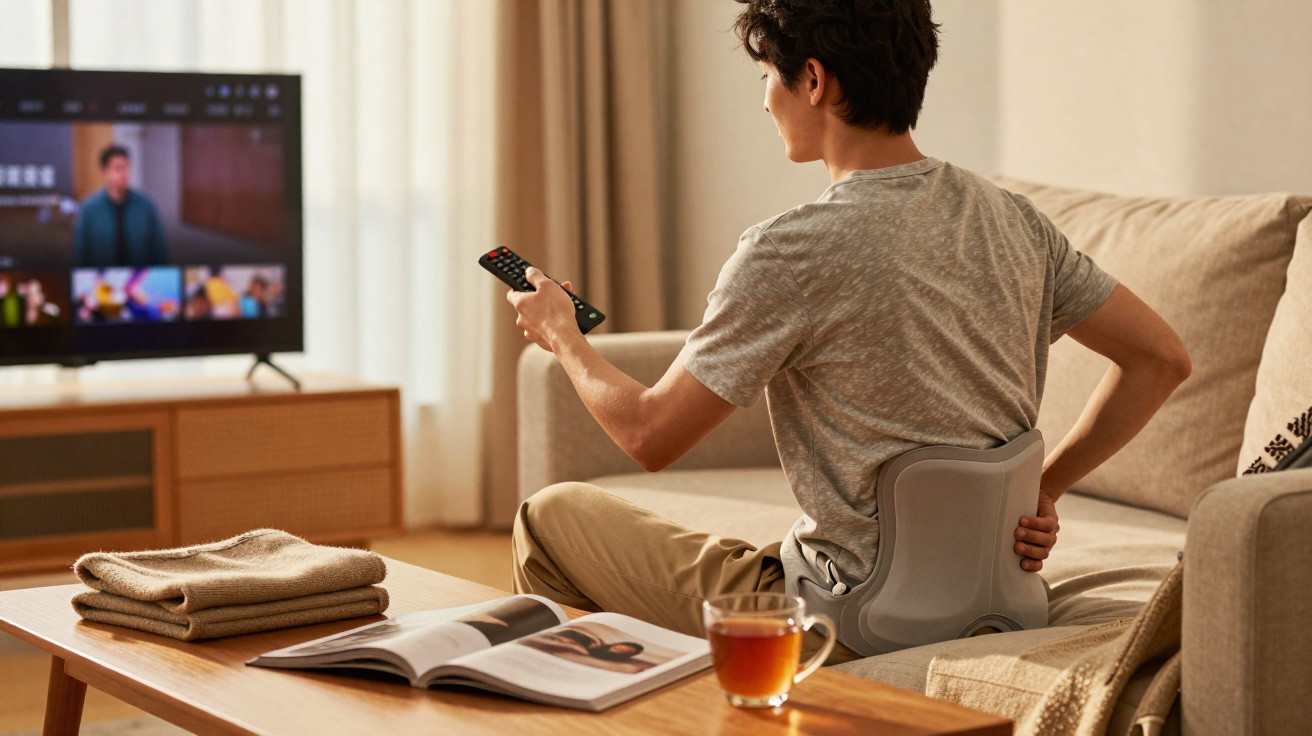
Netflix has asked for the third time whether you are still watching, the crisp packet is open, and your phone has disappeared somewhere between the sofa cushions and a blanket. You slide a little lower, draw up your knees and lean at an angle against the armrest. It feels comfortable, almost like a small cocoon. Twenty minutes later, you start shifting about, briefly stretch your back and hear something crack. Never mind - one more episode. Another hour passes and you notice it: a pulling shoulder, a tense neck and a mild burning sensation in your lower back.
We all know the point at which the sofa swallows us up - and we love it for that. Yet at the same time, we quietly pay the price. Very few people realise they are repeating the same simple mistake every time. It starts out unnoticed, then eventually makes itself heard through the body.
The comfortable sofa mistake almost everyone makes
Most people do not really sit on the sofa: they sink into it. The sofa becomes a semi-reclined hammock, the lumbar spine rolls backwards, the bottom slides forwards and the head moves towards the screen. In short, you end up hanging like a question mark. At first, that feels unbelievably soft and cosy. Nothing resists; everything gives way. Ideal for drifting off.
The issue is that while your body enjoys short-term comfort, your back resents it over time. This rounded, slumped posture forces your spinal discs in a direction they simply were not designed for. “Just lounging for a moment” becomes a 30-minute fix. That 30-minute fix can then become a habit that quietly wears away at your musculoskeletal system.
Picture a typical Sunday evening: a couple on the sofa in two completely different positions. He is half lying down, with a cushion behind his neck, a laptop on his stomach and his feet on the coffee table. She sits upright, cross-legged, with a cushion behind her to support her lower back. By the end of the evening, he complains about his neck and lower back, while she may only have tired eyes. That is no coincidence. Ergonomic studies show that pressure on the lumbar spine rises noticeably in soft, sunken seating - especially when the upper body is slightly twisted and the head is pulled forwards.
Orthopaedic specialists often tell almost identical everyday stories from their practices: people in their 30s, 40s and 50s who “really just enjoy relaxing on the sofa in the evening” and cannot understand why their backs feel stiff in the morning. No construction work, no heavy lifting, no sports injury. Instead: years at a desk, followed by sinking into the sofa swamp every night as a reward. What feels snug is, mechanically speaking, a minor but constant attack on muscles, spinal discs and fascia.
The sober reality is this: your back is not damaged by one movement, but by the thousand repetitions of it. A sunken sofa posture essentially combines flexion - a rounded back - with a tilted pelvis and a forward head position. Fine for a short time; exhausting over the long term for structures that favour stability. The muscles in the lower back must constantly compensate to maintain balance, while your body is supposedly switching into rest mode. This is how the dull pulling sensation develops that many people feel in their lower back the next morning. The body does not forget evenings like these; it collects them like tally marks on an invisible list.
How to sit on the sofa without quietly ruining your back
The good news is that you do not need to replace your sofa. Nor do you have to sit bolt upright as if you were in a waiting room. The answer lies in small adjustments to your routine. When you first sit down, consciously position yourself slightly farther back until your bottom reaches the backrest. Then take a cushion and place it in the small of your back to create a gentle, natural curve. Keep your feet on the floor or on a footstool rather than dangling in the air. Let your upper body recline, but do not let it collapse: it should be supported.
When watching a series, try to place the screen nearer eye level rather than well below it. Is the television mounted too low on the wall? Even a few centimetres can make a difference. Rather than leaving a tablet or laptop flat on your knees, raise it slightly on a stack of cushions or a slim tray. Then change position briefly every 20–30 minutes: stand up, stretch or perhaps walk across the room once. Let us be honest, nobody actually does that every half-hour - but doing it twice during a long evening is more realistic than we might think.
The second step is to move away from all-or-nothing thinking. Nobody expects you to sit every evening like an anatomy textbook. Simply avoiding that deeply sunken C-shape in your back already helps. In other words, choose either a semi-reclined or semi-upright position, rather than that unconscious in-between posture where the pelvis slips away, the upper body hangs crookedly and the head is twisted. If you prefer lying on your side, support your head with a cushion so that your cervical spine stays aligned with the rest of your spine. If needed, put a second cushion between your knees to stop your pelvis from rotating.
“Sofa hygiene may not sound sexy, but it is often exactly where it is decided whether someone complains of back pain at 50 or not,” a physiotherapist who works with office employees every day once told me.
- A cushion in the lower back - creates a natural curve instead of a pronounced rounded back.
- Feet grounded or supported - takes pressure off the pelvis and stops you sliding forwards.
- Practise no more than three favourite positions consciously - this helps you automatically settle into a healthier “relaxation pattern”.
- Keep the screen at a comfortable height - so your head does not have to remain pulled forwards.
- Small breaks rather than guilt - 60 seconds of stretching can achieve more than any expensive mattress.
What your sofa reveals about everyday life - and what you can change
Watch people sitting on a sofa and you often see more than habit; you see the pace of their whole day. Someone who has had to function constantly during the day throws themselves into a nest of cushions in the evening, as if saying: at last, I do not have to hold or carry anything. This is where the extreme contrast comes from: 8 hours of rigid sitting in the office, followed by 3 hours of passive sinking in the living room. By the end, the back knows only two settings: too much tension or too much giving way.
Your sofa posture may also reflect more than tiredness. Sometimes sinking deeply into the cushions is a quiet way of saying, “Just leave me alone.” And yes, that is entirely understandable. Even so, it is worth asking: could I give myself this restful moment without effectively switching off my body in the long run? One small trick is to stand consciously for a moment before sitting on the sofa: roll your shoulders, lift your arms, take one deep breath, then sit down. This marks the start of your break internally - and gives your body a different signal.
It becomes interesting when you share this with others: couples, housemates and families. What happens when someone says, “Hang on, I’m going to set up my sofa position better, otherwise my back will start complaining again”? Suddenly, there is a conversation about bodies, pain and small tricks. Perhaps you test together how many cushions you actually need. Or someone laughs, then realises a week later that one cushion in the small of their back really does make a difference. These little experiments do not only change an evening; they quietly reshape your attitude towards your own body. That is where a long-term shift begins.
| Key point | Detail | Benefit for the reader |
|---|---|---|
| Sofas unconsciously put us into a rounded-back posture | Soft cushioning lets the pelvis slide forwards and the head drop forwards | Explains why “comfortable” feels good but places physical strain on the body |
| Small adjustments can greatly alter the strain | Cushion in the lower back, supported feet, higher screen | Clear steps that can be put into practice immediately for less pain |
| Regular micro-breaks beat perfectionism | Briefly getting up and stretching instead of sinking in for hours | A low barrier that remains realistic in busy everyday lives |











Comments
No comments yet. Be the first to comment!
Leave a Comment