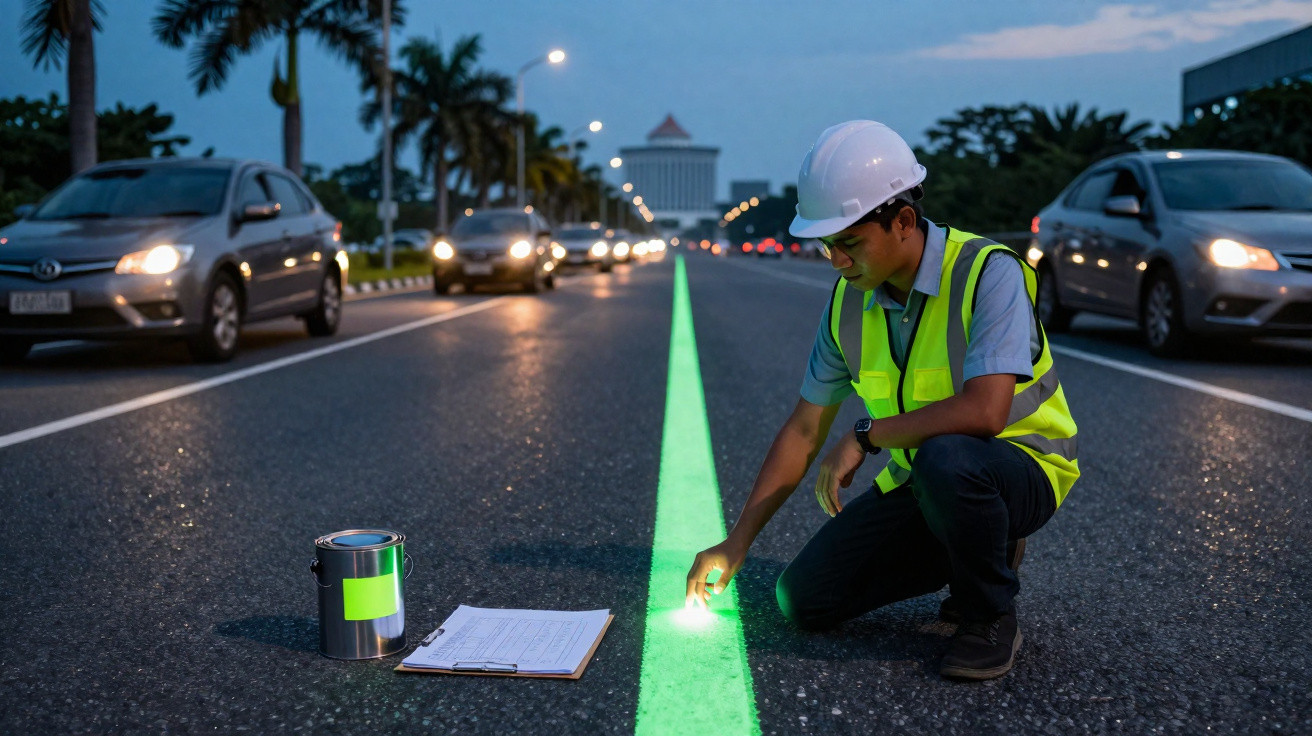
A short stretch of road near Kuala Lumpur made headlines around the world in 2023: rather than relying on conventional street lights, it would use special road markings that glow by themselves after dark. The concept appeared straightforward, modern and, above all, safer for drivers. Yet just as the excitement gathered pace, the project faltered because of stark cost figures and disappointing test results.
How a 245-metre stretch became a promise of the future
The trial began in autumn 2023 in Hulu Langat district, Selangor. On a roughly 245-metre section at the junction of Jalan Sungai Lalang and Jalan Sungai Tekali, Malaysia replaced traditional road lighting with photoluminescent road markings.
The technology works by using a specialist paint that absorbs sunlight during the day before releasing that stored energy as light at night. In principle, this should keep lane lines and road edges clearly visible without street lamps.
Instead of lamp posts, the road itself was meant to become the light source – with no electricity connection at all.
The road construction department responsible for the scheme presented it explicitly not as a display piece, but as a road-safety trial. On unlit rural routes, lane markings can quickly become almost invisible in heavy rain or complete darkness, creating a genuine hazard, particularly on narrow country roads.
Early response: enthusiasm rather than scepticism
During the first few weeks, many motorists reported favourable experiences. The glowing lines offered much clearer visual guidance than ordinary markings. Malaysia’s Works Minister, Alexander Nanta Linggi, said the markings could remain visible for up to ten hours and provide a “good luminous effect” even in rain.
At first glance, it sounded like a model example of modern infrastructure policy: improved safety, lower energy use and a touch of high technology for the country’s often-overlooked roads.
Glow-in-the-dark roads: not an idea unique to Malaysia
The prospect of roads that emit their own light has been part of transport planning discussions for some time. The Netherlands, for example, ran the “Smart Highway” project. It used so-called “Glowing Lines”, which charge in daylight and fluoresce greenish for several hours overnight.
In a Dutch pilot scheme, these lines remained visible for up to eight hours each night. The principle was that the asphalt surface would do more than carry traffic: it would also act as a “luminous surface”, guiding drivers like a horizontal strip of lighting.
Malaysia followed this basic concept but placed its emphasis elsewhere. The priority was not a spectacular design scheme, but a practical question: how can dark, lightly used rural roads be made safer without installing kilometres of lamp posts?
- Aim: better lane visibility without electricity consumption
- Focus: rural roads and routes with poor lighting
- Argument: a contribution to road safety, not a marketing stunt
- Basis: technology similar to projects in Europe and Asia
The major expansion plan – and paint that was far too expensive
As the Selangor test was initially well received, those behind it quickly moved to the next stage. In February 2024, the state announced plans to extend the luminous markings to a total of 15 sites across all nine districts. Around 15 kilometres of road were to be upgraded, including routes in areas such as Sepang, Kuala Langat and Petaling.
According to the plans at the time, the cost would be about 900,000 Malaysian ringgit. Other states were keen to follow. Johor identified 31 road sections for its own pilot schemes, including a 300-metre stretch in Batu Pahat.
The proposal attracted considerable praise on social media, with many users celebrating Malaysia as a pioneer. Behind the scenes, however, one issue had already emerged that would shake the entire concept: the cost of the material.
The specialist paint cost nearly twenty times as much as normal road-marking paint – before anyone knew how long it would last in everyday use.
Government figures put the price of the luminous paint at around 749 ringgit per square metre. Conventional marking paint, by comparison, costs roughly 40 ringgit per square metre. Questions also remained over durability and wear under tropical sun, heavy traffic and intense rainfall.
The parliamentary statement that changed everything
The reversal came in November 2024. Deputy Works Minister Ahmad Maslan told Parliament that the costs were simply too high, making any continuation of the glowing lane solution unlikely. Almost in passing, he added a second crucial point: the ministry’s technical specialists had not been convinced by the internal tests.
That completely changed the narrative. What had been seen as a promising innovation became a familiar kind of infrastructure project that fails a conventional cost-benefit assessment. Drivers may like the idea, but that alone is insufficient when technical standards, maintenance demands and public budgets point in a different direction.
There is another issue beneath the surface. During pilot phases, new technologies can seem impressive because they are novel and highly visible. In day-to-day operation, however, what matters is whether they work reliably for years and can be sensibly maintained nationwide by authorities with limited resources.
Innovation, yes – but at today’s maintenance costs
The case demonstrates how strongly infrastructure decisions depend on practical considerations:
| Aspect | Luminous marking | Conventional marking |
|---|---|---|
| Initial cost | Very high (approx. 20 times higher) | Low |
| Electricity requirement | No electricity required | No electricity required |
| Visibility in darkness | Significantly higher – but limited | Dependent on external light |
| Real-world wear data | Still limited | Known for decades |
Until durability, cleaning and repair costs are at least broadly comparable with conventional markings, the striking appearance remains an expensive luxury.
The fundamental issue remains: visible lane guidance at night
Even if Malaysia does not proceed with a large-scale rollout, the underlying challenge has not gone away. Road-safety authorities worldwide are still trying to ensure that lane markings remain clearly visible in darkness and rain, especially on motorways and rural roads without additional lighting.
In Japan, for instance, the National Institute for Land and Infrastructure Management is developing performance indicators to measure the quality and visibility of road markings objectively. There, such markings have long been regarded as an integral part of the safety system, as important as crash barriers or speed limits.
The Malaysian trial therefore illustrates two sides of modern road planning:
- New technologies can attract attention and deliver genuine improvements.
- They must nevertheless pass every test of standards, budget requirements and maintenance reality.
What other countries can learn from Malaysia’s retreat
For transport planners in Europe, including Germany, Malaysia offers useful lessons. Photoluminescent road markings may initially seem like a gift: no electricity costs, improved visibility and a futuristic look. The figures from Selangor show, however, how quickly the equation can change when the paint is exceptionally expensive and long-term experience is lacking.
A different approach could be possible: rather than upgrading large areas, trials could focus on especially hazardous or isolated sections, combined with strict monitoring. That would help establish whether the technology is financially viable in particular niches, such as winding mountain roads, tunnel approaches or bridges frequently affected by fog.
At the same time, manufacturers of conventional road markings are working on improved materials, including reflective glass beads, more durable resins and better contrast in wet conditions. Technical progress is therefore happening not only in the eye-catching “glow-in-the-dark” segment, but also in smaller, almost invisible developments.
Why glowing roads will remain relevant
Although Malaysia is applying the brakes for now, the idea of a self-illuminating road is not disappearing from planning discussions. As suitable materials become cheaper and more durable, they are more likely to return to the agenda, especially at a time of high energy prices and climate targets.
Combining them with other technologies could also prove interesting:
- intelligent road markings designed to work optimally with sensors or cameras used by driver-assistance systems
- materials that adjust brightness and colour according to weather conditions or traffic levels
- schemes in which only particularly dangerous sections receive glowing lane guidance
Until then, the 245-metre stretch near Semenyih remains a useful lesson: technological innovation quickly inspires enthusiasm, but the decisive question is always whether it fits the everyday reality of public finance departments and road authorities. In Malaysia, at least for now, the answer was no – even though the road looked in the dark as if the future had already arrived.

















Comments
No comments yet. Be the first to comment!
Leave a Comment