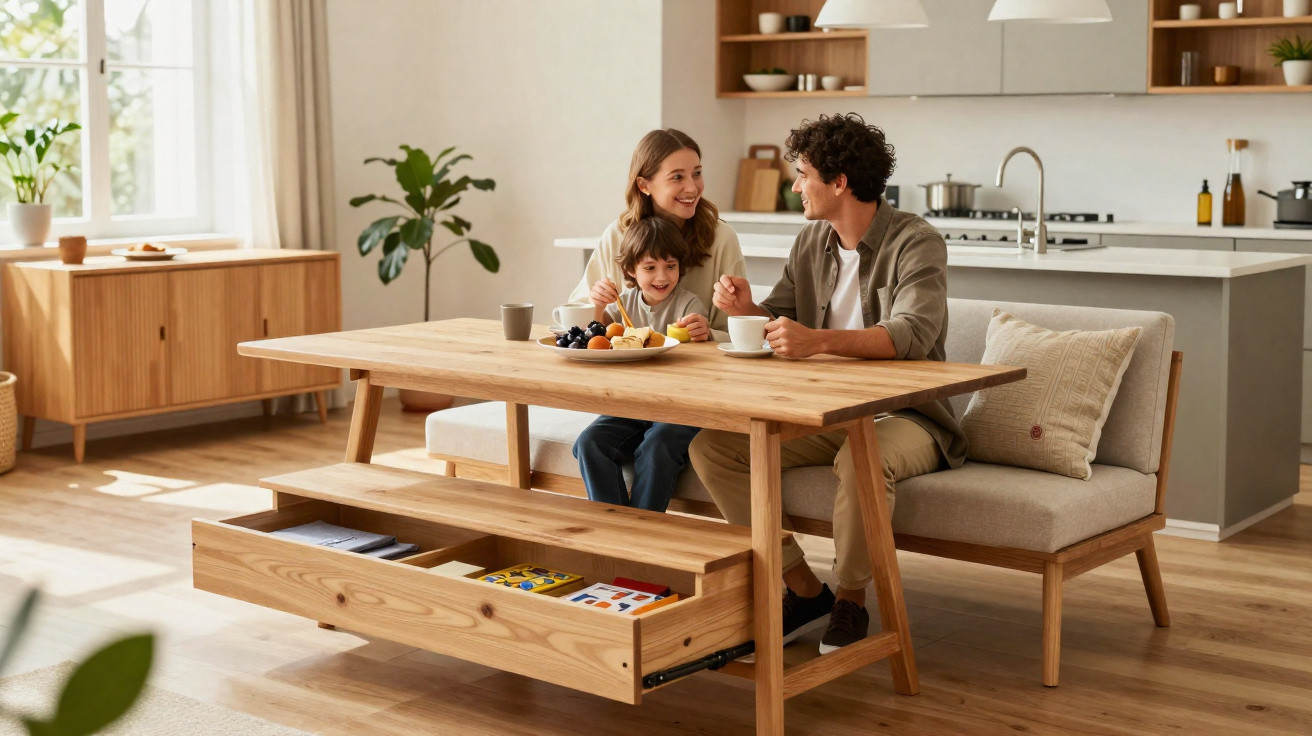
Another type of furniture is quietly moving into the centre of the home.
Instead of rigid rows of chairs, more and more people are choosing a piece that brings to mind cafés, brunch bars and cosy corner pubs: the dining bench at the table. It is changing the way we eat, talk and, more broadly, live together.
The dining bench takes centre stage
From formal chair arrangements to a living-room feel
Anyone leafing through interiors magazines or scrolling through living rooms on Instagram will soon spot the shift: dining tables are increasingly surrounded by more than chairs alone. Where eight chairs once stood in a strict line along the table, there is now often a bench – softly upholstered and layered with cushions and throws.
“The dining bench turns a meal from an appointment in the diary into a small evening ritual.”
People naturally sit closer together, children simply take a place beside their parents, and dinner can turn into an evening of games or conversation. A bench creates more of the atmosphere of a welcoming local than a ‘proper’ formal dining arrangement. It is less formal and more sociable.
This is particularly appealing during the darker months. Rather than thinking, ‘We’ll eat quickly and then go our separate ways’, the mood is more likely to be: ‘Shall we stay here a little longer, have another tea, play a round of cards?’
A space-saving solution for small and large rooms
Space is another reason behind the trend. Traditional chairs need clearance on every side. Their backs knock together, walkways become cramped, and every trip to the kitchen turns into an obstacle course.
A bench makes more efficient use of the available area:
- In a corner: An L-shaped bench puts otherwise unused corners beside the table to work.
- Against a wall: The bench can sit closer to the table because nobody has to squeeze behind it.
- Beneath a window: The seat also becomes a window perch with an outdoor view.
This often allows two or three extra people to sit at the table without making the room appear more crowded. In larger homes, a bench also keeps circulation routes clear, as chair legs do not get in the way. The overall result is calmer and more visually ordered.
Why interior designers favour the bench
Defining zones without building walls
Interior designers use bench seating deliberately to organise open-plan living spaces. In kitchen-diners and open layouts, a bench establishes the dining area without the need for a wall. Sightlines stay open, making the room feel generous while still giving it structure.
The bench is not limited to a ‘traditional’ dining room either. It also appears in:
- compact kitchens as a breakfast nook,
- living rooms as a link between the sofa and dining table,
- work areas that also serve as a family meeting point.
Many professionals pair benches with striking fabrics or distinctive materials. This gives the room a recognisable character – almost the feel of a boutique hotel, but at home.
Materials that shape the look
The chosen fabric and finish can alter the mood of an entire room. Common options include:
| Style | Materials | Effect |
|---|---|---|
| Scandinavian | Pale wood, linen, cotton in natural shades | Airy, calm, welcoming |
| Bohemian cosy | Rattan, wool, velvet, plenty of cushions | Warm, lively, gently playful |
| Mediterranean | Built-in masonry bench, ceramics, textiles in ochre and sand shades | Sunny, relaxed, holiday atmosphere |
Cushions, throws and covers make it easy to update the look with the seasons. Autumn may bring in warm shades and chunky knitted throws, while spring might call for pale linen and pastel colours. The bench stays in place, while the atmosphere changes.
How to plan a dining bench in practical terms
Shape and position: where it genuinely works
Even the best bench is no use if it obstructs everyday life. Three factors matter most: circulation routes, light and table size.
Common layouts include:
- A straight bench against a wall: ideal for narrow rooms, since chairs are needed on only one side.
- An L-shaped corner bench: makes full use of corners and creates a classic seating nook.
- A gently curved bench: gives a softer impression and works well with round or oval tables.
Placed in front of a large window, the bench creates a breakfast spot with a view outside. In a long, narrow room, it can be the ideal way to seat plenty of people, with chairs positioned only on the opposite side.
Multi-purpose seating and storage combined
The area beneath a bench is highly useful space. Many manufacturers offer models with built-in storage, which is especially helpful in flats where every centimetre matters.
“Games, tablecloths, Christmas or autumn decorations and even rarely used crockery can be tucked away beneath the seat.”
Typical designs include:
- a storage bench with a lift-up seat,
- a bench with front-facing drawers,
- a hallway bench with room for shoes and bags.
The room therefore looks tidier without requiring extra cupboards. The area beneath the dining table becomes a concealed organisational aid.
What daily life with a dining bench feels like
More sitting together, less shifting furniture
Many households report that everyday routines become noticeably more relaxed with a bench. Vacuuming the floor is quicker when eight separate chairs no longer need moving back and forth. Children can hop straight into place instead of dragging chairs around and leaving them at an angle.
Arguments over the ‘best’ seat are less common because the bench offers one long, uninterrupted surface. Visitors can simply shuffle along. Even unexpected guests can usually fit in somehow – a bench is more forgiving than a fixed set of chairs.
In winter, it soon becomes a favourite place: a laptop, tea and candles can turn the dining bench into a home-working seat, reading corner and family hub all at once.
How hosting at home changes
A bench also changes the way people host at home. The setting feels more relaxed, less like a ‘formal invitation’ and more like: ‘Sit down and stay as long as you like.’
Older family members appreciate the continuous seating surface, which makes it easier to change position without having to move a chair. Children can half lie down, sit or kneel – the bench accommodates these movements more readily than narrow chairs with hard edges.
The bench can be styled especially effectively for festive occasions: with fairy lights on the wall behind it, a sheepskin on the seat or seasonal cushions. The dining area quite literally becomes a stage for the biggest evenings of the year.
What to consider when buying or building a bench
Do not underestimate ergonomics and dimensions
For all the cosiness of the trend, anyone using a bench every day should pay attention to sensible dimensions. Key points include:
- a seat height similar to that of chairs (usually 45–48 cm),
- sufficient seat depth – both with and without cushions,
- solid construction, particularly for corner designs.
Many people build their own bench from timber boards or kitchen units. The advantage is that it can be tailored precisely to alcoves, window fronts or unusual floor plans. Upholstered seat pads and cushions can then provide comfort.
How a bench affects the feeling of a home over time
People who swap a group of chairs for a bench arrangement usually notice after a few weeks how strongly one item of furniture can influence a room’s character. Conversations tend to happen on the bench side, children play there, and guests gravitate first towards the upholstered side of the table.
The dining zone is perceived less as a ‘functional place to eat’ and more as a meeting point. In many homes, a third favourite spot emerges alongside the sofa and bed – one that has often been overlooked: the table with a bench at the heart of the home.
Anyone currently considering how to make their living space cosier and more practical should take a closer look at this piece of furniture. A well-planned bench does more than replace several chairs – it changes how home feels when the days grow shorter and the evenings longer outside.










Comments
No comments yet. Be the first to comment!
Leave a Comment