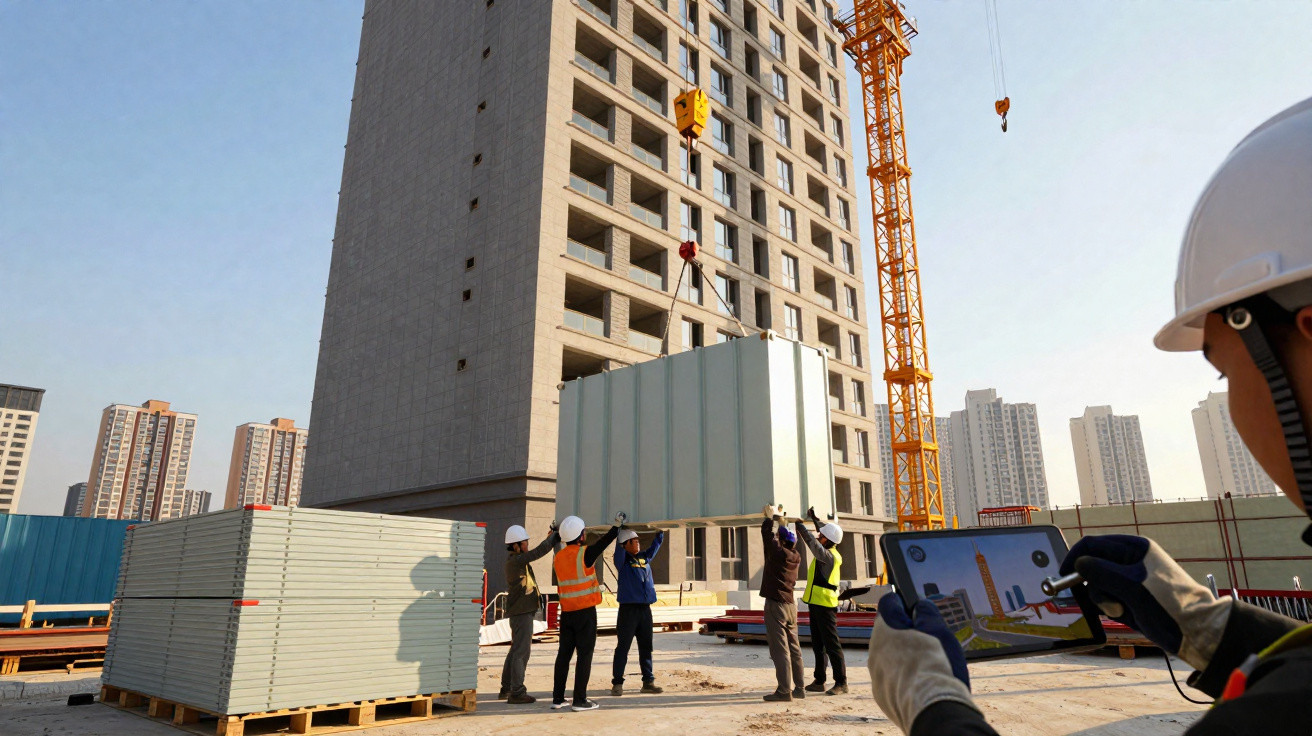
On Changsha’s southern outskirts in central China, people gathered outside what seemed to be an enormous Lego construction set. There was no cloud of dust, no overwhelming din and scarcely any shouting. Instead, cranes moved smoothly, modules locked together and teams worked with uncanny precision beneath floodlights more suited to a stadium. At sunrise on the first day, the concrete platform was bare. By the following morning, a completed ten-storey apartment building stood there. The location was unchanged; the skyline was not.
Passers-by recorded it from the pavement, holding up their phones and leaving the same comment beneath the footage in different languages: “Fake?”
It was not fake.
Those viral videos do not show a trick.
They deliver a message.
China’s ten-storey sprint that shocked the world
The figures look almost incorrect: ten floors, a habitable building, completed in roughly 28–29 hours. This was not a case of “the structure took 29 hours, then the façade took six months”. The whole building was stacked and sealed while social media counted down the hours.
Broad Group, the company responsible, calls the approach “Living Building”. Its modules are manufactured in a factory, folded in a way that resembles shipping containers and transported to the site. There, cranes raise them into place while crews bolt and connect each unit, allowing the structure to climb like a stack of oversized bricks designed for people to live in.
For nearby residents, it was like seeing a time-lapse video unfold in real time. Except here, the sound of impact wrenches filled the air.
In one video, a crane carefully lowers a steel box into position. A worker wearing a yellow hard hat directs it with two fingers, as though placing a smartphone onto its charger. That single box already contains plumbing, electrical wiring, insulation, windows and even basic finishes.
Standardised joints allow every module to connect with the next. Water, power and ventilation systems are all plug-and-play and tested before leaving the factory. As a result, the building does not emerge gradually, floor by floor, but in rapid bursts: one storey appears, followed by another, and then another.
Before your food-delivery app had finished a lengthy shift, the crew had assembled a tower.
This kind of speed did not emerge from nowhere. China has spent years putting rapid construction methods through demanding tests: emergency hospitals in Wuhan were built within days, full bridges have been manoeuvred into place overnight and stations have appeared along expanding high-speed rail routes.
The logic behind it is straightforward: industrialised construction, extreme standardisation and a supply chain that operates more like smartphone production than conventional building work.
The unsettling question is not “Can we do this?” but “Why aren’t we doing it already?”
The method behind “impossible” construction speed
The process begins well away from the building site. At Broad Group’s factory, modules are made much like cars on a production line, with identical dimensions, connection points and pre-tested parts. That removes much of the normal disorder associated with construction: materials arriving late, mistakes requiring correction and details being improvised in wet weather.
At the site itself, workers are not “building” in the traditional sense. They are assembling. Their movements can be quicker because the complex decisions have already been resolved upstream at the drawing board rather than on the scaffolding.
It is the difference between preparing a meal from individual ingredients and reheating a tray that has already been measured, seasoned and divided into portions.
Anyone who has watched a conventional building rise will recognise the familiar slow stages. There are deep foundations, concrete that must cure for weeks, teams waiting for approvals and unexplained delays hidden in procurement documents. We have all seen it: a half-built structure behind a green fence that appears completely frozen in time.
The Chinese experiment cuts across that familiar sequence. The foundation still requires substantial, serious engineering, but once the base is complete, much of what follows becomes a logistics operation. Lorries arrive in order. Cranes are not left standing unused. Teams work in shifts resembling a factory line rather than a slow-moving site.
The “29 hours” is more than a publicity stunt. It signals what can happen when construction treats time with the same intensity that e-commerce applies to delivery slots.
Naturally, sceptics immediately ask: Is it safe? Is it comfortable? Will it endure? Those are reasonable concerns. The modules use steel, reinforced floors and standardised quality inspections that are rarely seen on smaller conventional sites. This does not eliminate risk by magic, but it does alter where that risk sits.
Instead of relying so heavily on one hurried crew working through a rainy Wednesday, the approach relies more on repeatable industrial quality.
Let us be honest: on a traditional site, nobody truly inspects every cable and pipe every day.
With modular construction, the promise is that systems are properly checked once and then reproduced, more like an aircraft component than a correction sketched out by hand.
What the rest of the world can actually learn from this
For architects, urban planners or simply curious people watching these clips, the practical lesson is clear: from the outset, design for repetition. That involves accepting certain constraints, including standardised modules, practical floor plans and plug-and-play cores for staircases, lifts and services.
The ambition for “every building completely unique” quietly slows projects down and pushes up costs. The ambition for modular families of buildings achieves the reverse.
China’s 29-hour tower demonstrates what happens when buildings are treated as products rather than one-off prototypes.
There is a risk, however, and cities in the West know it well: unattractive, lifeless blocks that appear identical. Speed without a human quality does not age well. The concern is justified; nobody wants to live in a spreadsheet.
The important distinction is between the structure and its outer layer. Modules can be heavily standardised internally, while façades, public areas, ground-floor spaces and rooftop uses remain adaptable and imaginative.
For anyone working in housing or construction, the real error is dismissing modularity altogether simply because they remember a few bleak prefabricated buildings from the 1970s.
“Fast construction doesn’t have to mean cheap or disposable,” says a Shanghai‑based engineer who worked on modular high‑rises. “The real luxury today is speed with reliability. People want homes now, not promises for 2030.”
Separate the core and the custom
Apply standardised modules to the structure and services, while keeping creative freedom for façades, layouts and communal areas.Think assembly, not improvisation
Organise logistics as a factory would, from lorry timetables to crane movements, to prevent downtime and disorderly overlaps.Design for maintenance from day one
Providing straightforward access to pipes, ducts and wiring within modules can prevent years of frustration and concealed expense later.Keep the human layer visible
Ground floors, courtyards and balconies are where everyday life takes place; they should be protected from excessive standardisation.
What a 29-hour tower really says about our cities
This Chinese building did more than challenge engineers. It quietly exposes the slow, difficult pace of housing delivery in cities facing severe rent crises. Once you have seen ten storeys rise in a day, the familiar reasons given for delays lasting three years can sound less convincing.
It also creates awkward questions. If buildings can be produced at this pace, who decides where such speed should be used? Emergency hospitals and pilot schemes are one matter. Delivering everyday homes across every neighbourhood is another, tangled up in politics, anxieties and established habits.
The ten-storey sprint is not a model that can be applied everywhere. Local rules, seismic conditions and cultural expectations all matter. Nevertheless, its central message travels easily: much of our slowness is a choice rather than an unavoidable reality.
What if public procurement rewarded speed and repeatability alongside beauty and sustainability? What if young architects learnt to create modular systems rather than only individual landmark buildings?
Some readers will interpret this Chinese project as a warning; others will find it inspiring. Both responses have value. They suggest that we are finally taking the pace of construction personally.
The next time you walk past a stalled site, with metal fencing clattering in the wind, you may think of that tower built in 29 hours on the other side of the world. The distance between “what is” and “what’s possible” is where future housing policy will be shaped.
Ask yourself: would you choose to live in a modular building if it meant stable rent and a home delivered in months rather than years?
Cities are made from conversations as much as concrete. This Chinese experiment has placed a sharp new question on the table. Our response will reveal much about the speed-and the kind of life-we are prepared to accept.
| Key point | Detail | Value for the reader |
|---|---|---|
| Industrialised building | Factory-produced modules with systems already installed | Helps explain how homes could be supplied more quickly and reliably |
| Assembly instead of classic construction | Work on site centres on stacking, bolting and connecting | Provides a way to rethink how projects are planned and scheduled |
| Standardisation with room for design | Repeatable structural cores, adaptable façades and shared areas | Illustrates how construction can be faster without sacrificing character or comfort |












Comments
No comments yet. Be the first to comment!
Leave a Comment