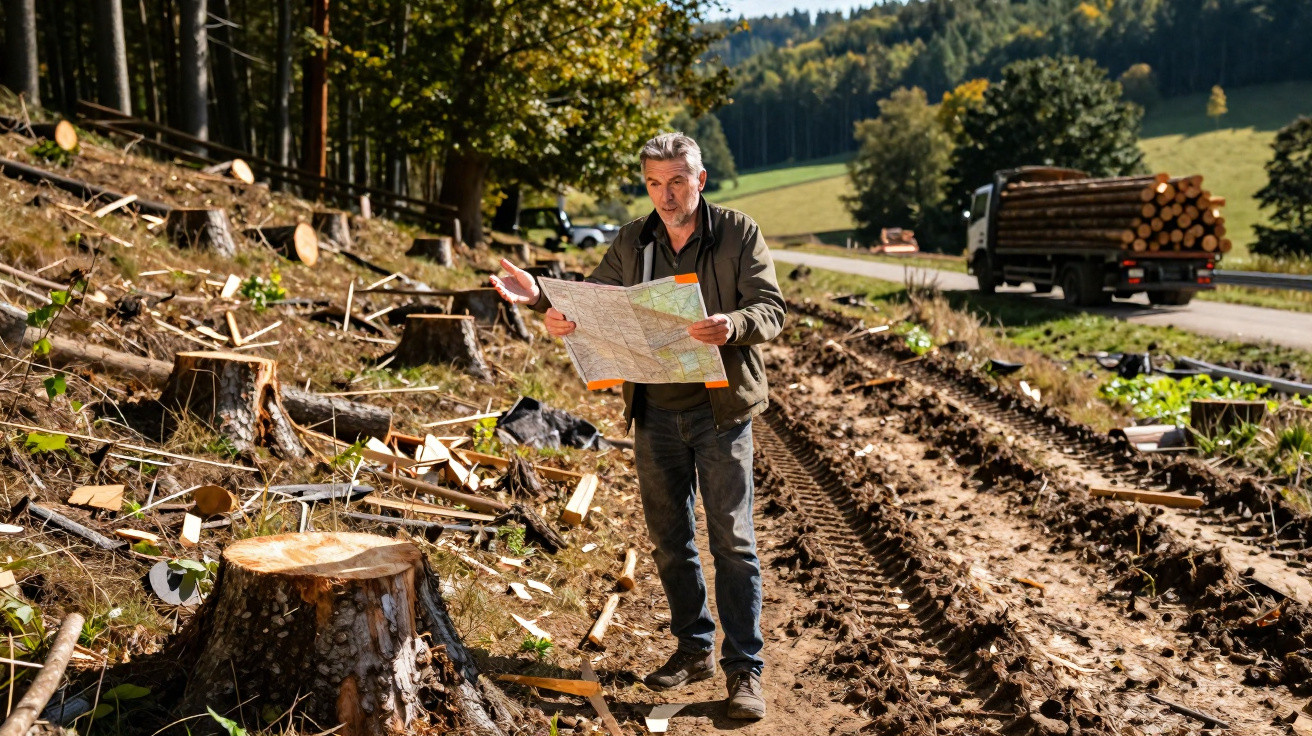
In a secluded part of eastern France, families enter their woods in search of tranquillity, only to discover a landscape of felled trees.
What started with several questionable clearings has grown into an escalating scandal: whole groups of hundred-year-old oaks are vanishing overnight, felled and removed by professional teams that had no permission to be there.
A Sunday stroll becomes a nightmare
One Sunday afternoon in Moselle, close to France’s borders with Germany and Luxembourg, Cédric went for an ordinary family walk through woodland cared for by his grandparents.
Arriving at his plot, he was stunned by what he saw. Fresh sap hung in the air, deep tyre marks cut through the mud, and woodchips from chainsaws were still wet.
Where his hundred-year-old oaks once stood, the land was shaved bare, as if a storm had passed with a saw.
Nothing but stumps was left, arranged like headstones. The thieves had acted swiftly and efficiently, leaving behind no equipment, fuel containers or documents - only quiet.
Cédric and his relatives had heard talk of “voleurs de bois” - timber thieves - operating locally. They had considered it somebody else’s problem, something that happened elsewhere. That day, they understood that they were now the “somebody else”.
Why Moselle’s fragmented forests are exposed
On maps, Moselle’s woodland appears thick and unbroken. In legal terms, however, it is divided among thousands of small parcels passed down through generations. That fragmentation contributes directly to the problem.
Didier Daclin, head of Fransylva Moselle, the local private forest owners’ association, says this ownership pattern is ideal for organised thieves.
“Predators search out the smallest privately owned plots, where boundaries are blurry and oversight is weak. They exploit them as if they had a licence.”
Numerous owners live in surrounding towns and inspect their plots only a handful of times each year. They may not know neighbouring owners well. Boundary markers disappear and ageing fences fall apart. A logging team can arrive, produce non-specific papers if challenged, and disappear again within days.
The worldwide demand for oak
These local offences are driven by an international market. Oak demand has surged since the early 2010s, with China playing a major part. French oak has become especially sought after.
France Bois Forêt, the industry body, reports that the average French oak price has approximately doubled since the beginning of the previous decade. In 2018, prices almost reached €200 per cubic metre, making stands of oak resemble ready-made cash machines.
France is now the largest exporter of unprocessed oak logs to China. Experts in Moselle estimate that Chinese purchasers receive roughly 80% of the oak felled there.
After logs have been placed in containers and sent by ship, establishing where they came from becomes almost impossible. Labels may be altered and documentary records can disappear. An oak stolen from a small family parcel in Moselle may ultimately become flooring, furniture or decorative panelling on the far side of the world, without anyone knowing its origin.
For woodland owners, the damage goes beyond finances
In financial terms, the harm is obvious. Yet for many families, the loss is far more personal.
Cédric’s stolen oaks represented more than saleable timber. They belonged to a family history, planted and looked after by earlier generations. Looking over the bare clearing, he feels that he has let down those who handed the land on to him.
The owners talk less about the market value of the wood and more about the shame of not protecting what they inherited.
Didier Daclin frequently hears the same sentiment: “What shakes them most isn’t the cheque they’ll never see. It’s the idea that they couldn’t defend something entrusted to them across generations.”
Time adds another burden. A stolen car can be replaced within weeks, but replacing an oak grown over a century requires thinking about children and grandchildren. Many owners recognise that they will never again see their woods as they once were.
Ecological damage to vulnerable woodlands
The methods used in these thefts create environmental harm in addition to the financial and emotional losses.
Legitimate logging in French forests is subject to strict rules. Forestry managers must follow plans governing the number of trees removed, the preservation of young growth, soil protection and biodiversity corridors.
Illegal teams disregard such requirements. Cyril Vitu, deputy director of CNPF Grand Est, the public forestry body, says hurried incursions commonly involve damaging practices.
“When people come in to steal wood quickly, they don’t care about soil compaction, damage to nearby stands, or the balance of the ecosystem.”
Heavy vehicles crossing wet soil compact its upper layers, making regeneration harder for new trees. Fragile young trees and ground vegetation are crushed, while sensitive species lose cover.
On certain looted plots, the remaining land is no longer managed woodland but deteriorated scrub. Restoring it to a functioning forest can require tens of thousands of euros and decades of sustained effort.
The expense of rebuilding a forest
For owners such as Cédric, the decision is now difficult: spend substantial sums on replanting or leave the plot in uncertainty while hoping that justice is served.
Replanting several hectares with suitable species, shielding young trees from game and caring for the area during its first years can readily cost five-figure amounts.
- Clearing leftover debris and preparing the ground
- Buying young trees, often a mixture of species rather than oak alone
- Planting work, frequently undertaken by specialist contractors
- Protection, including fencing and guards against deer and wild boar
- Ongoing care, such as weeding, replacing dead saplings and monitoring
Cédric believes he would need about €15,000 merely to begin again. For now, he says he is unwilling to commit that money while the thieves remain free and another theft is still possible.
He and other owners have made complaints, but criminal proceedings involving rural property can progress slowly. Demonstrating ownership, establishing precisely which team cut the trees and tracking the destination of the logs all demand time and resources that local police do not invariably possess.
How timber theft scams operate locally
Timber theft is not always a covert crime carried out at night. In many instances, it is made to resemble lawful forestry work.
French forest owners have reported several recurring scenarios:
- Teams displaying vague papers and saying they hold a contract with an “absent owner”.
- Loggers extending work beyond the boundaries of an authorised plot and cutting a neighbour’s trees.
- Subcontractors being used so that they can later say they believed the work was lawful.
- Lorries registered abroad being loaded rapidly before leaving the region within hours.
As woodland borders are often badly marked, neighbours may not know exactly where one parcel finishes and another begins. Before anyone can verify matters with the true owner, the trunks may already be travelling along a motorway towards a port.
What “grume” and related terms mean
Accounts of this trade often refer to “grumes de chêne”. A “grume” is simply an unprocessed log taken directly from the forest, complete with its bark. Exporting grumes rather than sawn timber means that value-adding tasks - sawing, drying and shaping - take place overseas instead of in France.
French private woodland is generally recorded and mapped in the cadastre, the official land register. Many owners possess extremely small holdings, sometimes only part of a hectare inherited alongside siblings and cousins. Where ownership is split or uncertain, opportunistic loggers have room to act.
What small forest owners can do in practice
Some owners feel defenceless when faced with this threat. A number of practical measures can nevertheless reduce the danger, even if none removes it completely.
| Action | Potential benefit |
|---|---|
| Clearly mark boundaries with posts or paint on trees | Makes it more difficult for thieves to claim they made a “mistake” over plot limits |
| Join neighbours in an owners’ association | Strengthens surveillance, mutual warnings and access to shared legal advice |
| Register management plans with official bodies | Enables authorities to identify unauthorised felling more rapidly |
| Inspect the forest regularly, including on weekdays | Raises the likelihood of detecting suspicious activity early |
| Retain records and photographs of standing trees | Supplies evidence for police and insurers if theft takes place |
Some areas are also trialling remote monitoring methods, including satellite images and drone surveys, to identify unexpected clearings. These tools remain costly and are generally used on larger estates, although prices are declining.
Long-term effects beyond France
If left unchecked, this type of theft harms more than a small number of families. It disrupts timber markets, disadvantages honest logging firms and removes value from rural communities.
The environmental consequences extend further too. Oak forests are important carbon sinks, provide habitats for birds and insects, and help protect land from erosion. When old-growth stands disappear without suitable regeneration, those functions are diminished.
Nations importing substantial quantities of raw wood also face increasing scrutiny. As climate policy becomes stricter, buyers of timber products - from construction companies to furniture brands - are being pressed to demonstrate that their supply chains are clean, legal and climate-friendly.
Scandals involving concealed clear-cut plots in Moselle show how precarious that assurance can be when small owners must protect themselves and enforcement cannot match the pace of a rapid, profitable trade in logs.

















Comments
No comments yet. Be the first to comment!
Leave a Comment