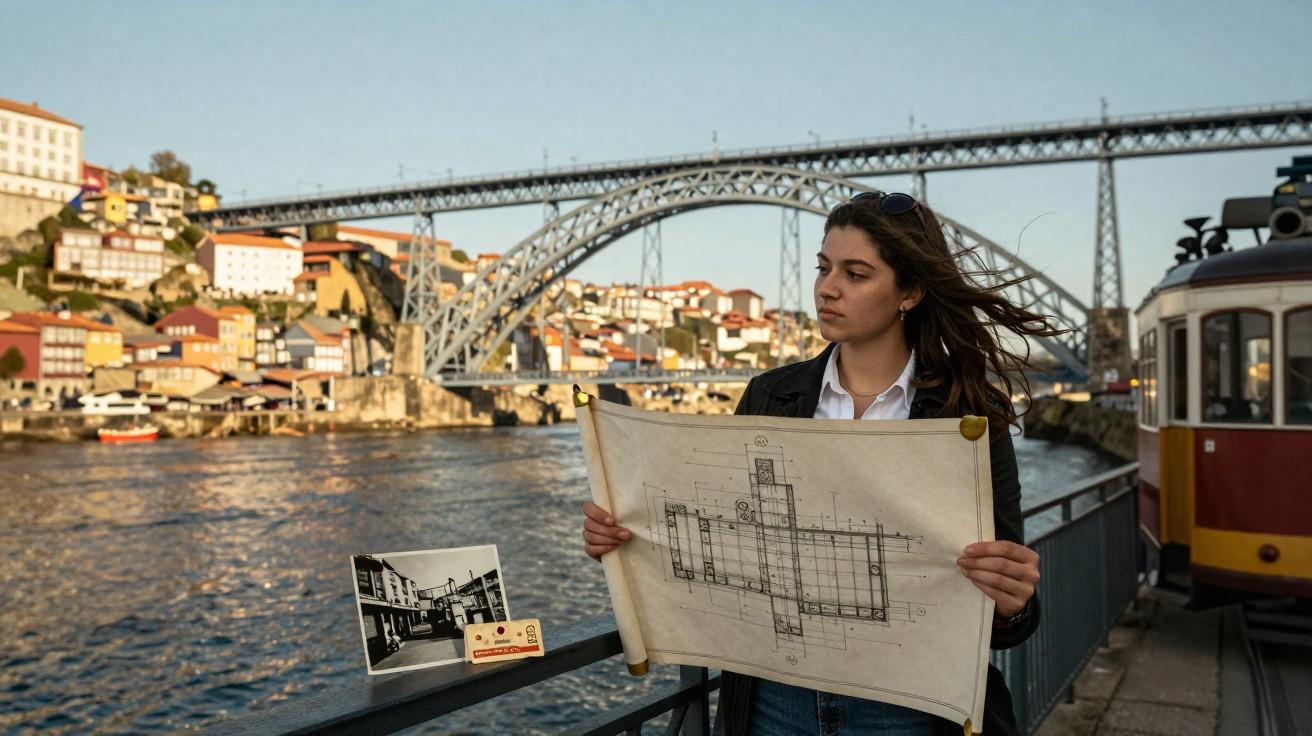
Porto has six bridges crossing the Douro, but the one we are looking at today is probably the most iconic of them all. Can you guess which one it is?
Until 2017, it held the record for the world’s largest wrought-iron arch, measuring 172 m, despite approaching a century and a half of existence. It also has a connection to engineer Gustave Eiffel - yes, the man behind Paris’s Eiffel Tower - although, unlike the Maria Pia Bridge, also in Porto, it was not designed by him.
Naturally, we are referring to the Luiz I Bridge (the historic spelling), which was first inaugurated on 31 October 1886. A second inauguration followed a year later, but more on that shortly.
The Luiz I Bridge’s link to Eiffel
Built from 1881 to 1886, this two-deck metal bridge connects the cities of Porto and Vila Nova de Gaia. It was designed by François Gustave Théophile Seyrig and replaced the older Suspension Bridge that had stood on the same site.
Its association with Eiffel comes directly through Théophile Seyrig, who had been one of Eiffel’s pupils as well as his business partner. In fact, the first proposal for this bridge was submitted by the two men together, but Portugal rejected it.
Although that initial design already included the now-iconic arch, it provided only a lower deck. Portugal required a two-deck solution to accommodate a greater flow of both goods and people.
Théophile Seyrig was the one who put forward the upper deck, supported by the bridge’s arch. This was also the initial cause of his disagreement with Eiffel, after which Seyrig took the project to the Belgian company Société Willebroeck.
It is therefore unsurprising that the bridge resembles other works by the French engineer, leading many people - incorrectly - to claim that it was his design.
The final proposal for the Luiz I Bridge is the structure we know today: it is 395 m long and 8 m wide. It features the two required decks, one upper and one lower. Altogether, the structure weighs no less than 3045 tonnes.
Two inaugurations
As mentioned at the beginning, the Luiz I Bridge was first opened on 31 October 1886, coinciding with the birthday of King Luís I, Portugal’s monarch at the time and the figure from whom it took its name. However, only the upper deck was inaugurated then.
Construction work on the bridge was not completed until the following year. The lower deck therefore had its own inauguration on 31 October 1887, exactly one year after the first ceremony.
Another interesting detail about the Luiz I Bridge is that it was once subject to tolls. They came into effect the day after its inauguration, on 1 November 1886, with each person charged five réis. The tolls remained in place for almost six decades and were only abolished in 1944.
Where is the “Dom”?
At this point, you may be wondering about the “Dom” in Ponte Dom Luís I, the name by which this Porto bridge is most widely known.
In reality, its official name was never Ponte Dom Luís I, and it never included the noble title “Dom”. It is simply an urban myth.
Legend has it that King Luís I of Portugal did not attend the inauguration of the bridge that bears his name. This supposedly prompted people to remove “Dom” from the bridge’s name as a form of protest. However, historical records show that the title was never part of its original designation. Similarly, the Maria Pia Bridge was never called the Dona Maria Pia Bridge.
The Luiz I Bridge today
Today, the Luiz I Bridge continues to fulfil its original purpose. Since 2003, its upper deck has no longer allowed cars to cross and, since 2005, has been used by the Porto Metro. Pedestrians may also use it. The lower deck is open to pedestrians and motor vehicles.
This major work of iron architecture has been listed as a Property of Public Interest since 1982 and has been a UNESCO World Heritage Site since 1996.
Source: Infraestruturas de Portugal and Porto Cultural Agenda














Comments
No comments yet. Be the first to comment!
Leave a Comment