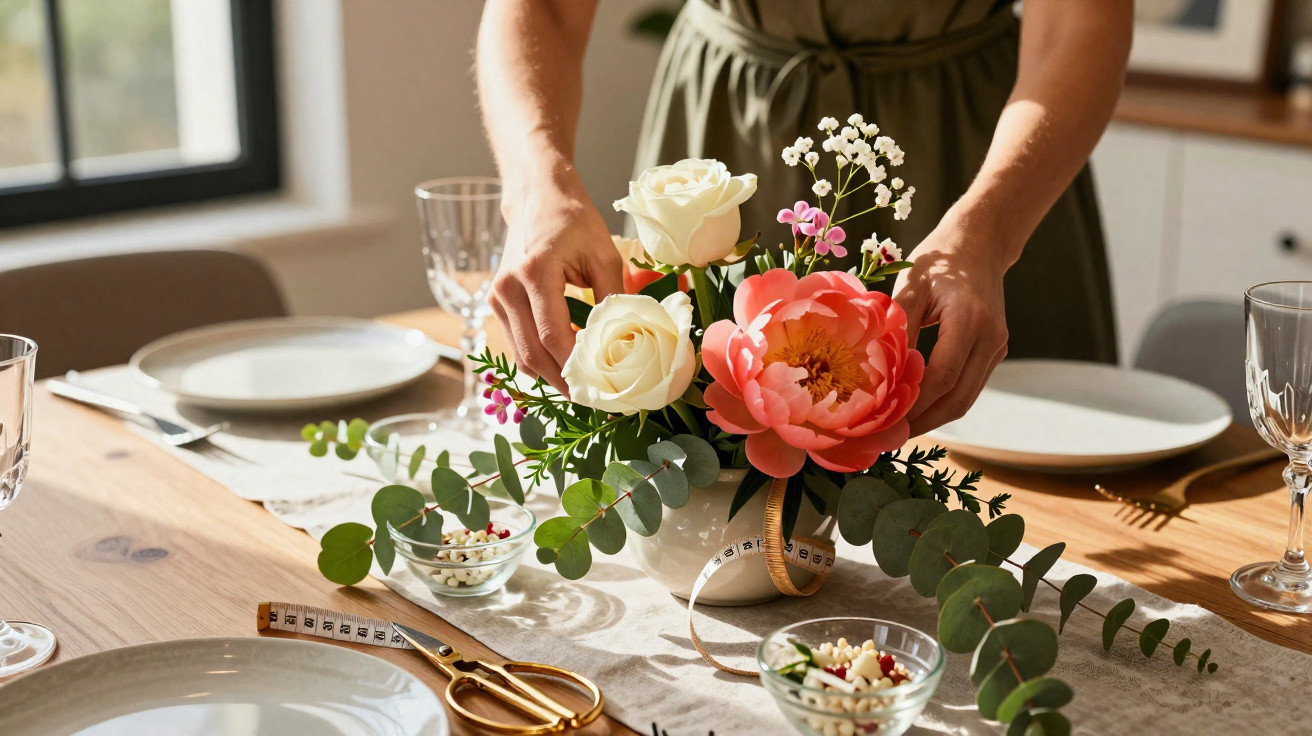
A few numbers and a little confidence can make your table decoration look as though it belongs in a luxury hotel.
Many people own attractive vases, beautiful glasses and have a flair for decoration, yet stumble at one particular hurdle: their bouquet ends up looking merely “all right”, rather than truly cohesive. Professional arrangements rarely rely on magic; they are usually based on a straightforward system. One especially easy method is the 3-5-8 rule – a simple technique that allows even beginners to create striking floral displays.
The principle behind the 3-5-8 rule
The 3-5-8 rule draws on a mathematical concept: the Fibonacci sequence. It may sound rather technical, but it creates a surprisingly harmonious effect on the table. The principle is that an arrangement feels balanced when the quantities of focal flowers, greenery and delicate supporting blooms relate to one another in the right proportions.
The rule of thumb: 3 varieties of focal flowers, 5 stems of greenery and 8 stems of delicate supporting flowers – and you have a bouquet with a remarkably professional appearance.
This approach is particularly useful for anyone facing an empty vase without knowing how to start. Rather than placing stems at random, you build the arrangement step by step, much as you would follow a simple recipe.
Step 1: The 3 – choose striking focal flowers
Begin with three different varieties of what are known as focal flowers. They form the centrepiece of the display, give it character and set its overall mood.
Suitable blooms
Choose larger, eye-catching flowers that immediately draw attention, such as:
- Hydrangeas
- Roses
- Calla lilies
- Dahlias
- Peonies (depending on the season)
The three flower varieties work particularly well when they differ in shape and size: one round, abundant bloom, such as a hydrangea; one classic, more closed form, such as a rose; and one elongated or gently curved flower, for example a calla lily. This naturally creates visual interest.
Combine colours thoughtfully
One professional trick is to stay largely within one colour family. For example:
- white: white hydrangeas, cream roses, pale green calla lilies
- pink-purple: dusty-pink roses, mauve dahlias, deep purple calla lilies
- natural earth tones: apricot roses, creamy chrysanthemums, soft copper-coloured carnations
You do not have to match every shade exactly, but related tones make a bouquet look more refined. Bright, untamed mixes can work too, although they are best created with clear contrasts, such as yellow and blue or pink and orange.
Arranging the focal flowers
Place the three varieties in the vase one after another. Avoid strict symmetry and position them at slightly different points. Some stems may sit higher, while others can be a little lower. Let the blooms face in different directions so the bouquet does not resemble a rigid “bunch of flowers”.
Think of a conversation around a table: nobody sits in a perfectly straight line and everyone turns slightly towards the others – that is how the focal flowers should feel.
Step 2: The 5 – greenery adds structure and depth
Once the focal flowers are in place, add the greenery: five stems or branches will fill gaps, support the flowers and add depth to the arrangement. Greenery is not simply “filler” – it frames the blooms and has a major influence on the finished look.
Suitable greenery from the garden or market
- Fern
- Rosemary or other herbs with sturdy stems
- Olive or citrus branches
- Eucalyptus
- Smaller branches from garden shrubs
A mix of trailing and upright greenery is ideal. Some can fall loosely over the edge of the vase, such as rosemary or fine branches, while the remainder stands more upright to provide support.
Positioning the greenery
Start by adding the longer branches, as these establish the outer shape of the bouquet. You can always trim them later if needed. Tuck the greenery between the focal flowers without concealing them completely. The aim is a loose frame, not a dense wreath.
Anyone who cuts their own flowers can save a great deal of money: shrub greenery, herbs and even a little “wild growth” from the edge of a fence can often be used beautifully.
Step 3: The 8 – delicate filler flowers close the gaps
Finish with eight stems of fine, generally smaller flowers. They link the whole arrangement together, fill small spaces and give the overall design a lighter feel.
Typical filler flowers
- Flowering eucalyptus
- Cosmos
- Heather
- Statice (sea lavender)
- Gypsophila (used sparingly)
Select shades that complement your focal flowers and look for delicate textures. Filler flowers should not take centre stage; instead, they should act like small points of light within the arrangement.
Add these stems last, placing them deliberately into any visible gaps and gently turning the vase as you work. This lets you identify any remaining “holes” from every angle.
Practical tips for a stylist-worthy arrangement
- Spread every element as evenly as possible – avoid creating “clumps of flowers” on one side.
- Use varied stem lengths so the bouquet does not look as though it has been cut flat.
- Trim stems on an angle so the flowers can take up water more easily.
- Choose a narrower vase where possible, as this keeps the stems more stable.
- Work in daylight whenever you can, since colours appear more natural.
Rule number one for a polished floristry finish: add slowly rather than cramming everything in at once and having to sort it out laboriously afterwards.
Planning a small cut-flower area in the garden
Anyone who entertains regularly or simply enjoys having fresh flowers indoors will benefit greatly from a small cut-flower bed of their own. Even a narrow strip can provide regular material for bouquets.
| Season | Suitable plants |
|---|---|
| Spring | Tulips, daffodils, ranunculus, anemones |
| Summer | Cosmos, zinnias, dahlias, sweet peas |
| Autumn | Chrysanthemums, asters, autumn anemones |
It is also worthwhile adding a small herb strip with rosemary, sage or thyme. These plants provide not only flavour for the kitchen, but also attractive greenery for your arrangements.
Mistakes many people make when arranging flowers
The 3-5-8 rule helps to prevent common pitfalls. Three recurring mistakes appear time and again:
- Too many different varieties: Ten flower varieties can quickly look chaotic, especially without a clear concept.
- No variation in height: When every stem sits on the same level, the bouquet looks flat.
- Lots of colour, too little calm: Highly colourful combinations without linking tones can overwhelm the eye.
Following the 3-5-8 scheme significantly reduces these risks. The number of varieties remains limited, greenery is used purposefully, and filler flowers are added with a defined role rather than without control.
Why the 3-5-8 rule works so well
Its strength lies in balance: three focal flower varieties offer enough choice for interesting contrasts without overwhelming the eye. Five stems of greenery provide structure without “swallowing up” the arrangement. Eight delicate blooms fill the spaces without making the design feel overdone.
After using this simple formula a few times, you will quickly develop a feel for proportions. In time, you can alter the numbers slightly – perhaps 3-7-10 for an especially large vase, or 2-3-5 for a small vessel on a bedside table. The underlying idea stays the same: a clear structure brings calm to the creative process and turns a few flowers on the kitchen table into an arrangement that looks as though a professional has created it.














Comments
No comments yet. Be the first to comment!
Leave a Comment