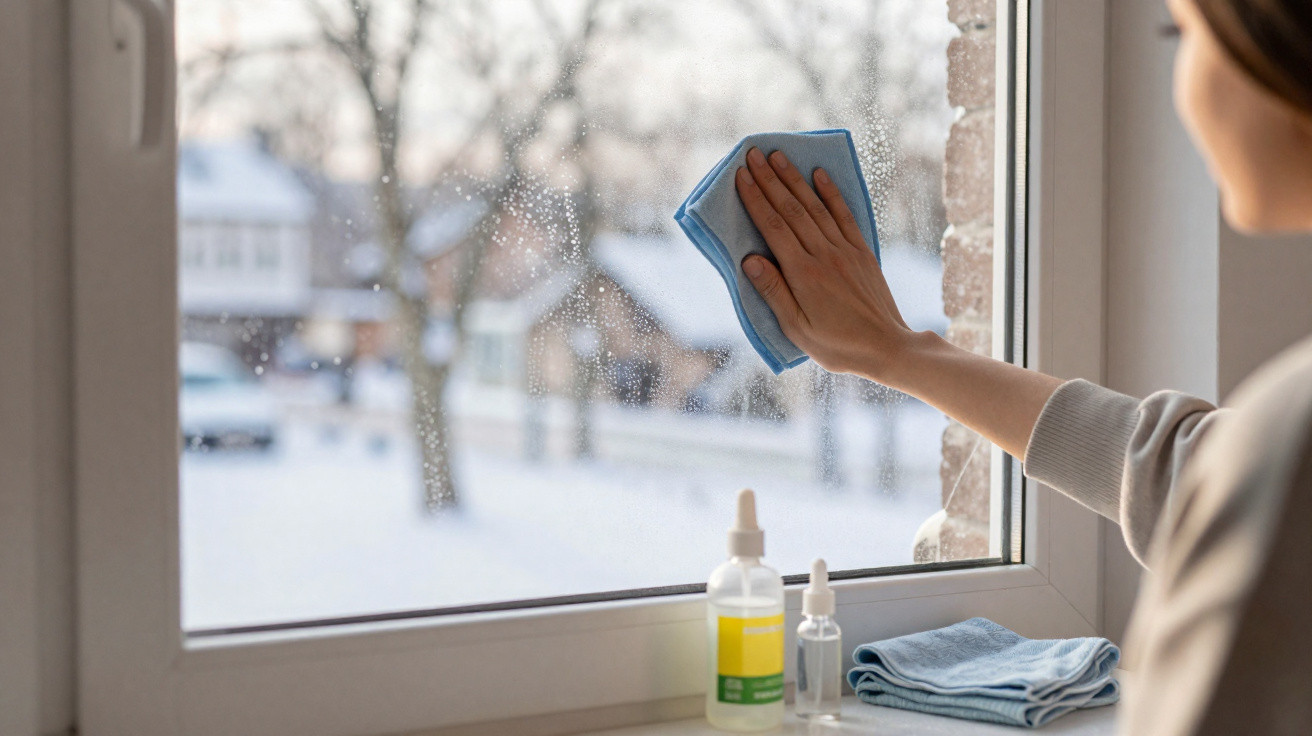
A tiny trick that our grandparents already knew is all it takes.
When people wake up in January, they are often met not by the view outside but by a cloudy, dripping windowpane. The heating is on and the air indoors is warm, yet the room still feels damp. Rather than battling the window with a towel every morning or turning up the thermostat, there is a remarkably straightforward solution. It costs next to nothing and uses a household product that almost everyone keeps in the kitchen.
Why condensation lingers on windows in winter
Condensation on the inside of windows is not merely unsightly; it is a completely normal physical process. Warm indoor air can hold far more moisture than cold air. When that warm, humid air reaches a cold pane of glass, it cools very quickly. The excess moisture then settles on the glass as droplets: the dew point has been reached.
The obscured view outside is not the only frustrating part.
Water running down the window in the morning will eventually reach the frame, seals and window sill – creating an ideal breeding ground for mould.
Over weeks and months, these small droplets can damage seals and frames, especially on timber windows and older uPVC models. Black spots on silicone seals, a musty smell and crumbling frames are common consequences.
Many people respond in unhelpful ways: they dry the glass every day, put an additional fan heater in the room or keep the heating permanently at a high setting. That costs money, uses energy and does little to solve the issue, because the underlying cause remains unchanged: the cold glass surface.
The simple anti-fog trick: washing-up liquid or glycerine as an invisible protective film
Rather than buying costly anti-fog sprays from a DIY shop, an old household method using two simple products can work: washing-up liquid or glycerine. Both act as surfactants. They alter the surface tension of the glass and, in turn, how water droplets behave.
Normally, countless tiny round droplets form and create the familiar white mist. Applying an extremely thin coating of washing-up liquid or glycerine changes this. The water is less able to gather into droplets, instead spreading more evenly or running off as a fine film. The pane stays clearer, even though moisture is still physically settling on it.
A microscopically thin layer of washing-up liquid or glycerine prevents moisture on glass from appearing as a dense mist.
Divers have used this effect on their masks for a long time, as have motorcyclists on helmet visors. The same method also works surprisingly well on windows at home, bathroom mirrors and shower screens.
How to apply it step by step
Success depends entirely on applying it properly. Use too much product and you will be looking through a smeary film. Get the amount right and you will see nothing at all – until the following morning.
Prepare the window
- Clean the inside of the window thoroughly so that no grease residue, dust or fingerprints remain on the glass.
- Rub it dry with a clean cloth; the pane must be completely dry.
Apply the washing-up liquid or glycerine film
- Put a tiny amount – around a single drop – of washing-up liquid or glycerine onto a slightly damp microfibre cloth.
- Rub it evenly over the inside of the pane using circular movements. Treat as much of the surface as possible.
- Then buff thoroughly with a second, dry, soft cloth until no visible streaks remain.
Importantly, do not wipe the pane with water afterwards. Doing so would wash away the remaining active film. If slight smears remain, there is usually simply too much product on the glass. In that case, buff it more thoroughly with a lint-free dry cloth.
How long does the effect last, and where is it most useful?
In practice, the anti-fog effect generally remains noticeable for several days, and in some homes for a week or longer. How long it lasts depends largely on two factors: humidity levels and cleaning habits.
- High humidity caused by lots of houseplants, drying laundry indoors or frequent cooking shortens the duration.
- Frequent cleaning with glass cleaner or all-purpose spray removes the film more quickly.
The trick is particularly well suited to rooms with a major temperature difference and plenty of moisture:
- Bedroom windows, especially where someone sleeps with the window shut
- Bathroom windows and mirrors that regularly fog up after showering
- Kitchen windows close to the hob
- Windows in small, poorly ventilated spaces, such as storage cupboards
The anti-fog trick does not replace ventilation – but it helps considerably
Useful though the protective layer on the glass may be, it does not remove moisture from the air. That moisture has to leave the room; otherwise, it will settle elsewhere. Anyone treating their windows should therefore also pay attention to their ventilation habits.
The thin film on the glass prevents visible droplets, but only airing rooms properly can permanently reduce indoor humidity.
The ideal approach is to air rooms fully several times a day: open windows wide, create a through-draught for five to ten minutes, then close them again. Leaving windows tilted open for hours is more likely to cool walls and window reveals without properly exchanging the air.
Anyone regularly finding dense mist on their windows in the morning can also check the following:
- Is someone sleeping in a small room with the window closed?
- Are towels or laundry regularly drying in the bedroom?
- Is the room not aired after showering or cooking?
Even small changes – such as drying laundry in another room, or keeping the bathroom door shut and opening the window wide after showering – can reduce humidity significantly.
Which products are suitable, and what are the limits?
For this method, choose a standard hand washing-up liquid without heavily conditioning additives or special shine polymers. The simpler the formula, the lower the risk of streaks. Glycerine is available from pharmacies and well-stocked chemists; it is often used in cosmetics and baking.
Both options are extremely economical to use. One small drop is easily enough for a standard-sized windowpane. If you want to treat large glazed areas or patio doors, it is best to work one pane at a time, as this makes the amount easier to control.
The method has its limits where panes remain extremely cold all the time, such as very old single-glazed windows in unheated stairwells. In these conditions, moisture forms so heavily that even an effective film quickly loses its impact. Structural measures, including tightly fitting windows, additional sealing strips or, in the long term, replacement windows, are much more effective in such cases.
Greater comfort, less risk of mould – with minimal effort
Anyone who tries the trick will often notice the difference by the next morning: the pane remains largely clear, the room immediately feels brighter and the tiresome wiping routine is no longer needed. It also reduces the risk of damp frames and mould patches, because less water collects in one place and drips down.
The method is especially practical in rented homes, where major alterations or costly technical solutions such as electric dehumidifiers are not an option. One drop of washing-up liquid or a little glycerine, plus two cloths, is all that is needed to noticeably ease a typical winter problem.
If you are already preparing windows for winter, the anti-fog trick can be combined perfectly with other measures: check the seals, avoid blocking radiators completely and hang curtains so that warm air can reach the glass. Together, these small, almost cost-free steps create a noticeably more comfortable indoor climate.















Comments
No comments yet. Be the first to comment!
Leave a Comment