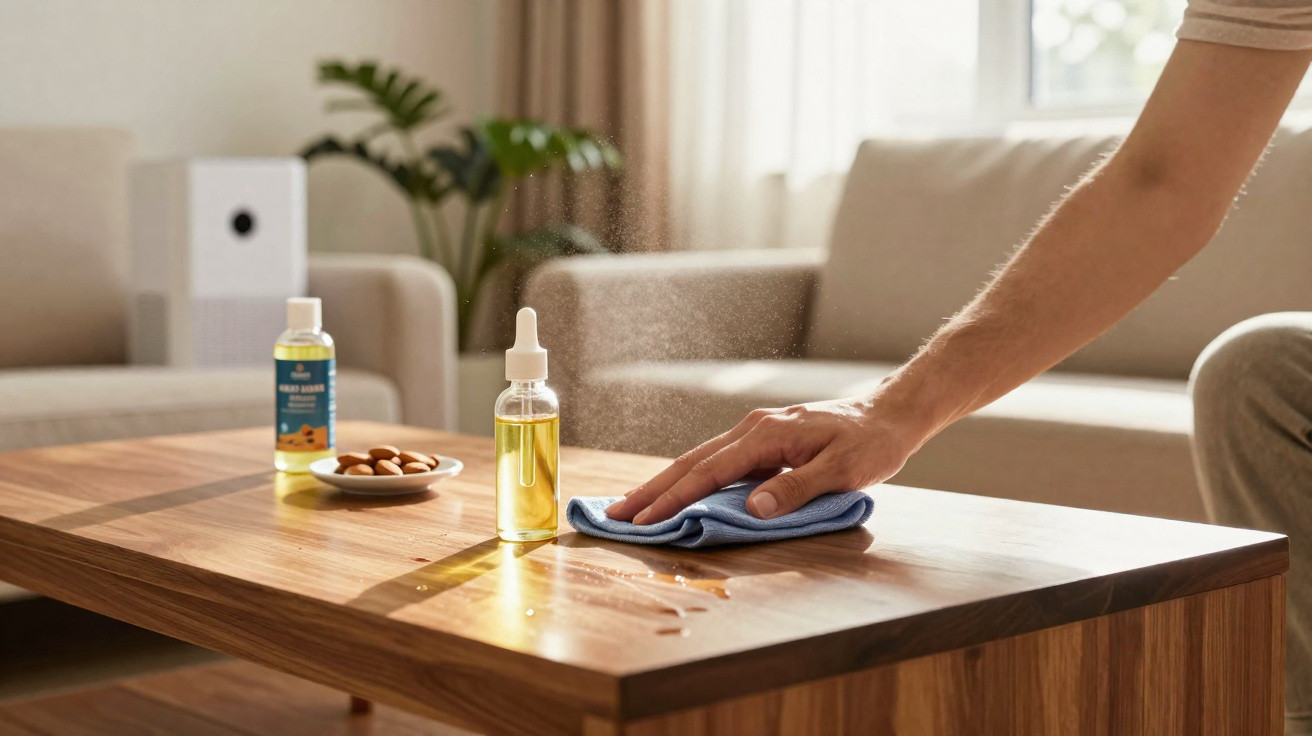
Many households swear by vegetable oil for gleaming furniture – but specialists warn that this trick can become a genuine trap for dust and allergens.
The desire for a clean, comfortable home increasingly goes hand in hand with the need for healthier indoor air. Natural household remedies are particularly appealing when they appear to replace chemical cleaners. Yet using vegetable oil on wooden furniture carries an often overlooked risk, one that cleaning specialists are now openly highlighting.
Household dust: far more than a little grey residue
The fine layer left on shelves, tables and picture frames is not simply harmless fluff. Research shows that ordinary household dust is a mixture of:
- pesticide residues, including substances banned long ago, such as DDT;
- textile fibres from clothing, carpets and upholstered furniture;
- fine particles from outdoors, brought in on shoes or through open windows;
- residues from cleaning products and wood treatments;
- skin flakes, hair and dust-mite droppings.
This combination can significantly affect indoor air quality. Children and people with allergies or respiratory conditions are especially sensitive to it. According to analyses, these problematic molecules occur in virtually every home, regardless of how frequently someone vacuums or mops.
“Household dust is not merely a visual problem. It carries pollutants and allergens that we breathe in every day.”
Vegetable oil for furniture care: natural helper or hidden risk?
A growing number of guides recommend almond oil or other vegetable oils as a “gentle” alternative to conventional wood-care products. At first, the idea sounds plausible: the oil forms a thin coating on the surface, restores a muted shine and is intended to stop dust from being stirred straight into the air.
When used correctly, it can indeed work. The slightly oily coating holds some of the dust, which is then picked up by the damp cloth. Supporters praise this as a natural way to tackle airborne particles, particularly in rooms with dry central-heating air.
This is precisely where cleaning specialists raise concerns: if too much oil remains on the wood, the surface acts like a magnet for anything suspended in the air – especially allergens and pollutant particles.
The issue is that anyone who gives it a quick wipe with a dry cloth will not remove most of this charged mixture. Instead, a layer of oil, dust and pollutants gradually builds up and adheres firmly to the furniture.
“An over-oiled piece of furniture becomes a long-term storage surface for dust, allergens and pollutants – and that is exactly what experts warn against.”
How to use almond oil safely
Despite the criticism, almond oil is not automatically off limits. Specialists instead advocate careful, sparing use. Their recommended method is as follows:
- Use the smallest amount: Apply only a few drops of almond oil to an already damp microfibre cloth, rather than directly to the wood.
- Follow the grain: Wipe the surface gently in the direction of the wood grain. This spreads the oil more evenly.
- Dry afterwards: Then polish with a second, dry cloth, completely removing any visible or detectable greasy film.
- Regularity instead of thick layers: It is better to treat furniture less often and sparingly than to “oil” it heavily a few times each year.
Specialists expressly point out that vegetable oils should not be used on glass, screens, electronics, smooth tiles, or very smooth laminate and parquet floors. They can cause streaks, create a slipping hazard and leave deposits that are difficult to remove.
Combining them with harsh cleaners is equally problematic.
“Anyone who mixes oil with bleach or ammonia-based products risks sticky films and unsightly marks on the wood.”
Where vegetable oil has no place
- Screens, smartphones, tablets and televisions
- Glass surfaces and mirrors
- Slippery floors, stair treads and high-gloss tiles
- Very porous wood that absorbs the oil deeply
Allergy risk: almond oil and nut allergies
One point is often overlooked online: almond oil is nut-based. Anyone with a nut allergy, or living with affected children, should be extremely cautious. If oil residues get onto toys, desks or children’s chairs, even skin contact may be enough to trigger a reaction.
Cleaning experts advise households in this situation either to choose alternative wood-care products without a nut base or to keep oiled surfaces strictly away from children’s hands. After cleaning, hands should be washed thoroughly and cloths cleaned separately.
“A natural origin does not protect against allergic reactions – especially with nut products.”
Everyday tips: reducing the pollutant load at home
Simple habits can go a long way towards cutting dust and pollutants, without any specialist products. Frequently recommended practical measures include:
- Ventilate regularly: Airing rooms several times a day with windows fully open reduces concentrations of fine particles and emissions.
- Wipe damp rather than dry: Dry dusters stir particles up, whereas damp cloths capture them.
- Wash new clothes: Wash items before wearing them for the first time to remove production chemicals and residues.
- Reduce aerosols: Sprays, air fresheners and propellant deodorants release many extremely fine particles.
- Keep cardboard boxes outside: Packaging, especially from electronics, often brings industrial dust and chemicals into the home.
Those who shop consciously tend to choose products with clear ingredient information and avoid furniture or textiles with a strong chemical smell. In many towns and cities, initiatives and workshops are currently emerging where neighbours share lower-pollutant cleaning routines.
How vegetable oil really works on furniture
To understand the effect, it helps to consider the principle: oil is lipophilic, meaning that it attracts and retains fat-loving substances. At the same time, its slightly sticky coating captures particles that would otherwise remain suspended in the air.
If the oiled surface is thoroughly wiped again with a slightly damp, washable cloth, this can be beneficial: dust and particles end up in the cleaning water rather than in the air. If the coating is left on the furniture permanently, however, it becomes a type of “long-term reservoir” for whatever settles in the room.
| Application | Benefit | Risk |
|---|---|---|
| Sparingly oiled, polished wooden surface | Gentle shine, less airborne dust | Low only if it is cleaned regularly with a damp cloth |
| Thick layer of oil that is not removed | Initially looks shiny | Strong binding of dust and allergens directly on the furniture |
| Oil on floors or glass | Hardly any useful effect | Slipping hazard, streaks and stubborn residues |
Practical alternatives for sensitive households
Anyone wishing to be especially cautious, or living with allergy sufferers, has several alternatives that do not involve vegetable oil. Microfibre cloths with a little water already remove much of the dust without additional products. For oiled or waxed furniture, mild wood cleaners with clear labelling are better suited than homemade mixtures from the kitchen.
In rooms exposed to heavy dust, such as those beside busy roads, an air purifier with a particle filter can be a useful addition. It does not replace cleaning, but it reduces the number of particles that settle in the first place.
It is particularly worthwhile to take a critical look at children’s bedrooms and sleeping areas: drawer handles, table tops and bed frames frequently come into contact with skin. In these places, easily wipeable, non-sticky surfaces should take priority over the high-gloss effect created by oil.
Anyone who nevertheless does not want to give up almond oil entirely can test it on selected areas, such as the back of a shelving unit. This makes it possible to see how the wood responds and how easily the oil can later be removed. A household diary or a brief note in the cleaning schedule can help keep track of the intervals between applications and prevent using “too much”.













Comments
No comments yet. Be the first to comment!
Leave a Comment