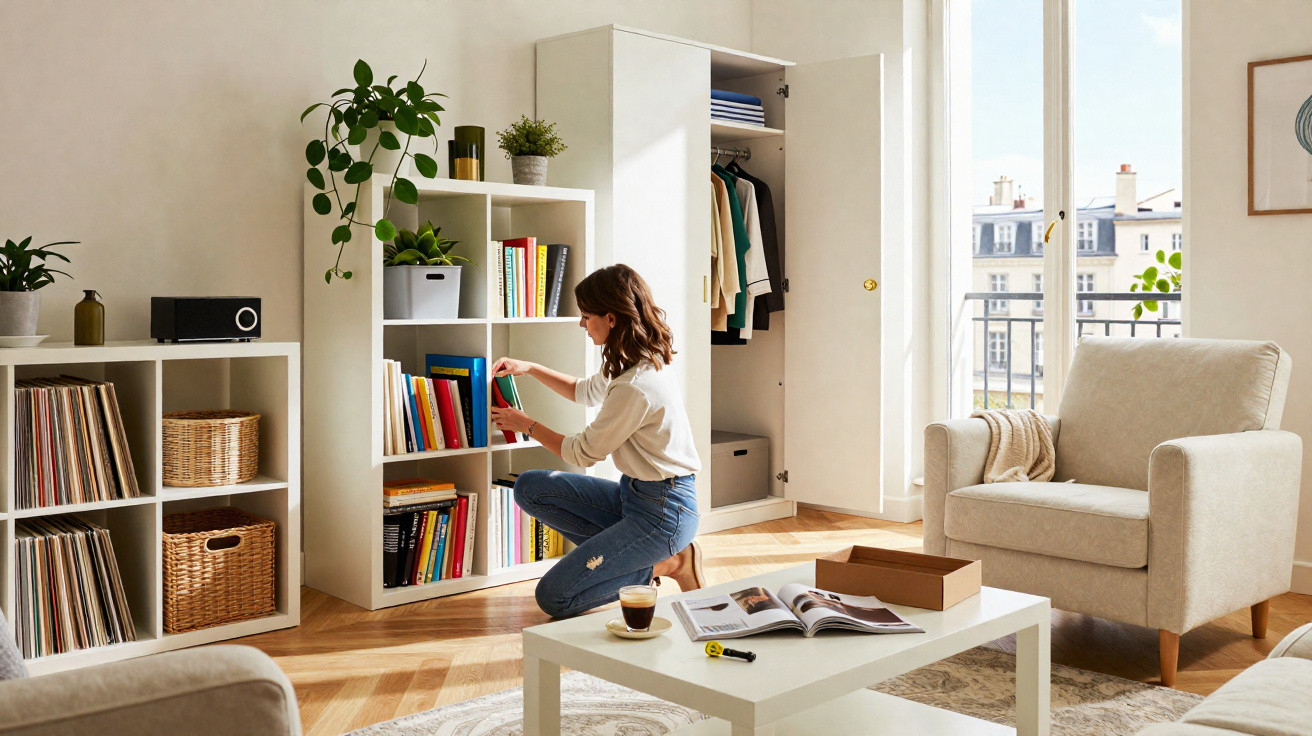
Ikea has long been a household staple for many people: a shelving unit from a first student flat, a coffee table from the first home shared with a partner, or a wardrobe that has survived several moves. The furniture retailer has now revealed which products most often end up in customers’ baskets in France – and, alongside predictable classics, there is an armchair that few would have expected.
What customers really prioritise today
A look at the sales figures makes one thing clear: people in France – and, almost certainly, in Germany, Austria and Switzerland too – are purchasing furniture far more practically than they did a few years ago. Homes are often smaller, layouts more awkward, and rooms need to serve several purposes at once.
This is precisely where Ikea’s bestsellers stand out. They can be adapted to different spaces, evolve with residents’ needs and do not cost a fortune. The most popular pieces are not the catalogue’s most dramatic statement items, but versatile workhorses for everyday life.
Multifunctional furniture, modular systems and affordable prices dominate Ikea’s top sellers – while a 1970s classic is quietly making a comeback.
Ikea’s best-selling furniture in France
Information from Ikea France reveals a clear ranking of the favourites. Many of these pieces can be found in countless German homes, which makes the list especially interesting.
- 1st place: Billy – the shelving unit that (almost) everyone knows
- 2nd place: Kallax – the square shelving unit for everything
- 3rd place: Pax – the custom-planned wardrobe
- 4th place: Poäng – the iconic sprung armchair
- 5th place: Lack – the coffee table for a first home
Billy shelving unit: the enduring bestseller
An Ikea hit list would be hard to imagine without Billy. This bookcase has been one of the Swedish retailer’s best-selling products for decades, both in France and across German-speaking markets. Even complete beginners can assemble it, while its design is understated and its price low.
Its key strength is adaptability. One unit can sit in a child’s bedroom, a row can serve a study, or several can create an entire library wall in the living room – all using the same system. Anyone needing additional space can simply add more units or fit top extensions.
Billy also continues to evolve visually. Ikea regularly introduces fresh colours and finishes. France has recently gained a blue version, for example, which is particularly popular in modern homes decorated with colour.
How many households use Billy
- as a traditional book wall in the living room
- as shelving for files and folders in a home office
- in a child’s room for books, games and storage boxes
- as a room divider in open-plan living and dining areas, with the rear side decorated
Kallax: the adaptable square shelving unit
Kallax follows closely behind. The familiar cube shelving unit has long developed beyond basic storage furniture into an all-rounder. Its square compartments can be left open, filled with boxes, or enclosed with doors and drawers. That makes it suitable for almost any room.
Many city residents position Kallax across a room to separate work and living areas without building a wall. In studio flats, it often creates a sleeping nook or a distinct home-office area.
One particularly notable use can be seen in France, where many music enthusiasts use the shelving unit for vinyl collections. The compartments are almost exactly the right size for records. Specialist forums contain countless photos of Kallax units filled to the top with LPs.
Whether used as a sideboard, room divider, record shelf or toy storage, Kallax thrives on all the creative repurposing by its owners.
Pax: a modular wardrobe system
Third in Ikea’s French sales charts is Pax, the wardrobe range built around the principle: “Build your own wardrobe.” Rather than choosing a ready-made model, customers select the width, height, doors and interior fittings themselves.
With clothes rails, drawers, baskets and shelves, storage can be used right into the last corner. This is particularly valuable in homes with sloping ceilings or alcoves. Interior designers recommend modular systems such as Pax for making sensible use of narrow or difficult-to-reach spaces instead of filling them with standard furniture.
| Feature | Everyday benefit |
|---|---|
| different widths and heights | also fits period-property alcoves and small bedrooms |
| sliding or hinged doors | sliding doors save space in tight rooms |
| flexible interior fittings | storage for clothes, shoes, bed linen and boxes |
Poäng: the armchair few expected
The real surprise in the ranking comes in fourth place: not a sideboard or a chest of drawers, but an armchair. Poäng, which has been in the range since the 1970s, is among Ikea’s best-selling products in France overall.
Its bent-wood frame, gently springing seat and distinctive Scandinavian appearance make it instantly recognisable. Many people place a Poäng by a window or directly beside a book wall – creating a spot for reading, streaming evenings or an occasional nap.
Poäng shows that Ikea customers are not only chasing storage space; they also want to deliberately give themselves a comfortable corner in everyday life.
Another reason for its success is that the armchair can be completely transformed with different covers. Light beige suits a minimalist look, a dark fabric works for a family home, and a patterned version adds character to a playful living room – the base remains the same, but the look changes. Those who have owned a Poäng for some time often simply replace the cover instead of buying new seating.
Lack: the standard coffee-table choice for a first home
Fifth place goes to a genuine classic: the Lack coffee table. Few Ikea products are as closely associated with setting up a first home. It is light, compact and, above all, exceptionally inexpensive. This is exactly why many students and young couples choose the model.
The simple, angular table works with almost any sofa and nearly every type of flooring. As their interiors improve over the years, many people happily keep Lack for a guest room, hobby room or as a side table.
Why these Ikea furniture pieces are so successful
At first glance, the five bestsellers appear to have little in common: a shelving unit, a cube system, a wardrobe, an armchair and a coffee table. Look closer, however, and several clear patterns run through every product:
- modular or flexible use – adaptable to different rooms and stages of life
- relatively affordable prices – suitable for a first home as well as family households
- understated appearance – fits into a variety of interior styles
- long-term availability – models remain in the range for years, making replacements or additions straightforward
What German buyers can take from this
Although the figures come from France, they translate well to the German-speaking market. Many of the trends are the same: smaller urban homes, more home working and limited furniture budgets. Those furnishing a home from scratch are often better served by flexible classics than highly specialised designer pieces.
Shelving such as Billy and Kallax can be expanded gradually, Pax grows alongside an expanding wardrobe, Poäng creates a relaxation zone in a small footprint, and Lack covers the early days in a new home without draining the bank account.
The armchair’s role is especially striking: among all the storage solutions, a piece of furniture designed primarily for comfort holds its own. This fits a broader interior trend: people are more deliberately investing in individual areas where they can genuinely switch off – whether with a book, a series or simply a view out of the window.
Anyone planning their home can use this top list as a guide: secure the functional areas first – storage, wardrobe and essential furniture – then intentionally create a place where everyday life can pause for a few minutes. In France, that place surprisingly often contains a Poäng armchair.








Comments
No comments yet. Be the first to comment!
Leave a Comment