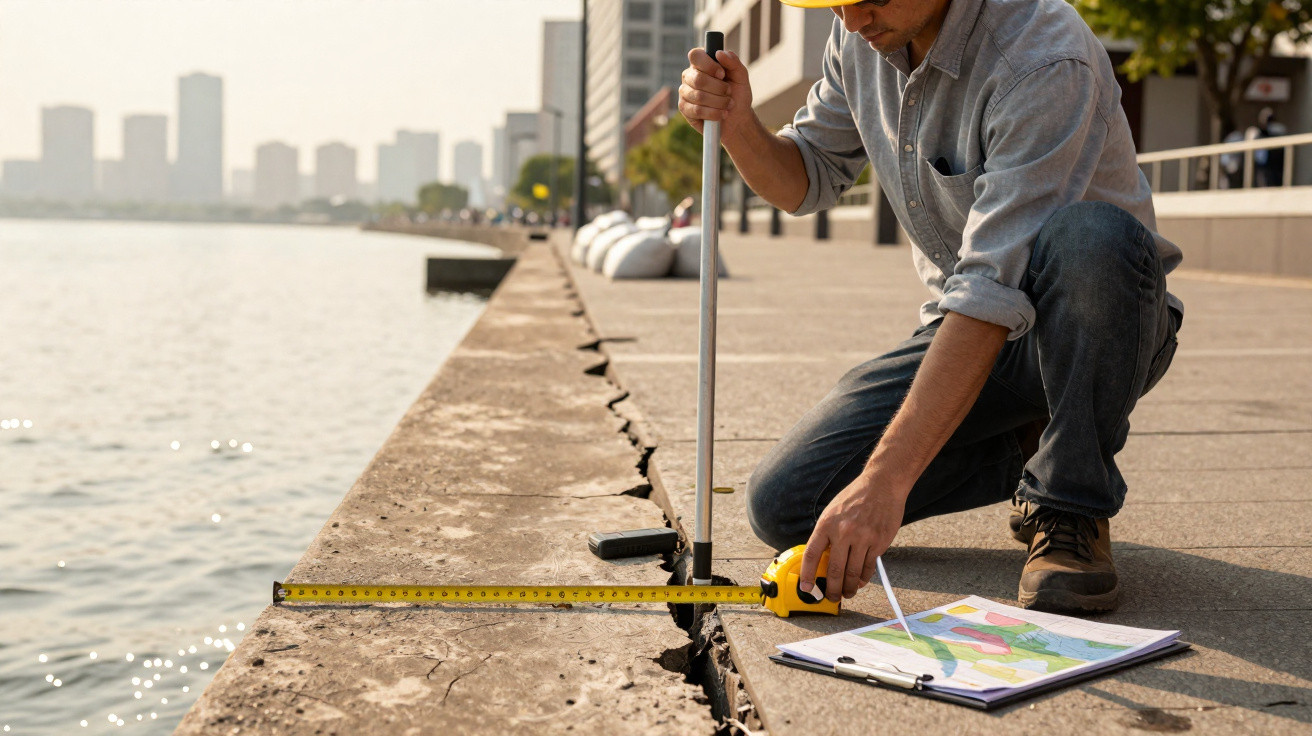
What had seemed a far-off climate danger is now intersecting with a less visible crisis: beneath many megacities, land is subsiding centimetre by centimetre every year, shortening the time available to millions of people.
Scientists’ warning on subsidence
A new study published in Nature Sustainability assessed 48 large cities already experiencing subsidence - the gradual lowering of the ground. Together, they account for about one fifth of the global urban population. Its findings are sobering: in certain areas, land is falling more quickly than sea levels are climbing.
In many coastal megacities, the land is sinking several times faster than the ocean is climbing, creating a double hit of risk.
Subsidence is not the same as a sudden sinkhole or a major earthquake. Instead, it is a gradual and uneven sagging of the Earth’s surface, caused by human activity in combination with local geology. Roads, buildings and pipelines are built on the expectation of reasonably stable land. When that stability disappears, the shape of entire urban areas can begin to change.
Cities with the fastest-sinking ground
The research identifies several urban hotspots where subsidence is especially concerning, whether because land is sinking rapidly or because so many people are at risk.
- Jakarta, Indonesia – up to 26 mm per year in some areas
- Ahmedabad, India – up to 23 mm per year
- Istanbul, Turkey – up to 19 mm per year
- Houston, Texas, US – up to 17 mm per year
- Lagos, Nigeria – up to 17 mm per year
- Manila, Philippines – up to 17 mm per year
A few millimetres annually may appear manageable at first glance. However, across 30 or 40 years, combined with faster sea-level rise, stronger storms and swift population growth, the implications become much more severe.
Jakarta: the capital left behind by sinking land
Jakarta is arguably the best-known case. In parts of the Indonesian capital, land is subsiding by more than 26 mm annually, largely because of unregulated groundwater extraction and the immense pressure of dense construction on soft, waterlogged ground.
Indonesia’s government has already made an extreme choice: it is relocating the national capital roughly 1,000 kilometres away, to a new location on Borneo. That decision does not solve the problem for the tens of millions of people who will remain in and around Jakarta, but it reveals how officials view the city’s prospects over the long term.
Relocating a capital city is less an act of ambition than an admission that some coastal risks can no longer be managed in place.
Mexico City: subsidence away from the coast
Subsidence is not confined to coastal locations. Mexico City, which was constructed on the site of an ancient lakebed, has long been known for sinking as its clay-heavy soils compress. Decades of groundwater extraction to serve its vast metropolitan population have depleted underground layers like a sponge that subsequently collapses.
In certain districts, roads buckle, pipes fracture and buildings lean in different directions. Engineers believe some areas are unlikely to recover even if groundwater pumping ceased completely, as the ground has already been compressed into a near-permanent condition.
What causes cities to sink
The precise causes vary between cities, although several recurring factors are responsible.
| Main driver | How it makes cities sink | Typical examples |
|---|---|---|
| Groundwater extraction | Removing water from underground aquifers makes the overlying soil compact and settle. | Jakarta, Mexico City, Manila, parts of Houston |
| Weight of urban development | Large buildings, roads and infrastructure place pressure on soft or reclaimed ground. | Coastal districts of Jakarta, Lagos, Asian port cities |
| Sand mining and land reclamation | Extracting or reshaping sediment alters the way land carries structures. | Lagos, rapidly growing ports in West Africa and Asia |
| Oil and gas extraction | Taking hydrocarbons from below ground can make underground layers slump gradually. | Houston and parts of the Gulf Coast |
Patterns of urbanisation are particularly important. Where development expands rapidly and informally, controls over well drilling, construction weight and monitoring of land movement are frequently disregarded. Within only one or two decades, that can drive subsidence rates sharply upwards.
Houston, Lagos and Manila: one shared trajectory
Houston’s petrochemical impact
Houston’s subsidence is partly linked to oil and gas extraction, as well as intensive groundwater use and industrial expansion along the Gulf Coast. Its low-lying suburbs already depend on levees and drainage infrastructure to prevent tidal flooding. Further land sinking weakens that protection and raises the expense of maintaining essential infrastructure.
Lagos and the cost of extracting sand
Lagos, among the fastest-growing cities in the world, has a different trigger for subsidence: large-scale sand extraction. Sand is essential for concrete production and land reclamation schemes. Taking it from coastal and lagoon areas can make the ground unstable, leaving buildings on foundations that are becoming progressively more vulnerable.
As millions of people settle in informal communities on land exposed to flooding, even minor additional subsidence can turn seasonal high tides into frequent emergencies for households.
Manila’s groundwater pressure
In Manila, groundwater pumping, soft delta soils and fast urban sprawl are together producing subsidence of up to 17 mm a year in some areas. The Philippine capital is already exposed to powerful typhoons. As storm surges move across higher seas towards a city that has become lower, both flood depths and financial damage increase sharply.
Subsidence doesn’t act alone; it amplifies every other coastal hazard that cities already struggle to manage.
Europe and France: affected at lower rates
The study finds that areas of Europe, including France, are also experiencing subsidence, although average rates are lower than those recorded in Asian and African megacities. Measurable land sinking has been identified in some port and delta areas, often associated with historical land reclamation and groundwater extraction.
Slower sinking does not automatically mean limited danger. European cities often contain extensive underground transport systems, ageing sewer networks and densely built historic areas. Even relatively modest and uneven subsidence can distort tunnels, damage masonry and compromise flood defences designed on very different assumptions about ground stability and sea level.
Can subsidence be stopped?
Researchers are clear that, without radical action, many of these cities could face partial or widespread inundation within decades. There is no universal answer, but a number of measures could reduce the rate of damage or contain its effects.
- Limiting or prohibiting uncontrolled groundwater extraction in high-risk areas
- Using lighter construction techniques and restricting exceptionally heavy towers on soft ground
- Locating new districts away from subsidence hotspots and flood-prone coastlines
- Strengthening or redesigning sea walls, levees and drainage networks to account for sinking land
- Using satellite monitoring to identify dangerous land-movement trends early
Some approaches can only delay the consequences. A sea wall completed today may work for 20 years, but then become less effective as water rises while land simultaneously falls. This helps explain why governments are beginning to weigh up managed retreat from certain districts while improving defences elsewhere.
What “inevitable disappearance” means in practice
When researchers describe a city’s “disappearance” as inevitable, they seldom mean that every street will be submerged during one dramatic event. In reality, the change is likely to be uneven and prolonged.
Low-lying areas may first become impossible to insure. The costs of maintaining infrastructure may exceed local authority budgets. More affluent residents could relocate to higher ground, while poorer communities remain in places flooded several times each year. Over a generation, parts of a city may effectively stop functioning, despite its skyline remaining above water.
Disappearance often begins as a quiet retreat: bus routes cut, schools closed, maintenance skipped in streets that flood just a bit too often.
Key terms to understand
Subsidence means the gradual lowering of the ground surface. It may happen naturally through geological processes, or result from human activity, such as pumping water or oil from underground.
Managed retreat is the deliberate and planned movement of people and infrastructure away from high-risk locations, rather than allowing repeated disasters to produce disorderly evacuations.
A straightforward future scenario
Consider a coastal district currently positioned one metre above high tide. Its land is subsiding at 15 mm annually, while local sea level is increasing by 4 mm each year because of climate change. Together, this creates a relative change of 19 mm a year. After 30 years, the district’s effective elevation has fallen by more than half a metre.
Storm surges previously considered “once in a century” events could then occur every decade, or even every few years. Drains built to handle infrequent flooding would regularly overflow. Buildings not designed to withstand standing saltwater would begin corroding from their foundations upwards. Without any single catastrophic event, the district would steadily become more difficult and costly to live in.
For many of the 48 cities examined, this calculation leaves very little scope for postponement. Their land is already shifting, and it is shifting against them.









Comments
No comments yet. Be the first to comment!
Leave a Comment