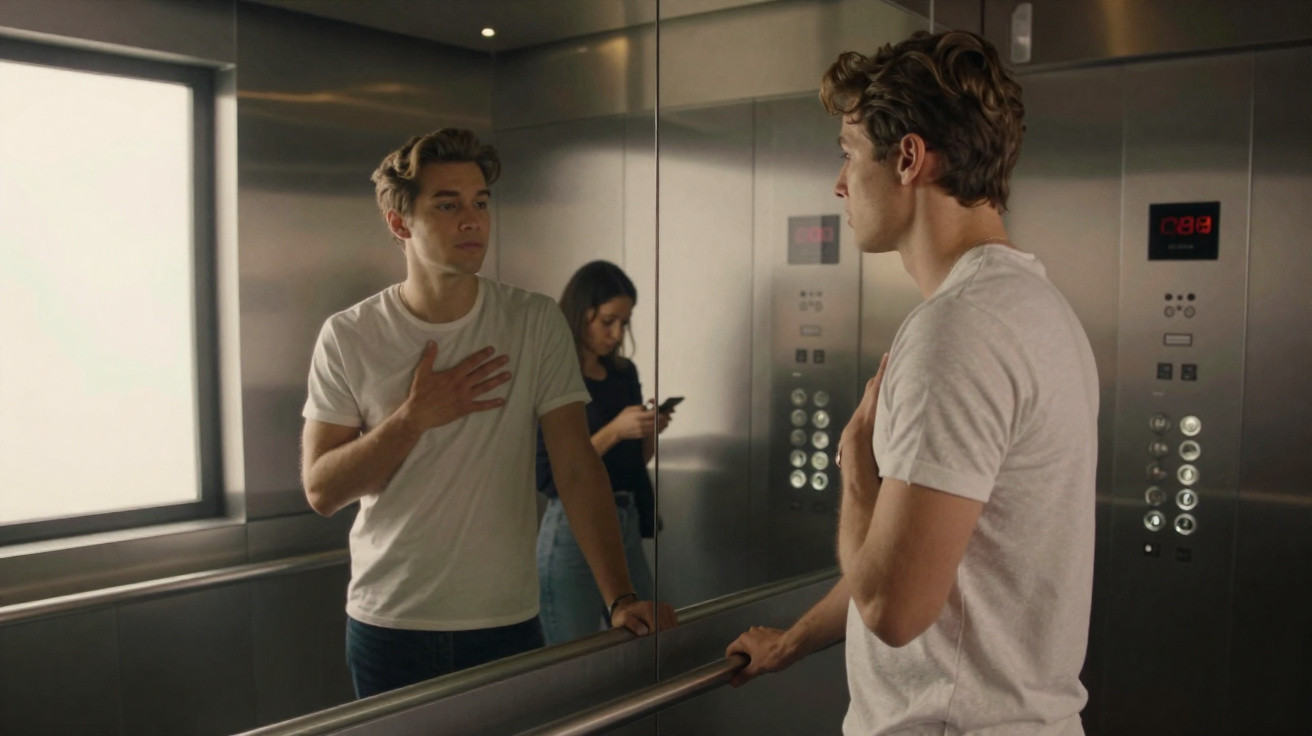
You sense the lift shift, watch the floor display flash and hear the soft hum of the motor above. Nobody says a word. Every gaze lands in the same spot: the mirror. You briefly inspect your hair, check your clothes or steal a sideways glance at the stranger standing a little too near. The journey lasts scarcely 20 seconds, but inside your chest it seems to pull and stretch like an elastic band.
You look at your reflection and, oddly, feel slightly less confined.
The walls are exactly where they were. Your thoughts, however, have changed.
Why mirrors ended up in lifts in the first place
Before mirrors became commonplace, a lift journey could be a small social ordeal. Passengers looked down at the floor, stared at the doors or counted the chimes. Time seemed to weigh heavily. In the silence, each second felt more pronounced. Early lift firms faced constant complaints about “slow lifts” which, technically speaking, were performing at a perfectly normal speed.
The issue was not the machinery but the human mind, confined in a metal cabin with no task to occupy it. Engineers adjusted motors and cables, while building owners complained about the expense. Then somebody tested an almost laughably straightforward idea: putting a mirror on the wall. Complaints about speed fell abruptly. The journey had not changed, but the way it felt had.
Historians of lifts recount a similar pattern: following the Second World War, as buildings became taller and busier, mirrors started appearing as an inexpensive answer to passenger irritation. People began tidying their hair, straightening ties and checking their lipstick. They also gained a socially acceptable way to avoid looking at one another. A minor redirection of attention altered the perceived length of the journey. The solution was not mechanical at all; it was psychological.
How a piece of glass hijacks your sense of time and space
Enter a mirrored lift and your brain is immediately given something to do. Before you have consciously chosen to look, your eyes settle on your reflection. You inspect your face, your stance and the way your bag sits on your shoulder. All at once, you are no longer merely a passenger in a metal cabin: you are a character on a small, temporary stage.
During a brief journey, that tiny interaction can be enough to reshape time. Research into attention and time perception suggests that subjective time contracts when the mind is engaged. The same principle that makes hours disappear while using your phone can make 15 seconds seem briefer when you are examining your appearance. You are no longer simply waiting for the lift to arrive at your floor; you are waiting for your reflection to offer a quiet approval.
Space adds another dimension to the effect. Mirrors create twice the visual depth inside the cabin. Your brain never entirely accepts that the wall has vanished, but it relaxes somewhat nonetheless. The cabin feels less like a cage and more like a slim corridor. That apparent extra distance reduces the instinctive unease of enclosure. People who are susceptible to claustrophobia often describe the same feeling: a mirrored lift appears larger, feels easier to breathe in and seems less oppressive.
The subtle tricks mirrors play on your fear of being trapped
If your heartbeat has ever quickened when lift doors shut, you are far from alone. At an instinctive level, being enclosed in a small moving cabin with strangers can set off ancient survival warnings. Your body responds before reason has a chance to intervene. Your chest constricts and the air seems thinner. Logically, you know the lift is safe, but your nervous system is not logical. It operates through “fight, flight or freeze”.
A mirror discreetly offers your brain a different narrative. Rather than facing a flat, impersonal surface, you see light, depth and another version of the room. Your focus is divided between the real cabin and its reflected counterpart. For an anxious mind, that division can be helpful. The space seems broader and its boundaries less severe. You remain in a box, but your senses are given enough uncertainty to stop shouting “we’re trapped”.
There is also a social buffer. Looking at yourself instead of fellow passengers lowers the tension slightly. You do not have to navigate uncomfortable micro-interactions: eye contact held for too long, a courteous smile or a hurried glance away. Your own reflection becomes somewhere to “hide”. That small sense of control is significant. When we can decide where to direct our eyes, we feel less like an animal backed into a corner. Designers are deliberately working with precisely that response.
How to use the lift mirror as a mental tool, not just a selfie spot
Most people look in a mirror out of vanity, and there is nothing wrong with that. Yet it can also serve as a subtle mental aid, particularly if lifts make you uncomfortable. Try this simple approach: choose one feature in the reflection and keep your attention on it for the whole journey. It might be your collar, the corner of your eye or your bag strap. Observe it, breathe slowly and count three complete breaths. The aim is not to get everything right. It is purposeful distraction.
This small ritual assigns your mind a task that is limited, tangible and visible. Instead of following the thought, “I’m trapped in here, what if something goes wrong?”, your internal script becomes, “I’m watching this one thing shift slightly while I breathe.” The lift continues moving and you can still feel the vibration underfoot. But the emotional intensity eases a little. You have anchored yourself to the mirror rather than to fear.
A further technique may help when the cabin becomes crowded and anxiety rises. Instead of taking in the entire room, restrict your attention to your outline in the mirror. Observe the space you take up, the position of your shoulders and the way your weight moves. Stand a touch straighter or make a small adjustment. Taking action with your body, even through the slightest gesture, quietly tells your brain: I am not merely stuck here; I am doing something.
People who find lifts difficult often feel mildly ashamed of it. They may assume they are being “irrational”. That shame places a second level of stress on top of the first, leaving you anxious about feeling anxious. A gentler perspective is to acknowledge that these cabins are, frankly, strange for humans. We are outdoor creatures who move horizontally, then suddenly travel vertically inside a steel tube.
Rather than resisting that response, treat the mirror as a gentle buffer. If panic begins to build, meet your own eyes for a moment and think, “Okay, you’re here, I see you.” It is not magic, and your heart may still race. But you have made room for self-recognition instead of only avoidance. That is already a success. Let’s be honest: nobody truly does this every day, but when you try it, it changes the texture of the journey.
Travelling with other people presents a separate difficulty: the unspoken expectation that you should appear “normal”. You do not want anyone to notice your discomfort. As a result, you may stiffen, look at the floor or clutch your phone. The mirror can loosen that rigidity. Use it to relax your expression, breathe out slowly through your nose and release your jaw. Small physical changes can often reduce the mind’s tight grip.
“Design isn’t only about how a space looks, it’s about what it gently does to your breathing without you noticing,” a building psychologist once told me as we rode a glass elevator up 30 floors.
When specifying lift mirrors, urban designers and architects quietly draw on several basic principles. Their concern is not purely aesthetic; they are also considering nervous systems.
- Mirrors need to be large enough to suggest depth, without being so warped that they alter faces.
- Lighting should be gentle and balanced, making reflections seem flattering rather than severe.
- Placement is important: a mirror opposite the doors often reassures people more than one positioned on a side wall.
- In hospitals and care homes, mirrors may be minimised or removed for patients who find reflections disorientating.
The strange comfort of watching yourself not panic
Once you begin viewing lift mirrors as psychological devices, ordinary journeys take on a different quality. You notice how instinctively you seek out your reflection, and how naturally it functions as both a social shield and a miniature stage. You spot those who groom themselves confidently and those who glance briefly before looking away. For a few seconds between floors, the cabin becomes a moving portrait of human self-awareness.
On a hectic morning, the mirror takes in plenty: weary faces, hurried clothing and private concerns about meetings, dates or bad news waiting above. Each of these passes over the same gleaming surface, then vanishes when the doors open. The curious truth is that this anonymous glass understands something we seldom acknowledge: in enclosed spaces, we need distraction from our own vulnerability.
The next time you enter a lift and see your reflection, you may experience a small moment of recognition. Not merely, “Oh, my hair looks okay,” but, “Oh, this is here to help keep me calm.” Mirrors do not make cables or motors faster, and they do not make a journey safer. They make it easier to endure. In a world where we spend increasing amounts of life in cramped, shared and vertical spaces, this quiet psychological device may be among the modern city’s most overlooked design choices.
| Key point | Detail | Why it matters to the reader |
|---|---|---|
| Mirrors reduce perceived waiting time | When your reflection occupies your attention, the journey appears shorter. | It helps explain why lifts seem less irritating than they might otherwise be. |
| Mirrors ease mild claustrophobia | They visually enlarge the cabin and provide a focal point you can control. | It offers a straightforward way to feel calmer in small, enclosed cabins. |
| Design choices are deliberate | Mirror placement, size and lighting are selected to subtly influence your emotions. | It encourages you to see everyday places as spaces quietly engineered around your mind. |









Comments
No comments yet. Be the first to comment!
Leave a Comment