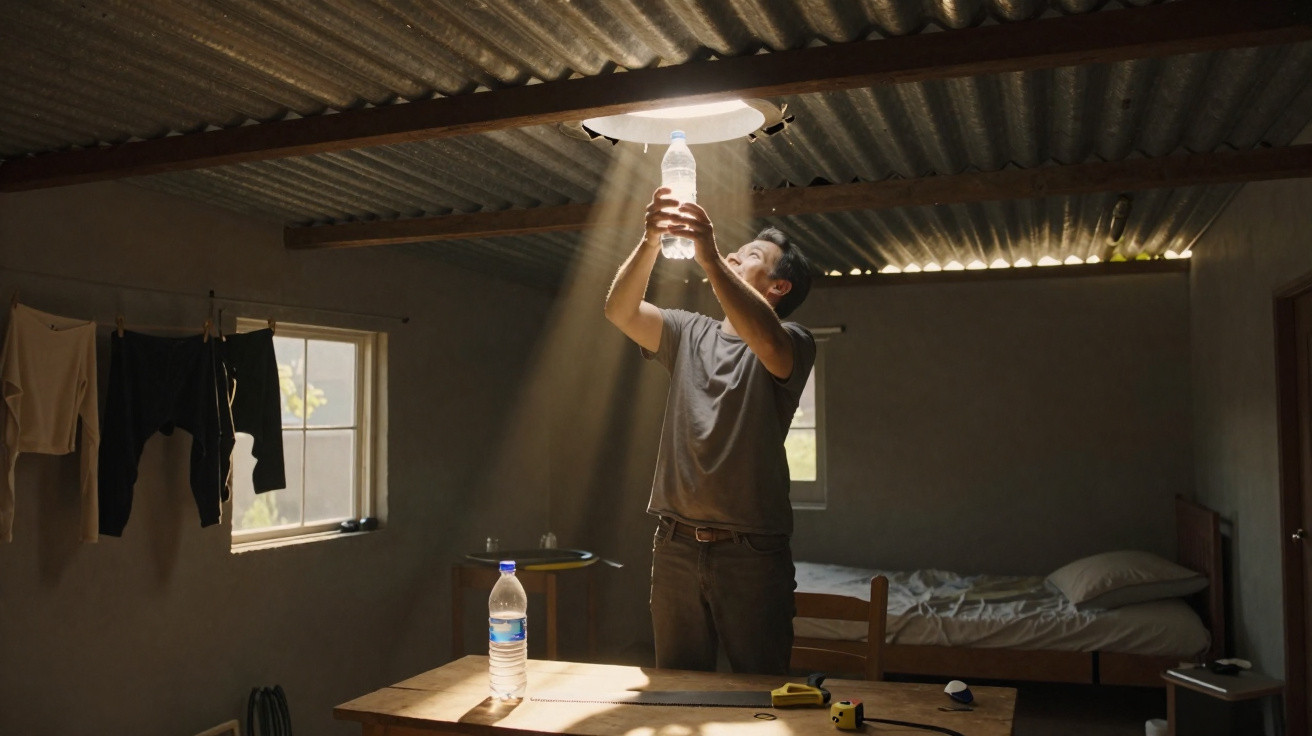
A simple plastic bottle filled with water can direct sunlight into rooms that would otherwise remain dark during the day. Known as a Moser lamp, this solution passes through part of the roof and uses the refraction and diffusion of natural light to brighten the inside of a home without an electric bulb, battery or electricity generation.
How can a bottle light up a room?
The upper section of the bottle is exposed to sunlight, while its lower section faces into the building. As solar radiation passes through the plastic and reaches the water, its path changes, spreading light in several directions around the room. This diffusion turns the container into a kind of compact skylight.
A hole in the roof alone would admit a more concentrated beam of light. The water in the bottle disperses that brightness throughout the space, lighting a wider area during periods when there is sufficient sunlight outside. The system therefore makes use of daylight; it neither produces nor stores electrical energy.
What is inside this plastic “lamp”?
The traditional version relies on very straightforward materials. The small amount of bleach added to the water does not make it brighter: it helps prevent algae and other organisms from growing, which could make the liquid cloudy over time.
- a transparent PET bottle;
- enough water to fill the container;
- a small amount of bleach to maintain transparency;
- a suitably sized opening in the roof;
- durable materials for securing it and sealing it against rain.
Where did the Moser lamp idea come from?
The system takes its name from Brazilian mechanic Alfredo Moser, who began testing the technique during Brazil's energy crisis of 2001 to 2002. His aim was to find an inexpensive way to use sunlight to brighten indoor spaces during the day, particularly buildings with few windows.
Years later, the principle expanded internationally. Liter of Light, a programme established in the Philippines in 2011, began fitting these bottles in homes and shared an open-source version that could be made locally. Within its first 20 months, the initiative had already reached hundreds of thousands of homes across different countries.
What are the benefits and limitations of this system?
The chief benefit is seen in homes with thin roofing and interiors that remain dark in daylight. The bottle repurposes a disposable container and uses no electricity while sunlight is available. Its performance, however, depends on the sun's position, weather conditions, roof characteristics and the amount of light falling on each container.
- it works only when there is enough natural light;
- the basic version provides no lighting at night;
- it does not charge batteries or generate electricity;
- it requires a roof that is suitable for installation;
- it needs careful sealing to prevent leaks;
- it does not replace an electrical installation where lighting is needed after sunset.
Why does a bottle lamp work especially well in dark homes?
In buildings with opaque roofs and few openings, bright sunshine may be present outside while the interior is still dark enough to require an electric light during the day. The bottle lamp creates a route for that outdoor light and redistributes it within the room. Experimental tests have measured meaningful illuminance levels using this principle, although results vary considerably according to the conditions of each installation.
The most important point is what the bottle does not do: unlike a photovoltaic panel, it does not turn sunlight into electricity. Instead, it acts as a daylighting element, directing and dispersing during the day the light energy already available on the roof. It was this combination of refraction, reused material and low cost that enabled the Brazilian idea to reach homes in many countries.















Comments
No comments yet. Be the first to comment!
Leave a Comment