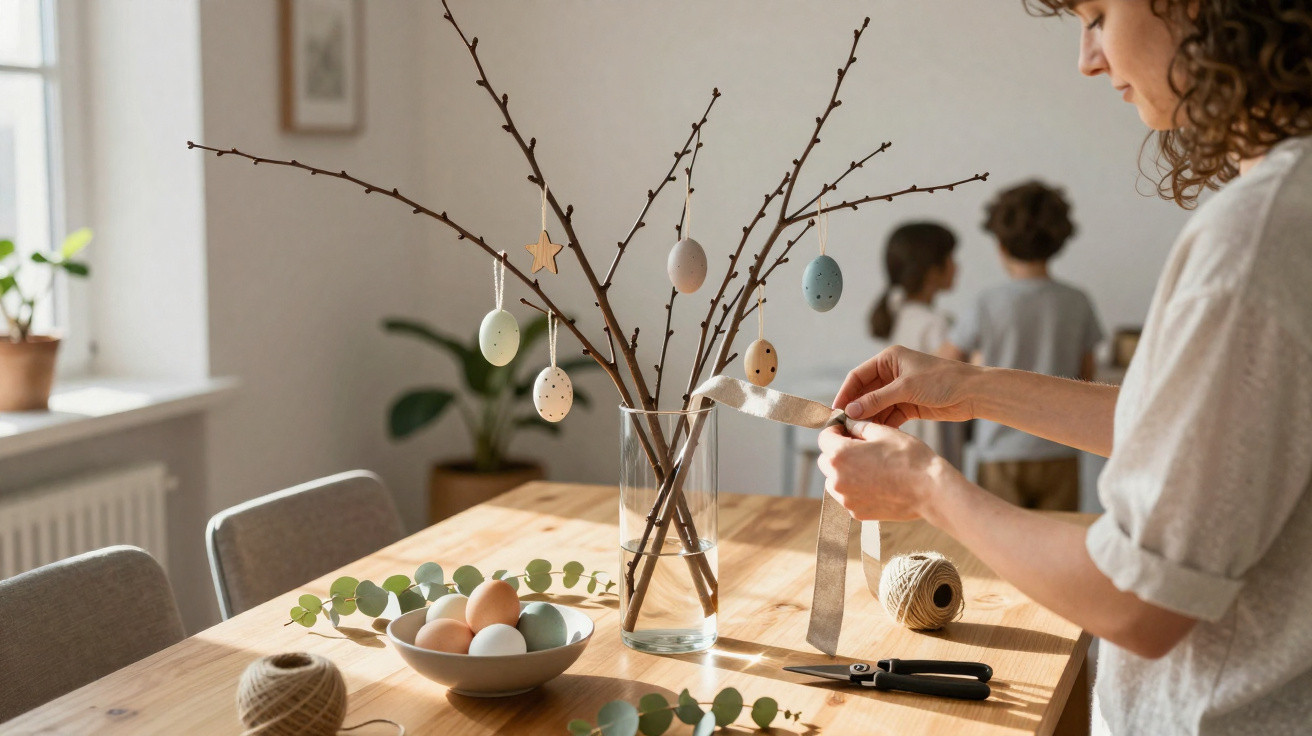
When inviting guests for Easter, it is easy to spend a great deal of time on napkins, table runners and costly decorative bits, only to be disappointed with the result. Yet one remarkably simple idea is currently gaining popularity: rather than an overloaded table, choose a natural focal point that costs next to nothing but looks as though it belongs in an interiors magazine.
Why the traditional tablecloth suddenly looks dated
Many people know the situation: you lay out a lovely cloth, add a runner, then candles, ornaments and flowers – but the table still quickly feels cluttered or random. Guests can barely see one another over the mountains of decoration. That is exactly where this new trend comes in.
“Instead of covering every inch of the table, the focus moves upwards – leaving the table free for enjoying the meal.”
The central principle is to stop spreading decorations flat across the entire table and arrange them vertically instead. This creates visual interest without taking away space needed for serving bowls, platters and glasses. The result is a calm, tidy look that appears far more luxurious than lots of small individual pieces.
The new star of the Easter table: an Easter tree instead of a table runner
A branch arrangement that takes centre stage
In place of lengths of fabric and scattered ornaments, use an upright arrangement of branches – often known as an Easter tree. The foundation could not be simpler: a sturdy vase, several attractively branching twigs and a few lightweight hanging decorations. In essence, that is all you need.
The appeal is that this decoration looks both rustic and elegant. It suits modern minimalist homes just as well as country-style kitchens or period dining rooms. The natural texture of the branches immediately adds atmosphere, without the need to buy dozens of decoration sets.
Vertical decoration creates space – and starts conversations
Its impact comes chiefly from its height. While low arrangements can soon feel oppressive and busy, a tall focal point opens up the room. Eyes are naturally drawn to the delicate details among the branches, while the table surface remains pleasingly clear.
- Faces stay visible, so no one is looking at a wall of decorations
- Serving platters have plenty of room
- You can clear or add dishes with ease
- Children can reach their food more easily without moving decorations
The tree also becomes a talking point: guests ask about the branches, the ornaments and the idea behind it. Rather than fading into the background, the decoration becomes something that brings people together.
How to create this natural focal point step by step
Use materials from nature rather than the decoration shop
Most of the items can be found in a nearby park, woodland path or garden. A short spring walk is often enough to gather everything required.
The following are particularly suitable for a typical Easter tree:
- Willow branches with flexible, gently curved stems
- Hazel branches with catkins for a soft appearance
- Cherry or other fruit-tree branches that will later flower
The important thing is that the branches have enough offshoots for the ornaments to show well, without looking too thick. Lightness matters more than volume.
“A heavy, stable base stops the tree from wobbling or toppling whenever it is touched.”
It is therefore worth checking the cupboard: a rounded glass vase, a plain ceramic vessel or even an old jug can work well, provided that its base is sufficiently heavy or can be weighted with stones, sand or dried soil.
This basic kit is entirely sufficient
For a balanced Easter tree, the following quantities work well:
- 1 large vase with a stable base
- 5 to 10 medium-sized branches, depending on their width
- Lightweight hanging eggs made from plastic, paper or blown eggshells
- Fine string, yarn or delicate ribbons in pastel shades
- A little moss, dried flowers or feathers for the edge of the vase
This is already enough to create a very harmonious tree without making it look overloaded. If you wish, add a few special pieces, such as a child’s painted egg or a small wooden ornament from a past holiday.
Fewer colours, greater impact: how professionals decorate
A defined colour palette gives the tree an elegant look
To prevent the tree from resembling a brightly coloured collection of odds and ends, follow one simple rule: use no more than three main colours. Soft pastel shades such as rose pink, pale yellow, sage green or light blue are typical for Easter. They combine beautifully with natural colours including beige, brown and white.
For a modern look, stick to white, cream and perhaps just one accent colour, such as dusty pink or sage green. Families with children can of course make it more cheerful – but even then, an overall colour direction gives the display a calmer feel.
“The more restrained the palette, the more premium the whole table looks – even without designer brands.”
When decorating, it is enough to place a few eggs on the outermost branch tips. Deliberate gaps between them create airiness and lightness. Moss, feathers or a small dried-flower wreath can be placed around the base of the vase to soften the transition to the table.
Where the Easter tree looks its best
In the middle of the table – or as a feature in the background
If there is enough room, place the tree in the centre of the table. It then forms the visual axis of the room. This works particularly well with simple tableware, perhaps stoneware or white ceramics, and cloth napkins in one of the tree’s colours.
If table space is limited, move the tree to a sideboard, windowsill or living-room chest of drawers. With a few candles in glass holders or tealight holders, it becomes a small spring stage that brings its effect to the entire room.
More than decoration: a small family ritual
For many households, decorating the Easter tree has now become a ritual. Children can make their own ornaments, while adults arrange the branches and create a balanced overall display. It produces not only decoration, but also a shared memory.
Anyone who deliberately uses branches collected on a walk experiences the season more intensely. You notice buds, fresh greenery and different bark textures more readily. For city families in particular, this can bring a little piece of nature into the home.
Practical variations and tips for everyday life and sustainability
A mini version for small flats and crowded tables
No one needs to miss out on the trend in a studio flat or with a very small table. A slim bottle holding two or three fine branches is enough. Rather than using many eggs, hang only a few very light ornaments from it. The effect remains, without blocking anyone’s view.
Several small vases with single branches, loosely distributed across the table, can also replace the traditional runner. In that case, it is better to avoid hanging eggs and use only delicate flowers or a touch of colour.
Reuse it after Easter rather than throwing it away
The tree does not have to go in the bin on Easter Monday. Once the ornaments have been removed, the branches can remain for a few days as pure natural decoration. With only a little effort, the Easter tree becomes a spring bouquet, perhaps with a few fresh tulips or daffodils added to the vase.
The eggs and ribbons can be stored in a small box and used again the following year. This protects both your budget and resources – and many people value the familiarity of recurring decorative pieces that carry memories with them.
What begins as a seemingly simple idea becomes more than an alternative to a tablecloth: it is a flexible, personal design feature that adds emotional warmth to Easter, frees up the table and, incidentally, looks more modern than most ready-made sets from a department store.












Comments
No comments yet. Be the first to comment!
Leave a Comment