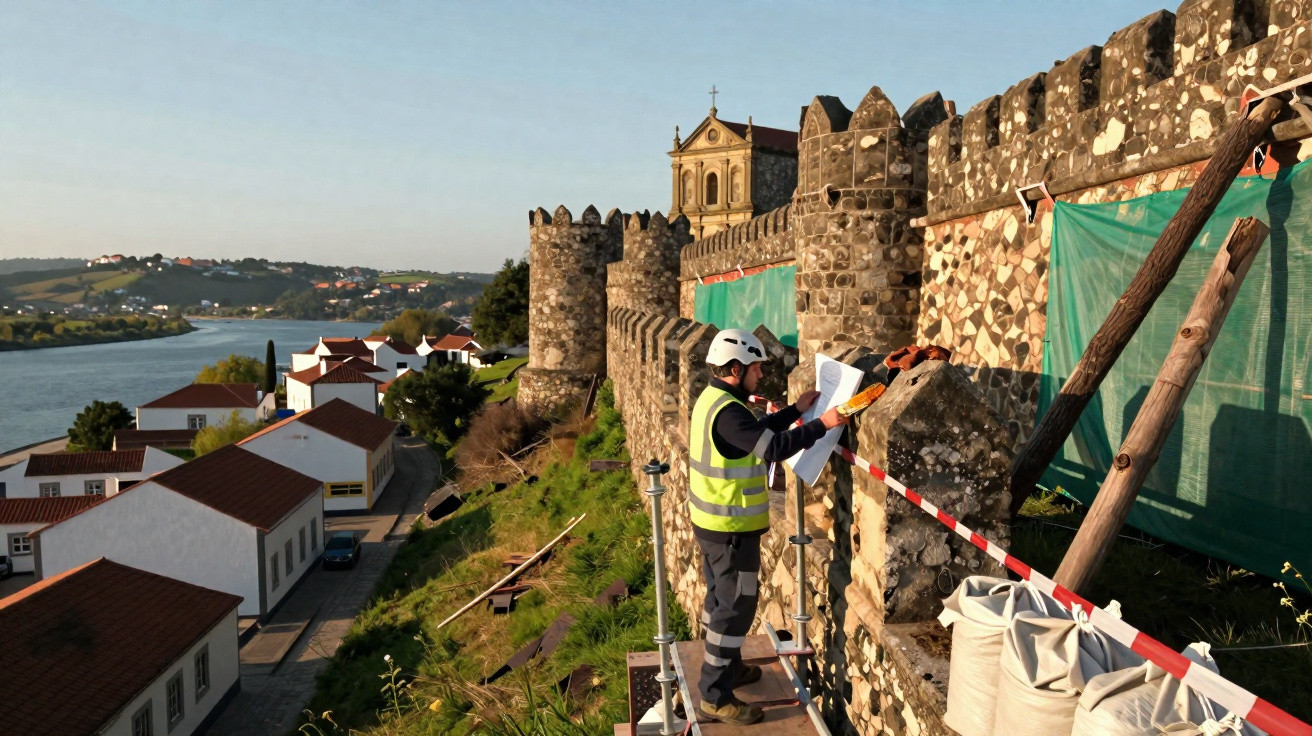
Two Portuguese castles designated as national monuments illustrate sharply differing rates of heritage recovery after the storms that struck the country from late January into early February. In Leiria, restoration work is already under way at the castle, which is preparing for a partial reopening on 22 May. In Alcácer do Sal, meanwhile, the castle slope still requires a structural solution: the Army installed temporary stabilisation measures following flooding to prevent further collapses, but the local authority told Expresso that the area remains restricted. It has unsuccessfully sought action from several bodies to stabilise both the slope and its vegetation.
The restoration of heritage sites and cultural facilities damaged by the storms remains far from complete. Information gathered by Expresso from the municipalities of Leiria, Alcácer do Sal and Batalha shows recovery progressing at markedly different speeds. Although some venues have reopened and works are in progress, other heritage assets remain restricted, while intervention in some places has gone no further than cleaning and temporary stabilisation.
Local authorities say they have not yet received public funding specifically earmarked for restoring affected heritage and cultural facilities, receiving only state advances instead. These were granted under an order published in April that increased the Municipal Emergency Fund by €75 million and provided advances to municipalities hit by the storms. While those sums may be used for this purpose, they do not represent a dedicated cultural heritage funding stream.
Leiria has restoration works under way, reopening dates and advances under state funding arrangements, albeit not funding targeted specifically at culture. In Alcácer do Sal, the response appears to remain focused on containment. The council has identified ten cultural spaces or facilities that still show damage, including the castle slope, the Pedro Nunes Municipal Museum, the Municipal Library, the Misericórdia and Nossa Senhora da Graça churches, as well as storage collections at the Pedro Nunes Museum and the Archaeological Crypt of Alcácer do Sal Castle. An official municipal source said that no state funding had been received for these facilities, only funding from the Environmental Fund for the restoration of public space.
Of the damaged cultural spaces and facilities listed, only the municipal library has obtained funding from a sponsor, after being registered on a platform indicated by the Mission Structure for the Reconstruction of Portugal’s Central Region. This body was set up by the Government to coordinate and monitor the broad recovery of affected areas. According to the council, the support did not involve state funding.
The Alcácer council also says it has struggled to fit its losses into support mechanisms designed around the circumstances in central Portugal: “We did not have roofs, which was what they had most of. We had floods,” a municipal source summarised. In Alcácer, one of the Alentejo municipalities included in the state of calamity, the principal impact came from flooding caused by the rising River Sado, damaging archives, museum collections, built heritage and urban movement routes. Marcelo Rebelo de Sousa, then still President of the Republic, described the flooding in Alcácer do Sal as “perhaps the most serious in the country”.
Alcácer do Sal Castle slope awaits a lasting solution
“The only work that has taken place consisted of washing and cleaning the spaces,” an official source at Alcácer do Sal Municipal Council said. “Regarding the museum collections, artefacts are being washed and relabelled. State support was requested for restoring the most sensitive materials. Work is under way to recover files from the planning permission archive [for private building works in the municipality], by drying them and separating their pages.”
For the conservation of more sensitive archaeological objects, including coins, ornaments and other metal pieces, the municipality has relied on the availability of Lisbon Archaeology Centre, a municipal facility, and other specialist private organisations.
The Alcácer council is currently assessing which facilities it will put forward for the exceptional support recently made available by the Government to safeguard cultural heritage. This financial mechanism, worth €12 million and funded through the Cultural Heritage Safeguarding Fund, is intended for listed cultural assets, assets undergoing listing, inventoried sites, or assets recognised as being of cultural interest. In principle, Alcácer do Sal Castle, a national monument, may qualify, as could the Pedro Nunes Museum, the churches referred to above and the Sanctuary of Senhor dos Mártires, which are properties of municipal interest. Eligibility, however, will depend on ownership, the supporting rationale for each application and validation by the competent services.
The most complex and urgent case concerns the castle slope, where the Army fitted a temporary protective barrier after landslides in order to safeguard homes below. “But we have a problem: we are not the owners of the castle slope, so we cannot be the ones applying for this support,” the authority said, adding that its attempts to involve several bodies in resolving the matter have not succeeded.
The municipal council insists that the response cannot stop at containment. The slope and its vegetation need to be stabilised so that roads connecting the upper and lower parts of the town can reopen. At present, the ground is no longer waterlogged, but further collapses are likely in hot weather because the soil contracts. The council has identified areas considered at risk.
Alcácer do Sal has unsuccessfully tried to secure the involvement of several bodies in a more durable stabilisation of the castle slope: Cultural Heritage IP, LNEC – the National Civil Engineering Laboratory, ICNF – the Nature Conservation Institute, as the work involves trees, APA – the Portuguese Environment Agency, because of the escarpments, and Estamo – Property Holdings, which “we understood to be the owner of the slope, but it is not entirely clear that this is the case”. By the start of this week, however, Alcácer do Sal Municipal Council said it had still been unable to obtain a coordinated assessment or a long-term intervention capable of resolving the problem and reopening the roads.
Leiria Castle restoration and cultural venue reopenings
Recovery is further advanced in Leiria, one of the municipalities hardest hit by Storm Kristin and home to the Mission Structure coordinating reconstruction in affected areas. Its most emblematic case is Leiria Castle, which has been closed since the storm and is due to partially reopen on 22 May, the municipality’s day.
After an initial emergency response, involving the removal of fallen trees and shrubs and stabilisation of the surrounding areas, work is now being carried out in several parts of the castle: the Guard House, Pena Church, Cistern and Paços Novos. The project is intended to repair storm damage at this national monument. Scheduled in separate phases, the first is expected to last 45 days and cost approximately €100,000, plus VAT. Alongside repairs to the damage already sustained, a wider plan is envisaged to strengthen the monument’s resilience against future climatic events.
At the beginning of the week, Leiria Municipal Council was still counting 17 damaged cultural facilities. When it replied to Expresso earlier that week, eight remained closed and one had restricted access. The reasons varied and included damaged doors, frames, skylights and roofs, water ingress, fallen trees and other losses.
The authority says it has received advances from insurers and the state, although these are not culture-specific, “with the amount of compensation per building not yet specified”, according to Anabela Graça, the council’s culture councillor. At the end of March, she announced that cultural support would remain close to €1 million.
For cultural heritage managed by the municipality, Leiria council estimates damage of around €15 million. That figure covers council-owned buildings, as well as the castle and the Church of São Pedro, which is state property but managed by the municipality.
The Afonso Lopes Vieira Municipal Library, Sant’Ana Market, the José Lúcio da Silva and Miguel Franco theatres, and Casa dos Pintores have already reopened, among other facilities.
Works are also currently taking place at the m|i|mo – Museum of the Moving Image and the Museum of Leiria, in addition to Leiria Castle. The m|i|mo suffered major building damage during the bad weather: virtually the entire western roof covering and the roof over the main exhibition hall were destroyed, while skylights, the heating, ventilation and air-conditioning system, doors and windows were also affected. It is expected to reopen on 6 June.
It was among more than 20 museums in the Portuguese Museum Network (RPM) that the Ministry of Culture identified in February as having been damaged by the severe weather. The ministry launched an extraordinary ProMuseus scheme worth €1 million for these institutions.
Sites outside the RPM, including the Paper Mill, BAG – Bank of Arts Gallery, and Villa Portela, are also expected to reopen to the public during May.
The Museum of Leiria has not yet been given a reopening date. Neither have the CDIL – Leiria Intercultural Dialogue Centre, Monte Real Cinema-Theatre and the Church of São Pedro. Anabela Graça did not specify the damage suffered by each of these facilities, although reports on the Church of São Pedro indicated substantial damage, including the loss of a significant number of roof tiles.
Batalha Monastery accounts for most of the damage
In Batalha, the municipality has received an advance of roughly €1.2 million to address losses caused by the severe weather. However, it “is being directed as a priority towards urgent and emergency interventions”, such as “municipal roads affected by landslides and blocked embankments, drainage infrastructure, sports facilities with significant losses, and other municipal and social facilities”, including the Multipurpose Hall, the authority explained. “To date, no funding specifically intended for the recovery of affected cultural facilities has been made available.”
In the assessment sent to Expresso of heritage assets located in the area designated as affected by Storm Kristin, the municipality estimates damage and losses to cultural heritage at €3.4 million. The largest share relates to Batalha Monastery, under state responsibility, where damage has been assessed at €3 million, alongside losses to architectural, archaeological, historical and artistic elements.
The monument, which houses the tombs of King John I and Philippa of Lancaster and is a UNESCO World Heritage Site, was indeed “the cultural facility most affected in the municipality” and, according to Culture Minister Margarida Balseiro Lopes in February, the national monument worst affected. The site recorded the fall of 21 groups of stone crowning elements, fractures to two groups of stone roof tiles, broken ceramic tiles, and distortion to the structure of two stained-glass windows, with the loss of painted glass.
Other cultural facilities with estimated damage include Batalha Parish Church, identified in the municipal assessment as a monument of national interest with losses estimated at €406,000 due to broken roof tiles, and Boutaca Bridge, a property of public interest where damage totals €35,000 after a tree fall fractured the parapet cladding. For other sites, including the Historic Quarry of Valinho do Rei and sections of the Aljubarrota Battlefield, losses have not yet been calculated, either because the assessment has not been undertaken or because access remains restricted.
Although no definitive structural interventions have yet been completed at the affected cultural facilities, with priority given to safety conditions, signage and restriction of risk areas, and to preparing the required technical procedures including comprehensive damage assessments, most are already operating. Nevertheless, some sites “still require intervention or additional technical assessment”, with circulation areas partly restricted by physical barriers for safety reasons, the municipality said. “This situation is particularly relevant in the case of Batalha Monastery, where a strict safety perimeter remains in place around the affected areas.”
“The timetable for definitive interventions depends on completing that assessment, which includes identifying possible collateral or less obvious structural damage, as well as confirming the relevant funding,” the council added. For Batalha Monastery, which falls under state responsibility, recovery “should be ensured by central government”. The remaining cultural facilities are still awaiting the definition and release of possible specific funding or support mechanisms for their restoration.
Expresso sent questions to the Ministry of Culture about available support, the criteria for allocating it and which facilities had already received funding, but had received no reply by the time this report was published. In February, Margarida Balseiro Lopes’s office had counted more than 120 museums and monuments damaged by the storms, with five RPM facilities and four listed heritage assets suffering serious damage.
















Comments
No comments yet. Be the first to comment!
Leave a Comment