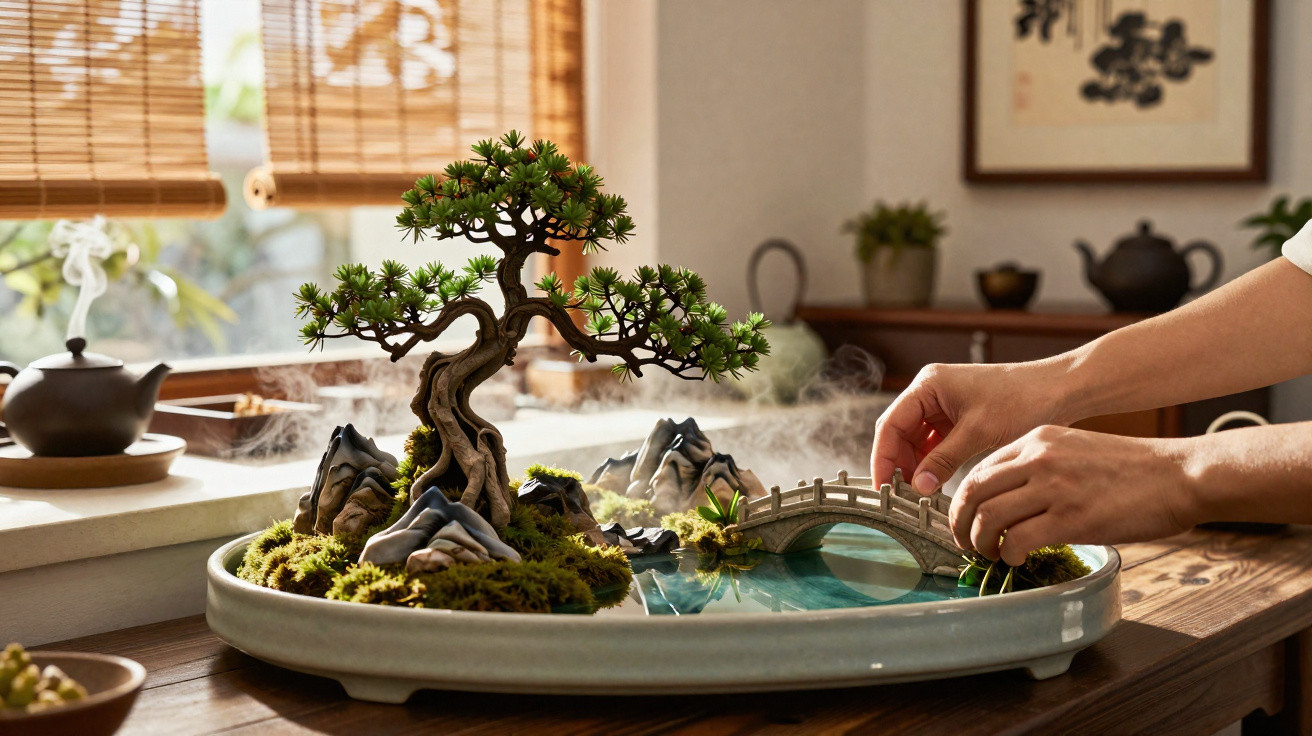
Penjing, the millennia-old art of recreating entire landscapes in miniature, is regarded as the origin of many bonsai traditions – yet it differs from them in important ways. Anyone who thinks only of strictly pruned bonsai trees misses its real magic: Penjing tells stories, creates tiny worlds and aims to stir emotions rather than simply display plants.
What Penjing really is – and why it is more than bonsai lite
The literal meaning of Penjing is “landscape in a pot”. Artists use it to compose living scenes featuring trees, shrubs, rocks, water, tiny houses or figurines. Together, these components form an image reminiscent of real mountain ranges, river valleys or fairytale settings.
At its heart, Penjing seeks to reveal the principles of nature within a tiny fragment – like a living painting.
Unlike many bonsai arrangements, Penjing often appears wilder, more open and occasionally almost dreamlike. Bonsai commonly concentrates on one tree and shapes it with great precision, whereas Penjing considers the whole scene. A horse on a path, a cottage on a steep slope or a bridge spanning a stream are recurring details.
Many compositions are deliberately imperfect: a leaning trunk, a rock that appears too large, or a tree growing “against all the rules”. This is precisely what creates the sense of real nature, which cannot be controlled completely.
A brief history: from Daoists to home gardeners
Penjing’s origins reach back to the 1st century AD, and perhaps even earlier. Daoist scholars wanted to bring the power of vast landscapes into a small vessel. Those without access to distant mountains and temples created their own reduced version instead.
Ancient stories tell of “magical” landscapes that a sage could shrink to the size of a bowl. Buddhist monks later brought the concept to Japan, where the bonsai tradition developed over many centuries. In China, meanwhile, Penjing continued to evolve alongside it, while retaining its own distinct character.
To this day, masters of the craft are highly respected artists. Many train for a decade or longer in botanical gardens or under traditional masters before creating their own major works.
The key Penjing styles at a glance
China is vast, and that diversity is reflected in its miniature landscape styles. Regional schools such as Lingnan, Taiwan, Shanghai and Yangzhou each bring their own emphasis. Specialists recognise three fundamental categories to which most works can be traced.
Shumu: the “forest in a pot”
In the Shumu style, trees take centre stage. They are grown in a bowl or shallow container, often in groups and sometimes as a single specimen on a rock. Artists shape them through pruning, wiring and patient development over many years.
- Attention centres on the trunk, canopy and branch structure
- The form closely recalls familiar bonsai styles
- The ground layer – soil, moss and small stones – supports the tree’s form without dominating it
Anyone with bonsai experience will recognise many techniques here. Even so, the overall image remains crucial: the tree should be more than merely “beautiful”; it should suggest a story, such as survival through a storm or the age of an ancient forest giant.
Shanshui: mountains and water in the leading role
Shanshui Penjing are closer to miniature landscapes than miniature trees. Carefully selected stones are placed in a shallow bowl, often surrounded by water. Small plants grow from crevices or along the “shore”.
Shanshui is reminiscent of traditional Chinese landscape painting – only three-dimensional and alive.
Choosing the right stone often determines the entire piece: its shape, texture, colour and veining need to work together. One rock can represent a whole mountain range, while a groove in its surface becomes a gorge. Areas of water reflect light and introduce movement.
Shuihan: where every element comes together
Shuihan Penjing combine the two preceding styles. Trees, rocks, water, figures and sometimes miniature houses create a complex scene that is often strongly narrative. The result resembles a diorama, except that everything is alive and growing.
Typical elements include:
- a rock with a sparsely growing tree
- a stream or small pond
- miniature human or animal figures
- structures such as pagodas, bridges or cottages
These arrangements often feel like frozen film sets. Anyone standing in front of one naturally begins to imagine stories: Who lives in the cottage? Where does the path lead? Why is the lone traveller standing at the mountainside?
Penjing in transition: living art rather than fixed rules
As it uses living material, every Penjing changes continuously. Branches grow, moss spreads and water evaporates. Many artists therefore see their work not as “finished”, but as a process they accompany over many years.
Over recent decades, the variety has expanded dramatically. Chinese Penjing artist Zhao Qingquan describes how contemporary creators are experimenting far more boldly: with unusual plant species, abstract forms and scenes that are almost surreal. Its central idea remains unchanged – drawing great emotions from small things.
How to try Penjing at home
If you are now thinking of years of master-level training, you are only partly right. Creating a top work certainly requires enormous experience. For a first attempt of your own, however, curiosity, patience and a few basic rules are enough.
The essentials: container, light and climate
Start with a shallow container with drainage holes. It should be wide enough to build a small scene, yet deep enough to give roots room. The following also matter:
- a bright position, ideally without harsh direct midday sun
- steady, fairly mild temperatures; many Penjing suit bright indoor spaces or sheltered balconies well
- a growing medium that retains water without becoming waterlogged
If you are unsure, choose plants that are well established in bonsai cultivation: small Ficus species, Chinese elm or certain conifers. Mosses and small ground-cover plants work well alongside them.
The concept: choose the scene before the plant
One practical tip is to decide on the story first, then select the plants. Would you like to recreate a mountain range, a riverbank or a stark rocky landscape with a solitary tree?
| Motif | Possible elements |
|---|---|
| Mountain landscape | tall rocks, small conifers, little moss, a single figure on the slope |
| River valley | a broad water surface, a winding “bank path”, several small trees, a bridge |
| Idyllic village | small houses, flat stones as a path, deciduous trees, animal figures such as cows or horses |
Once the scene is clear in your mind, you can search specifically at a garden centre or online for suitable plants, stones and miniatures. Many shops now have dedicated bonsai or miniature sections offering appropriate varieties and accessories.
Patience instead of perfection
Beginners in particular tend to do too much at once: pruning too severely, cramming too many elements into one bowl or constantly redesigning the arrangement. A better approach is to proceed gradually, observe how the plants respond and make corrections only where needed.
Penjing rewards a blend of persistence and calmness – anyone who keeps correcting everything robs the miniature garden of its tranquillity.
One small but effective technique is to photograph your arrangement regularly. Uneven angles, gaps and visual clutter often become apparent more quickly in photographs than in everyday viewing.
What makes Penjing so compelling – and what to keep in mind
Many people who begin Penjing continue with it because they discover how meditative its care can be. You focus on tiny details, set aside your phone and stress for half an hour, and watch a scene change over the months. For children, it can offer an engaging introduction to plant knowledge and design.
The hobby is not entirely risk-free: poor care can quickly cause problems. Waterlogging makes roots rot, excessive direct sun scorches leaves, and unsuitable figures can look cheap and throw the whole scene off balance. Those who start small and progress step by step generally learn to recognise – and avoid – such pitfalls quite quickly.
Combinations with other hobbies are particularly interesting: model-making enthusiasts can apply their knowledge of miniature figures and buildings, keen aquarists can use their feel for water and rock compositions, and photography fans can stage a Penjing landscape as a project in its own right.
Ultimately, this art form thrives on every bowl remaining a personal statement. Some people recreate a place from childhood, while others make fantasy landscapes or draw on classic mountain motifs. Whether on a windowsill, balcony or in a conservatory, Penjing brings a piece of grand landscape into miniature – and sharpens the eye for the real natural world outside considerably.






Comments
No comments yet. Be the first to comment!
Leave a Comment