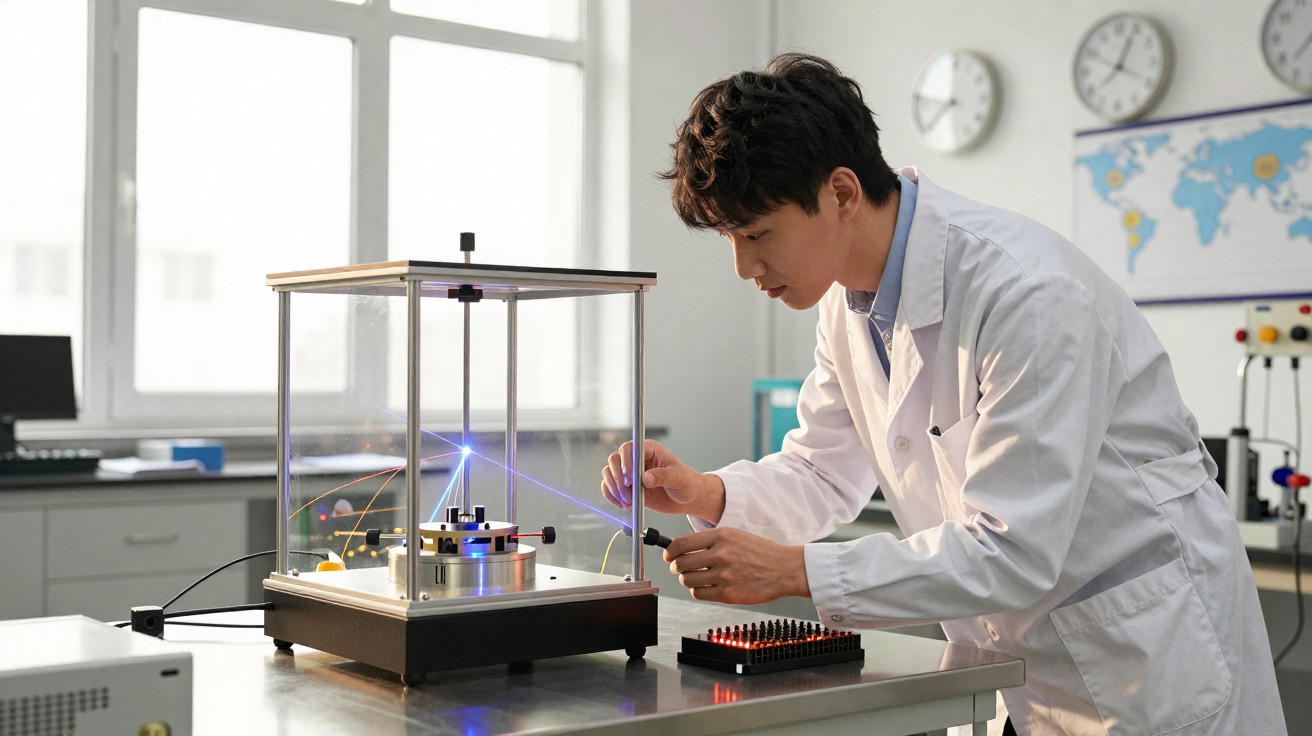
Researchers in China have developed one of the most accurate clocks ever built – one so exact that it may soon help scientists formally redefine the second.
Strontium optical lattice clock reaches new accuracy
Called a strontium optical lattice clock, the sophisticated device can track seconds to 19 decimal places. If it were allowed to run for 30 billion years – more than double the Universe's present age – it would gain or lose only around one second.
Such precision, unattainable until recently, represents an important advance towards revising the official definition of the second within roughly the next decade.
Several conditions must be fulfilled first. In particular, at least three optical clocks using the same kind of ‘tick’, and meeting specified standards for precision and stability, must operate at separate institutions.
The new optical clock satisfies those requirements for precision and stability. Beyond improving timekeeping, it could assist researchers in the hunt for dark matter and in measuring variations in Earth's gravitational field.
From Earth's rotation to atomic timekeeping
Originally, a second was defined as a portion of a day: specifically, one 86,400th. This results from dividing 24 hours into 60 minutes apiece, then splitting every minute into 60 seconds.
While suitable as a broad reference, that definition is inadequate for scientific and industrial uses. A ‘day’ is not a fixed measurement, since Earth's rotational speed changes for numerous reasons. If the second still depended on a fraction of a day, its length would therefore vary too.
Atomic clocks made it possible to define the second independently through constant features of nature. Since 1967, the International System of Units (SI) has defined one second as exactly 9,192,631,770 oscillations of the caesium-133 atom.
That standard is extremely precise, although it can be improved upon. Atoms such as strontium oscillate at frequencies of visible light, generating about 700 quadrillion ‘ticks’ each second, rather than caesium's 9 billion. Optical clocks can count these ticks, achieving a precision of 10^-18 seconds.
USTC optical clock and a future SI second
In the new study, scientists at the University of Science and Technology of China (USTC) outlined improvements to the institution's strontium optical clock. The upgrades lowered its uncertainty to 9.2 x 10^-19 and its stability to 6.3 x 10^-19.
"This performance meets the 2 x 10^-18 single-clock accuracy requirement for redefining the SI second, with potential applications in relativistic geodesy and high-resolution dark matter searches," the researchers write in a new paper describing the work.
According to the team, two other strontium optical clocks have already reached this benchmark, alongside two clocks that keep time with aluminium ions. As additional ultra-precise clocks are brought into service, the requirements for an official redefinition of the second could soon be fulfilled.
The General Conference on Weights and Measures (CGPM), convened once every four years, makes decisions of this kind. Its next meeting is due in October this year, but progress towards the required criteria has not been sufficient for a redefinition decision to be made then.
Instead, the committee has been requested to "work towards a proposal for the new definition of the second to be presented at the 29th meeting of the CGPM (2030) and a proposal for the date of its implementation."
Research into USTC's optical clock has appeared in the journal Metrologia.
















Comments
No comments yet. Be the first to comment!
Leave a Comment