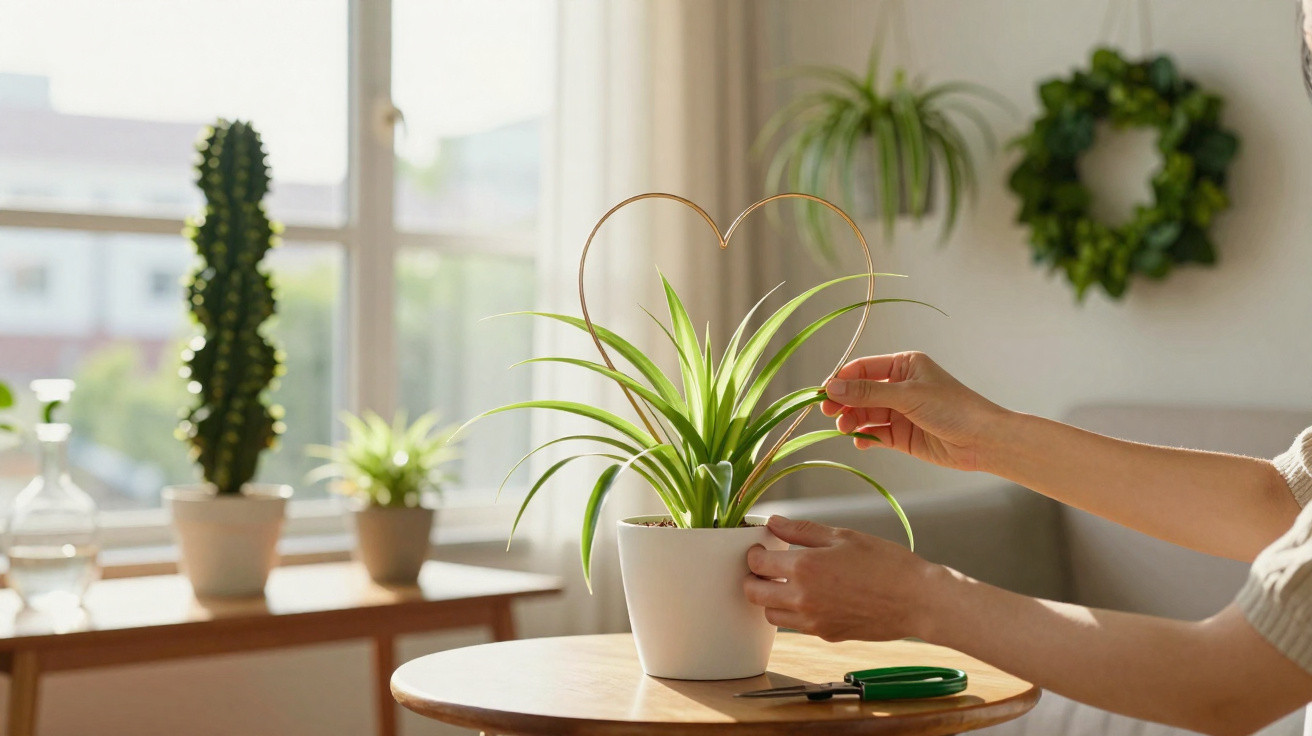
That ordinary green plant drooping over your sideboard may have an unexpected gift: it can create genuinely dramatic visual impact.
Throughout Europe and the US, a modest houseplant is quietly taking centre stage in style-conscious homes. The spider plant, once valued chiefly as an easy-care air-purifying plant, is now being trained into hearts, crowns and upright columns that resemble contemporary artwork far more than a traditional macramé basket.
From overlooked pot plant to living artwork
Native to South Africa, the spider plant (Chlorophytum comosum) is generally chosen for three key reasons: it is inexpensive, tolerant of neglect and pet-safe. Its striped, arching leaves cascade over the edge of its pot before producing long, slender stems with miniature rosettes known as “spiderettes”.
These hanging young plants are not merely decorative. For anyone prepared to direct them, they can act as a pliable construction material.
By gently training the stems, an everyday spider plant can become a structured, graphic feature that reshapes an entire room.
Handled gradually, the stems curve without breaking, making them well suited to decorative forms. Rather than letting foliage spread across a tabletop or trail into a hallway, owners are beginning to guide it up and around supports, gathering the greenery into bold circular or vertical displays.
Treating the spider plant as sculpture rather than background greenery
The essential change in approach is straightforward: do not see a spider plant as filler foliage. Think of it instead as a living sculpture that happens to grow and require water.
Designers and plant enthusiasts use light support frames to give those wandering stems a defined silhouette. Aluminium craft wire is a common option: it is sturdy enough to retain a shape, flexible enough to bend by hand and will not rust in damp compost.
A plain metal frame shaped into a circle, hoop or heart becomes the skeleton; the spider plant drapes itself over it like a costume.
As soon as the support is fitted, the plant takes on a far less informal appearance. A green ring can become the focal point of a dining table, while a narrow column of plaited stems can look almost architectural beside a sofa or bookcase.
Shaping spider plant hearts, rings and braids
Before bending or weaving stems, take time to assess the plant. The strongest and longest stems, especially those carrying several spiderettes, are the best ones to train. Shorter or weaker stems should be left to recover and develop naturally.
- Select 3–6 strong stems carrying several baby plants.
- Gently lay them along the desired form: a circle, heart or upright column.
- Fasten them using soft ties, such as raffia, foam-covered twist ties or fabric strips.
- Remove excess spiderettes to pot up separately or to make the original clump fuller at its base.
For heart or circular forms, wrap the stems around the metal support without drawing them tight. Contact is the goal, not pressure. Over a period of weeks, the spiderettes grow larger, covering spaces and sharpening the shape’s outline.
Another method uses braiding instead of frames. Gather several lengthy stems, plait them together, secure them at intervals and support them with a simple wooden stake inserted into the pot. The result resembles a topiary pillar or totem rather than a loose, cascading houseplant.
A braided “totem” of spider plant stems can lift greenery up to eye level in tight spaces where floor area is scarce.
The best places for spider plant sculptures at home
Once trained, these living forms function as centrepieces or compact installations, so positioning becomes part of the overall design.
A dense, leafy hoop is particularly effective in the middle of a table, where its green circle can surround plates and glasses without obscuring people’s faces. Spiderettes may trail slightly beyond the pot’s rim, softening the form without allowing it to become tangled again.
Heart-shaped supports are suited to occasional displays: on a hallway console, a guest-room bedside table or a sideboard during a celebration. Placed against an unadorned wall, the shape is immediately recognisable, even to visitors who would normally overlook the plant.
Braided columns and smaller versions fit neatly into slim areas that are often left bare, including beside a TV unit, at the end of a bookcase or next to an armchair. Height is important in these settings. A taller floor-standing column gives a corner presence, whereas a shorter design on a bedside table introduces greenery without taking up valuable surface space.
| Shape | Best location | Visual effect |
|---|---|---|
| Circular crown | Dining table, coffee table | Soft focus point, 360° view |
| Heart frame | Hall console, bedroom shelf | Graphic, romantic accent |
| Braided column | Room corner, by a chair or TV unit | Vertical line, adds height |
Keeping a sculpted spider plant in good health
Following all that bending, the plant benefits from some care in return. Gentle feeding can help it recover and become fuller. During spring and summer, many growers add a basic liquid fertiliser with a balanced NPK ratio to the watering can every few weeks, diluting it first.
Good light, modest feeding and gentle handling matter more for long-term success than perfectly executed braids or frames.
Spider plants favour bright but indirect light. On a shaded windowsill, or set a short distance back from a sunny window, their variegation is normally more defined and their stems grow long enough for training. Strong direct sunlight can scorch the leaves’ white stripes, reducing the sculpture’s visual appeal.
The plant can be kept outdoors in mild conditions, although it does not tolerate cold weather. In the US, gardeners in zones 10 and 11 sometimes move sculpted spider plants outside in warmer months, provided temperatures remain above approximately 13°C (55°F). A sheltered, shaded patio or balcony offers additional light while protecting the plant from the midday sun.
What plant “training” actually does
For beginners, bending live stems may seem a little harsh. From a botanical perspective, however, it is less severe than it appears. Spider plant stems are naturally flexible runners, intended to fall and root wherever they meet soil. Training simply prevents that downward growth and provides a structure against which they can rest.
Every curve produces small internal stresses, which the plant repairs as it continues growing. In time, the tissues become thicker at the bends, helping the structure remain in place even after some ties have been taken away. Quick or severe bends can nevertheless cause splits and disease, so it is safer to make gradual movements and minor adjustments.
Risks, mistakes and how to prevent them
There are several potential problems. Tying stems too tightly to a frame can constrict them, restricting water movement and causing brown leaf tips. Fine metal wire placed directly against the plant may cut into the tissue as it grows, creating scars and increasing the risk of rot.
Soft ties that can be adjusted are much gentler. Household items, including strips cut from an old T-shirt or lengths of yarn, are also suitable, provided they are inspected and loosened occasionally. If a stem does break, the main plant will usually survive, and the damaged section can be rooted in water or compost to create a new plant.
Beginning with a weak or poorly nourished plant is another frequent error. Shaping requires energy, and a spider plant that looks pale, produces few spiderettes or sits in depleted compost is likely to struggle. Repotting it in fresh compost, then giving it a month of attentive care before training, produces far better outcomes.
Creative variations and ways to take the idea further
After mastering a simple heart, hoop or column, gardeners can expand the technique in scale and scope. A number of spider plant pots can be joined around one large ring to make a green halo for a sideboard. Small hoops may also be displayed at varying heights on a shelf, repeating the same motif.
There is scope for experiments with other plants too. A spider plant column can share its pot with a compact trailing plant, such as string of hearts or small ivy, as long as both species require comparable light and watering conditions. The spider plant supplies the framework, while its companion fills spaces with contrasting foliage or colour.
For tenants or those living in compact flats, these living sculptures provide something that houseplants do not often offer: a bespoke design effect without making a single hole in the wall. With a wire frame and a patient hand, an inexpensive supermarket spider plant becomes a feature guests will ask about-and, importantly, one that still copes when life becomes busy again.






Comments
No comments yet. Be the first to comment!
Leave a Comment