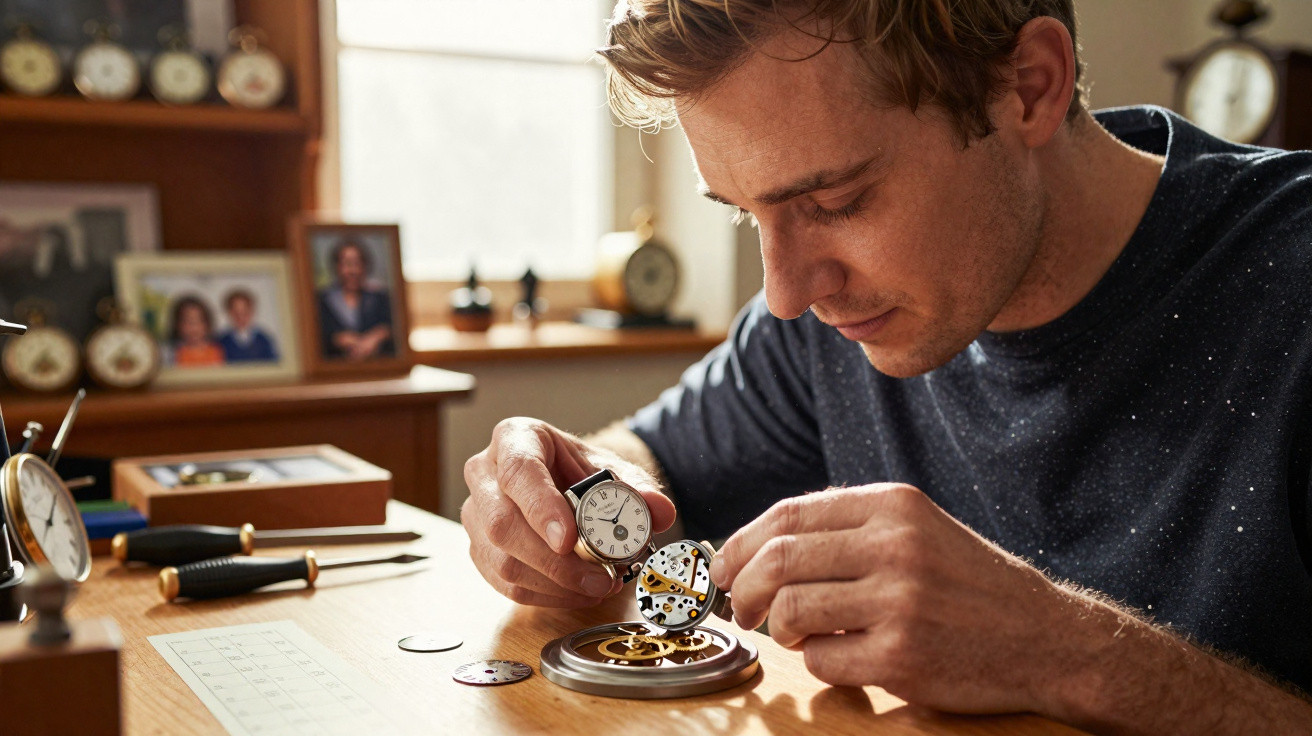
On a dreary Tuesday in Somerset, I met a man who had fixed a small but persistent worry I had never known I possessed.
You know it: late February arrives, the diary suddenly feels like a trapdoor, and everybody asks, “Is it 28 or 29 this year?” Naturally, our phones know the answer, but a mechanical clock on the mantelpiece can be merciless. It faithfully marks birthdays and bills, only to stumble on 30 April like an obstinate mule. In a cosy workshop scented lightly with tea and metal filings, a clockmaker showed me a brass-and-steel solution that remembers what most of us do not. He has made a timepiece that recognises leap years and adjusts itself overnight: no anxiety, no manual correction, no “Oops, I’m a day off.” The remarkable part is that he did not programme it. He gave it a memory.
The man who teaches machines to remember February
John Armitage is a quietly spoken clockmaker with ash-dark eyelashes and a gift for understatement. His workshop sits behind a florist, hidden off a market street where buses hiss past and teenagers clatter through in damp trainers. The room is warm, and its benches hold a gentle disorder of lathes, tweezers, oilers and old jam jars packed with screws. A kettle clicks as a slender curl of steam joins the brass-dust scent. John moves a clock case towards me with both hands, as carefully as if he were carrying an infant.
Raised in Sheffield, he still has an even northern lilt in his voice. A small scar marks his index finger, left by a mainspring that once sprang free and bit him. “Best lesson I ever paid for,” he jokes. Everyone has experienced the embarrassment of a clock or watch letting them down; John’s came when a customer called to report an incorrect date on 1 March. That was the day he resolved to create something that would not require an apology.
The quiet drama inside a dial
When he removes the rear of the case, the room appears to fall silent. The familiar ensemble is there: the escape wheel flicking, the balance wheel breathing and the lever ticking like a metronome in a school hall. Yet beneath the components that measure time, another world turns slowly, like a city beneath a city. There are rings and cams, miniature fingers tipped with sapphire, and springs shaped like smiles. Their job is not to show the time, but to make the months obey their rules.
John calls this system the calendar train. Its 31-tooth date ring carries one number for each day. At midnight, a lever advances it with a gentle push, almost palpable in your throat when the room is quiet enough. Without intervention, it would move relentlessly from 1 to 31 each month, ignorant of humanity’s inconvenient 30-day and 28-day months. The answer lies in a collection of memory components that determine when days must be skipped.
The 48-month memory wheel
Beneath the date ring sits a wheel that completes one turn every four years. Its 48 months are represented not by figures, but by varying depths. Every month forms a step around its rim: a deep one for February, a shallower one for the 30-day months, and full height for months with 31 days. A steel feeler rests against this edge, reading it as a fingertip might trace a book spine. When it detects a shorter month, it allows the lever to advance the date ring twice or three times instead of once, clearing the surplus dates in one midnight movement.
February requires special treatment. In most years, the feeler descends to the deepest point of its step and the mechanism moves directly from 28 to 1. Every fourth February, however, the wheel presents a marginally taller step, just high enough to permit the 29th. The distinction is no wider than a breath, and a single overly confident pass with a file could destroy it. John holds up two components that look virtually identical to me. He smiles with the restrained satisfaction of a craftsperson whose magic is not yet visible to their visitor.
Then there is the inconvenient reality of the calendar’s centuries. Years divisible by 100 are not leap years, unless they are also divisible by 400. Most clockmakers simply accept this and ask the owner to correct the date manually in 2100. John felt that a shrug was insufficient. He installed a slowly turning “century cam”, geared down so dramatically that a full revolution takes four centuries. Its single additional notch removes 29 February once every hundred years, then restores it every fourth century. It is an eccentric little moon, moving so slowly that the thought catches in the mind, while still ticking towards a day neither of us will ever see.
From brass to inevitability
The project began on graph paper. He sketched wheels in pencil, sketched them again, and woke at 3 a.m. to alter a tooth count on a Post-it note. His dog, Molly, became accustomed to the sound of the mainspring winder in the evenings. Soon the workshop floor was strewn with tiny yellow curls of brass, like confetti that had been spilled. He would hold the 48-month wheel against the light, checking every step through a loupe to ensure it had exactly the right depth.
Its tolerances are more human than digital. A feeler pressing too firmly creates friction and gradually wears away the cam; one pressing too lightly may fail to trigger the skip every time. John shows me a spring he produced thirteen times before achieving a strength that was just short of temperamental. He breathes on a jewel, misting it faintly, and then cleans it with a soft square of leather as though soothing a nervous horse. The mechanism is not so much fragile as exacting, demanding patience from the person making it.
The midnight choreography
Ten minutes before midnight, the carriage starts to rise. This is John’s description: the lever collects energy from the hour wheel, as though drawing back a bow. The date wheel braces itself against its jumper spring, secure and prepared. At midnight, the locking finger retreats and everything shifts: one clean click that reaches your ears, followed by another you feel as the case firms in your hand. In shorter months, it clicks twice, and sometimes three times, making a small concealed drumroll behind the dial.
He has included safeguards to prevent damage if the time is adjusted near midnight. For a brief part of the day, the quickset is disabled, stopping anyone from forcing the system while it is active. He indicates a brass beak that stops two fingers from attempting to drive the date at the same time: a peacemaker. Anyone who has felt the grinding resistance of a cheap watch during a date adjustment will recognise the problem he has designed out. Midnight should be a waltz rather than a wrestling bout.
Why we crave this kind of accuracy
All this effort for a single day every four years, you might ask. Perhaps its appeal is the quiet reassurance that something is taking care of you while you sleep. We are surrounded by devices that ping and nag, whereas mechanical memory feels gentler. It offers relief without making a sound. Let us be honest: nobody really manages this every day.
We rely on our phones, but a phone has no soul and will not remain on a mantelpiece after we are gone. A clock that honours February feels rather like discovering that somebody remembered to leave the light on. It promises that a month’s awkward irregularity will not put your life out of step. A good clock is a promise kept. When John says his calendar will remain correct until the year 2400, the resulting silence feels part mathematics and part myth.
The day the leap didn’t land
John recounts an episode from 2015, the year before the following leap year. He had nearly completed the first version: a compact table clock in a walnut case with a faint scent of old books. He set it going in September, left it humming on the bench, wound it each day and recorded small observations in a pencil log. On 29 February 2016, it leapt like a gymnast and stuck the landing.
Yet that November, as the date changed from the 30th to the 1st, it advanced by only one tooth when it should have moved two. It was a minor and unusual failure, but still a failure. He identified minute wear in the jumper spring, microscopic wear of the kind that would be irrelevant if people had not made months so much like trick questions. He replaced the spring steel, polished the cam edge and redesigned the feeler so that it rolled instead of sliding. The following cycle was so clean that confidence itself seemed audible in the click.
What it takes to encode a century
The 400-year cam is a kind of romantic madness. John shows me the gear train behind it, each stage reducing speed like whispers travelling along a church pew. The final arbor turns so slowly that he made a faint black-ink mark on it simply to observe movement over several weeks. A single notch instructs the calendar to reject 29 February in 2100, 2200 and 2300, before allowing it again in 2400. For a sense of scale, imagine watching a wheel spend a month moving one millimetre.
He is pragmatic about the audacity of it. “Someone will service it,” he says, “and someone else will swear at my choices.” Beneath the base plate, he leaves written notes for future hands, explaining where oil should be applied and where it should be left alone. Every clock also comes with a hand-drawn chart, a small folded guide to the coming years. The clock does not need it, but owners seem to enjoy checking the machine’s memory against their own. Leap years are not mistakes; they’re the Earth’s confession that life is messy.
Hands and hearts
I ask who would buy such an object. It is not only collectors, he explains. There is a midwife in Leeds who wanted a clock to mark the peculiar elastic time of night shifts. A retired maths teacher wanted to demonstrate to grandchildren that machines can retain rules better than people. One couple married on 29 February and wanted their anniversary to be acknowledged. Such stories make the workshop seem warmer.
We have all known the moment when a small piece of mechanical consideration resolves a larger irritation. It is the satisfying snick of a door latch catching, or the silence when a tap stops dripping after its washer has been replaced. A clock that does not require your hand on the crown on 1 March offers that same feeling: somebody, somewhere, cared enough to remove a minor nuisance. It is only one day, yet it is also a promise that your days will proceed in a gently ordered way.
Why bother when a chip could do it?
John laughs at the question. He owns quartz clocks and carries a phone, just like everyone else. He does not claim his work is essential in the way that a kettle or fuse box is essential. It belongs to another class of usefulness: useful as a window or as music. You can live without it, but it makes life easier to love.
There is also a quiet satisfaction in mastering a rule without relying on electricity. Brass and steel can be shaped until a machine understands February’s secret by touch alone. He says he once explained the 48-month cam to a room of twelve-year-olds using biscuit tins and cardboard. They understood immediately. You could see the idea settle: memory can be encoded in form rather than software. Memory pressed into metal remains memory.
Listening for the leap
During my final visit, he set the clock to the evening of 28 February in a leap year, and we waited over mugs of tea like travellers in a railway station. The workshop grew quiet while the town outside continued making its ordinary sounds. Somewhere, a bus sighed and a gull complained. Inside, the second hand continued its neat circuit, and at midnight came one click, then another. The 29th slipped into the little window so perfectly that I nearly believed in magic.
John appeared pleased, but entirely unsurprised. It is his preferred party trick, although he would never use that expression. The clock simply did what it was designed to do: it recalled a rule that we often overlook and followed it without protest. This is a perpetual calendar in a small British workshop. The romance lies not in the leap, but in the certainty.
The small future on your mantel
As I left, rain threaded across the street while the florist swept petals into a dustpan. I could not stop thinking about that slow century cam, labouring towards a day long after our names have vanished from living memory. Designing for such a distant horizon is audacious, almost cheeky. But it also contains humility. You build something to behave properly for as far ahead as you can see, and then trust it beyond the turn.
John’s clocks will not sound the headlines. They will not request updates or dim themselves to conserve energy. They will rest on a shelf and tick, making a discreet extra skip at midnight on the final day of the appropriate months, keeping your plans in order. They will save your future self one tiny annoyance. And if you stand close enough to listen, you may hear it: a machine that was taught, once, to remember February, and never forgot.

















Comments
No comments yet. Be the first to comment!
Leave a Comment