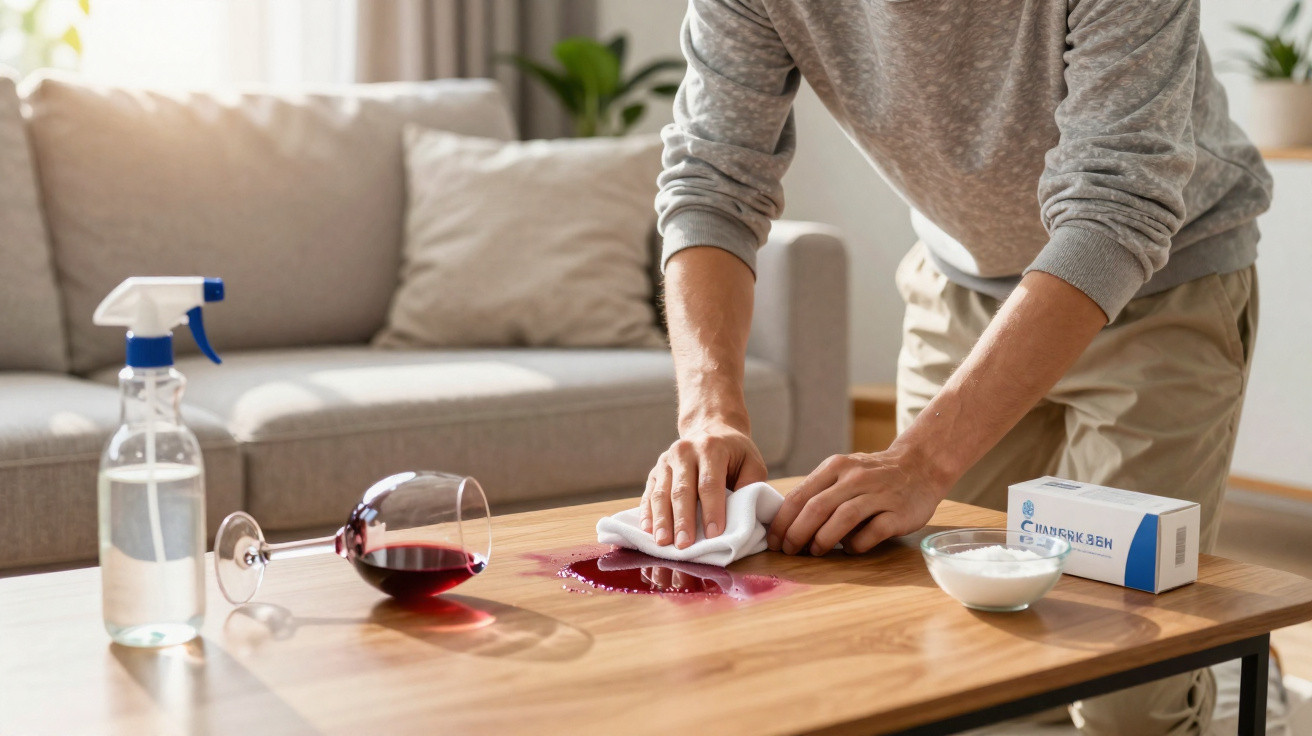
The glass tilts, time seems to slow, and a deep ruby splash flies through the air.
You see it hit the pale upholstery of your sofa in apparent slow motion, bursting into tiny, star-like droplets.
Everyone nearby gasps; one person reaches for a pile of kitchen roll, someone else blames the coffee table, and you get that awful surge of “why tonight, of all nights?”.
You blot, panic and search online.
The mark lifts slightly… then dries into a faint pink halo that looks worse than the original spill.
That circle is the real problem.
Once you notice it, it is impossible to ignore.
Why red wine creates that unsightly ring on a light sofa
Your instinct is usually identical: grab something absorbent and go after the spill as though it has personally offended you.
You press, scrub and twist the material, hoping it will vanish as fast as it arrived.
On a pale sofa, the wine appears to soak in deeply and stubbornly, while the surrounding upholstery begins to look… different.
That is the moment the future ring starts to form.
The harder you attack only the middle of the spill, the greater the contrast becomes with the rest of the cushion.
The stain shifts, fades and spreads.
Once dry, it leaves a pale, bleached-looking halo that clearly says “someone panicked here”.
Imagine a beige linen sofa at a birthday meal, with candles all around.
A friend sits down a little too quickly, knocks the glass with their elbow, and suddenly a Bordeaux-shaped map appears across the cushion.
You react as everyone does in that moment.
You reach for kitchen roll, rub in tight circles, add washing-up liquid mixed with hot water, and continue rubbing as if giving a terrible massage.
The wine becomes lighter… but so does the fabric.
The following morning, the middle of the stain is almost gone, yet a pale circular patch, a little wider than your hand, surrounds it.
The material in that spot feels slightly rougher, almost abraded.
The stain may be “gone”, but that ring catches your attention whenever you walk into the room.
That pale circle is essentially evidence of uneven cleaning.
You dealt with one small damp patch rather than considering the cushion as a whole, and the upholstery remembers.
When just one section of upholstery is washed and rinsed, it can appear brighter than the surrounding material, however thoroughly you rinsed it.
Soap, heat and scrubbing can also affect fibres differently, altering the way they reflect light.
You are then left with three areas: the place where the wine landed, the part you cleaned, and the section you left alone.
Your eye notices the boundary between them, and that is precisely what appears as a ring.
The key is not simply removing the red wine; it is preventing that edge from forming at all.
The step-by-step method for removing the stain without a ring
First, stop for three seconds.
Only three.
Next, carefully blot the spill using a clean, light-coloured cloth or kitchen roll, moving from the outer edge towards the centre.
Do not rub or work in circles.
Your aim is to draw wine out of the upholstery, not force it further in.
Then combine cool water and a tiny drop of mild washing-up liquid in a bowl.
Dip a second clean cloth into the mixture, wring it out thoroughly, and dab both the stained section and a wide border around it.
Think of it as treating “one small area”, rather than targeting “one tiny spot”.
This is the point where most people make a mistake: they concentrate entirely on the most obvious red mark.
They vigorously scrub that little area, overlook the rest of the cushion, and then wonder why the outline of the cleaned patch remains visible.
Treat the upholstery gently.
Use cool or barely lukewarm water rather than hot water, particularly on natural materials such as linen or cotton.
Heat can set the pigment and lock in the very mark you are trying to remove.
After most of the wine has lifted, use another cloth dampened with plain cool water to “rinse” both the stain and a broad, gradual area around it.
You are merging the cleaned section into the untouched fabric, so there is no abrupt change for the eye to detect.
Now for the crucial step that prevents a clean stain becoming a faded-ring disaster.
Cleaning professionals have a simple rule: “You never treat a stain, you treat an area.”
That means you always extend your work a bit beyond what you see, so the fabric dries in a uniform way.
To support this, gently pat the whole surface of the cushion with a dry towel once you have rinsed the area.
Allow it to dry naturally in the air, away from direct heat and strong sunlight.
- Always blot, never rub - rubbing can distort fibres and spread pigment sideways.
- Use cool water with a tiny amount of mild soap - excessive foam leaves residue that may mark the upholstery.
- Clean a wider area rather than a single spot - this avoids the sharp edge your eye interprets as a ring.
- Finish by dabbing with clear water and drying gently - no hairdryers, radiators or aggressive scrubbing.
Living with a light sofa in a red wine world
Having a pale sofa in a home where people genuinely live, drink and laugh requires a certain amount of faith.
You know spills are inevitable eventually, and no protective spray can remove real life.
The aim is not to own a museum exhibit; it is to have a sofa where friends can relax with a glass in hand without you anxiously watching from the doorway.
Honestly, no one follows this routine perfectly every time.
You will not always have stain remover ready, and your response will not invariably be textbook-perfect, which is fine.
What makes the real difference is keeping this straightforward approach in mind.
Blot, treat a wider section, rinse gently, and allow it to dry without heat.
It transforms a small panic into a manageable task.
| Key point | Detail | Value for the reader |
|---|---|---|
| Blot, don’t rub | Move from the outside edge towards the centre with a clean cloth | Restricts the stain’s spread and prevents fibre damage |
| Treat an area, not a dot | Clean and rinse a larger surrounding section evenly | Avoids the dreaded faded ring after the fabric dries |
| Cool water and gentle drying | Use mild soap with cool water and air-dry away from heat | Prevents pigments setting and helps maintain an even fabric colour |
FAQ:
- Question 1 Can I use white wine to neutralise red wine on my sofa? Short answer: you can, but it is not the miracle solution people suggest. White wine dilutes the red wine and keeps it wet for longer, but you still need to blot properly and clean with soapy water afterwards.
- Question 2 Is sparkling water genuinely effective on fresh red wine stains? Yes, provided you use it quickly. The bubbles can help lift pigment, but repeated blotting and cleaning a wider area prevent the ring; the fizz alone does not.
- Question 3 What if I only notice the stain once it has dried? Lightly dampen the area with cool water, then use the same step-by-step method while extending the area you clean. It may need a couple of attempts, but you can still lessen or remove both the stain and the ring.
- Question 4 Can I use bleach on a light fabric sofa? For most upholstery: no. Bleach frequently discolours fibres unevenly, which almost guarantees rings or pale patches that are more difficult to disguise than the original red wine.
- Question 5 When should I contact a professional cleaner? If the sofa is costly, made from delicate material such as silk or pure linen, or has a large, old stain, hiring a professional is worthwhile. They have products designed to clean the whole cushion evenly, which is the safest way to prevent halos.













Comments
No comments yet. Be the first to comment!
Leave a Comment