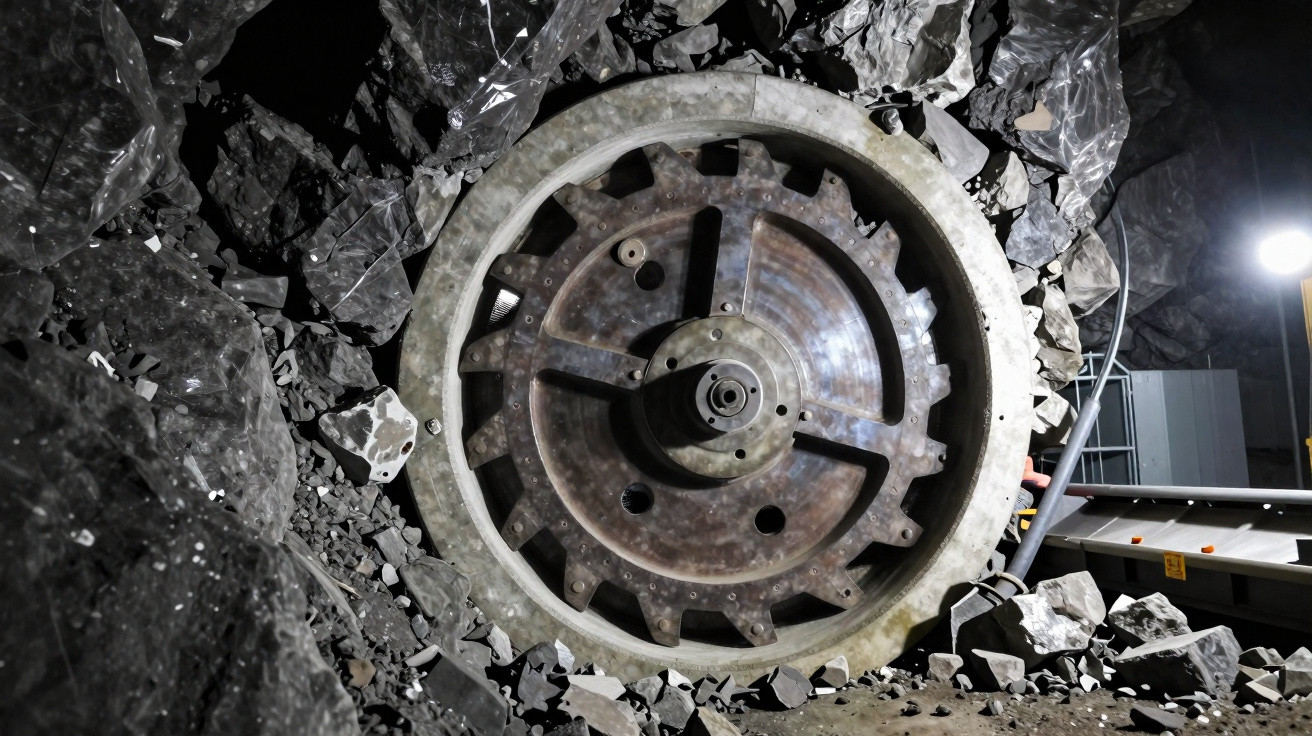
A tunnel boring machine (TBM) is often called a giant drill, but that description misses most of the work. A machine built for a long mountain tunnel does far more than cut rock: it has to remove the broken material, support the newly excavated ground and, in some designs, install the permanent tunnel lining as it moves forward.
That is the central idea behind using a TBM for a proposed Andes crossing such as Agua Negra between Argentina’s San Juan province and Chile’s Coquimbo region. The scheme remains dependent on planning, funding, approvals and detailed engineering, but a purpose-designed machine could provide a controlled, repeating excavation process if the ground conditions suit it.
What the proposed Agua Negra crossing involves
The Agua Negra project has been proposed as a road route through the Andes linking San Juan and Coquimbo. Plans have included two parallel road tunnels, each carrying traffic in one direction, over a route of roughly 14 kilometres.
A crossing on this scale is not simply a matter of making a hole through a mountain. Engineers would need to account for changing rock types, fractured ground, water inflows, fault zones, drainage, ventilation, emergency access and the practical challenges of working at high altitude.
The final excavation method would depend on detailed ground investigations. A TBM is not a standard machine that can simply be delivered to site unchanged: its cutterhead, shields, conveyors, power systems and lining arrangements are selected around the conditions expected underground.
The machine does not merely break rock. It has to manage the rock, the tunnel walls and the logistics of a moving underground worksite.
How the cutterhead breaks the rock
At the front of a TBM is the cutterhead: a wide rotating steel wheel matching the excavation diameter. It carries many cutting tools, commonly including disc cutters for hard rock.
These cutters do not work like the bit in a household drill. As the cutterhead turns, the discs press with great force against the tunnel face. The pressure causes chips and fragments of rock to crack away.
The machine then moves forward in short, controlled advances. Depending on the TBM type, it may be pushed by hydraulic cylinders braced against installed lining rings, or it may use grippers that bear against the tunnel walls.
Operators continuously monitor conditions, including:
- rock strength and abrasiveness;
- cutterhead torque, thrust and vibration;
- wear on the cutting tools;
- water entering the excavation;
- movement in the surrounding ground; and
- whether the machine remains on its planned alignment.
Hard, consistent rock can be well suited to a hard-rock TBM. Mountain geology is rarely consistent for an entire route, however. Broken, weak or water-bearing ground may require slower progress, extra support or a different machine configuration.
Removing spoil without stopping the job
Cutting the rock is only the first stage. The excavated material, often called muck or spoil, must be removed quickly enough to prevent it interrupting the next cutting cycle.
Material collected behind the cutterhead can be transferred onto an internal conveyor. A succession of belt conveyors may then carry it through the machine and along the completed tunnel towards the portal. There it can be stored, tested, processed or taken away in line with the project’s environmental and transport arrangements.
This is why a TBM is often compared with a moving factory. Behind its cutting head are conveyors, hydraulic systems, electrical equipment, ventilation ducting, control areas, stores and access routes for workers and replacement parts.
Spoil cannot automatically be treated as useful building material. Before it is reused as engineered fill or processed as aggregate, it would need to meet technical specifications and environmental requirements.
Installing the tunnel lining as the machine advances
A shielded TBM can place a permanent tunnel lining close behind the excavation face. This is especially useful where ground needs prompt support.
The lining is commonly formed from precast reinforced-concrete segments. Several curved pieces are assembled into one complete ring, making up the circular wall of the tunnel. The machine can then press against that new ring while it cuts the next section.
The repeating cycle
Excavate a short distance
The cutterhead rotates while the TBM advances through the rock.Carry away the muck
Broken rock is collected and moved rearwards on the conveyor system.Position the segment erector
When the planned advance is complete, a mechanical arm prepares the next lining ring.Place the concrete segments
The erector lifts and positions each segment precisely until the ring is complete.Fill the space behind the lining
Grout may be injected into the gap between the lining and excavated ground, depending on the tunnel design and ground conditions.Start the next advance
The TBM pushes from the installed ring and repeats the process.
This approach reduces the length of newly excavated ground left without permanent lining. It does not remove risk: the appropriate support method must always be determined by the conditions encountered underground.
Why two separate tunnels may be used
Two single-lane bores can separate opposing traffic, which can simplify day-to-day traffic management and reduce certain risks in the event of an incident.
Cross-passages linking the bores would normally form an important part of the emergency design, providing potential evacuation routes and access for responders. A completed road tunnel would also need carefully designed systems for lighting, communications, drainage, power, fire safety, traffic control and ventilation.
The two tunnels would not necessarily be excavated at the same rate or with identical methods. The programme would need to coordinate machine assembly, segment manufacture, spoil removal, workforce access and deliveries to remote mountain portals.
A TBM can only keep cutting when every system behind it - power, segments, conveyors, maintenance and crews - keeps pace.
Why an Andes tunnel is particularly demanding
The Andes present difficult conditions for any major underground project. High altitude can complicate transport, working arrangements and access to specialist equipment. The geology may vary sharply over relatively short distances.
A route could pass from strong, abrasive rock, which wears down cutters, into fractured ground needing additional support. Water inflows, temperature changes and seismic design requirements would also need to be considered from the earliest design stages.
Before selecting a TBM, engineers would use methods such as geological mapping, boreholes, geophysical surveys and laboratory tests on recovered rock. The results help determine the machine’s diameter, cutter type, shield arrangement, drive power, segment design and backup systems.
TBMs are normally manufactured in sections and delivered to site for assembly in a launch chamber or at a tunnel portal. Even a highly specialised machine requires regular inspection, repairs and replacement cutters throughout the drive.
Common mistakes when imagining a TBM project
It is easy to picture a TBM as an unstoppable mechanical worm. In reality, it is a closely monitored industrial system that can slow down or stop when conditions demand it.
Common misunderstandings include:
- Assuming it cuts at a constant speed. Advance rates change with rock quality, cutter wear, maintenance and lining work.
- Thinking it removes the need for underground workers. Surveyors, engineers, geologists, electricians, mechanics and tunnel crews remain essential.
- Treating every lining system as the same. Segment shape, reinforcement, sealing and waterproofing details depend on the project.
- Overlooking logistics. Large quantities of spoil, concrete segments, fuel or power equipment, tools and supplies must move through a confined site.
- Assuming a TBM is always best. Drill-and-blast excavation may be more appropriate for some ground conditions, cross-passages, caverns or irregular sections.
Safety, maintenance and environmental control
TBM tunnelling is high-risk work. Safe operation depends on trained crews, machinery guarding, clear exclusion zones, reliable communication, ventilation and rehearsed emergency procedures.
Workers need protection from moving machinery, high-voltage equipment, pressurised hydraulic systems, dust, noise and restricted spaces. Water inflows must be managed carefully, as uncontrolled water can affect stability, equipment and water quality beyond the worksite.
Cutter inspection and replacement can be particularly hazardous, especially near the tunnel face. These tasks require project-specific procedures and should only be undertaken by properly trained teams under controlled conditions.
What a successful tunnel drive would require
If the Agua Negra scheme goes ahead, the TBM would be only one part of the project. Its performance would rely on dependable power, geological monitoring, segment production, conveyor capacity, maintenance planning and a robust safety system.
The basic process is simple: cut the rock, transport it out, support the tunnel and repeat. Delivering that process reliably beneath the Andes is the real engineering challenge - and the reason a carefully specified tunnel boring machine could have such an important role.















Comments
No comments yet. Be the first to comment!
Leave a Comment