The rice is bubbling over on the hob.
Your phone is vibrating somewhere beneath a stack of post.
A single sock lies in the hallway, this morning’s mug sits beside the sink, and bags left in the entrance “just for now” have been there for three days.
You step through your own front door and, rather than breathing out, feel your shoulders tense another notch.
Nothing is truly awful, but somehow everything feels slightly too noisy.
You light a candle, scroll for a while and straighten a cushion.
Yet the tension remains.
Then, almost accidentally one day, you test a very small idea.
Sixty seconds. One particular habit.
And suddenly, the room feels changed.
The one-minute reset your home is begging for
The practice is almost absurdly straightforward: devote one focused minute to restoring a single small “landing zone” in your home.
Not the full sitting room, not the kitchen, and not your entire life.
Only the spot where clutter usually gathers first.
For many people, that place is the entrance.
For others, it may be the coffee table, kitchen worktop or bedside table.
Choose one, set a 60-second timer in your head, and reset that area alone.
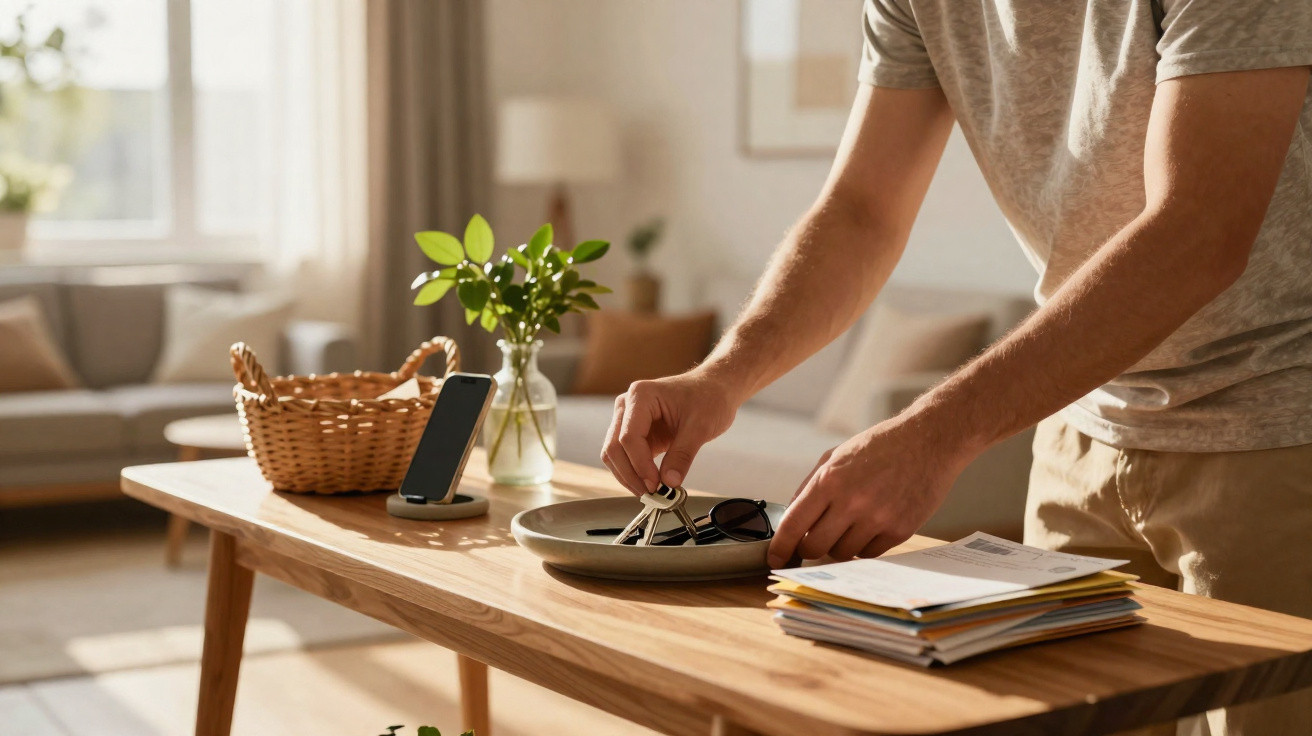
Hang up coats. Put keys in a bowl. Stack the post.
Take one cup to the sink.
Then stop.
It seems far too minor to make a difference.
That is precisely why it is effective.
Imagine this.
You arrive home on a Tuesday with your brain exhausted from work, carrying two bags, a half-open umbrella and the nagging feeling that you have forgotten somebody’s birthday.
Usually, you would abandon everything in the entrance, kick off your shoes somewhere close to - but not on - the mat, and tell yourself you will deal with it “later”.
Later does not happen.
By Thursday, the entrance resembles the backstage area of a theatre after a storm.
Now picture another version of yourself.
You still come home worn out.
But just inside the door, you pause and complete your one-minute reset ritual.
Bags are put in their place.
Shoes are lined up.
Your jacket is hung up.
A random leaflet goes into the recycling.
Sixty seconds.
As you walk away, your eyes first meet a small area of order.
Your nervous system registers it.
There is a reason it can affect your mood so quickly.
Our brains are continually scanning our surroundings, registering incomplete jobs and visual “noise”.
Every item left out creates a small open loop that whispers, “Deal with me.”
A cluttered area silently creates more of those mental tabs.
You may not hear them, but they show up as underlying stress.
One clear landing zone dramatically reduces that noise, much like putting in earplugs.
Environmental psychology researchers have found that visual disorder increases cortisol and makes relaxing or concentrating more difficult.
You do not need to transform the whole house to alter the message your home gives you.
You need only one reliably peaceful spot that your eyes encounter first.
That small success tells your brain:
Things are under control enough.
And that sense of “enough” is what helps you settle.
How to do a one-minute home reset that actually works
Begin by selecting your reset zone.
Choose the first surface or corner you notice when entering a room you use frequently.
It could be the entrance console, kitchen island, bedside table or sofa area.
Next, decide what a “reset” looks like in that location.
For an entrance, for instance, it could mean shoes aligned, jackets on hooks, keys in their bowl and no rubbish on the console.
For a coffee table, it might mean no dirty dishes, one remote control and perhaps one candle or book - nothing more.
Then make this commitment: whenever you enter or leave that room, spend one intentional minute on it.
Do not think or judge; simply carry out a quick, small reset.
Once the minute ends, you stop, even if the result is not perfect.
The aim is not immaculate.
The aim is “visually calm at a glance”.
The danger is allowing this to become another invisible task for which you criticise yourself.
It is not a test of your character.
It is a nervous-system hack.
There will be days when you forget.
Sometimes the minute may become three because you have found your rhythm.
On other days, you may be too tired to do more than move one pair of shoes - and that still counts.
Honestly, nobody manages this every single day.
Life gets in the way, children scatter toys everywhere, work exhausts your mind, and laundry multiplies like a Netflix series.
The key is to keep it easy.
If you miss a day, begin again the next time you spot the clutter.
No dramatic internal speech and no “I’m hopeless at this”.
Treat it as you would brushing your teeth.
At times it is hurried and half-hearted, while at others it is thorough, but you generally know what “clean enough” feels like.
Your reset zone is the household equivalent.
“You don’t need a perfect house to feel calm; you need one or two spots that tell your brain, ‘You’re safe here.’ The one-minute reset is just a way of writing that message in objects and space.”
- Choose your zone
Pick the entrance table, sofa area, kitchen worktop or bedside table - wherever your gaze falls first. - Decide the baseline
Create one simple rule, such as “nothing on this surface except lamp, keys, and one bowl”. - Attach it to a trigger
Do it after shutting the front door, before preparing coffee or just before bed. - Keep a tiny toolkit nearby
Use a tray, small basket, hook or bowl to collect stray belongings quickly. - Celebrate the glance
Take a step back, look at your reset zone for two seconds and allow your body to register the calm.
Let your home exhale with you
What makes this habit quietly effective is that it does not require you to change your entire personality.
You do not need to turn into “that organized person” who labels everything.
You merely become somebody who offers their home one minute of focused care whenever possible.
Across a week, those minutes accumulate.
Over a month, you begin to trust that at least one part of your home will welcome you gently when you arrive.
You may even find that, as this one zone remains calmer, other areas begin to follow.
We all know that moment when a messy room seems to prove we are failing at adulthood.
Usually, the reality is kinder: life is busy, and the home is where all that busyness spills over.
A one-minute reset is not about taking control of life; it is about making its edges softer.
You could begin with the entrance, then introduce a bedside reset, a small bathroom reset or a desk reset.
Not as a strict routine, but as small breaths your home takes alongside you.
Then one day, you will come through the door, lower your shoulders without even thinking and realise that the calm you were looking for was already waiting on that clear little table.
| Key point | Detail | Value for the reader |
|---|---|---|
| Define one reset zone | Select the first surface or corner your eyes meet when you enter a room | Immediately lowers visual noise and stress as you walk in |
| Limit it to 60 seconds | A brief, focused reset linked to a trigger such as coming home or going to bed | Keeps the habit realistic, sustainable and manageable |
| Set a simple baseline rule | Decide beforehand which few items “belong” in that area | Reduces decision fatigue and makes the space feel calmly purposeful |







Comments
No comments yet. Be the first to comment!
Leave a Comment