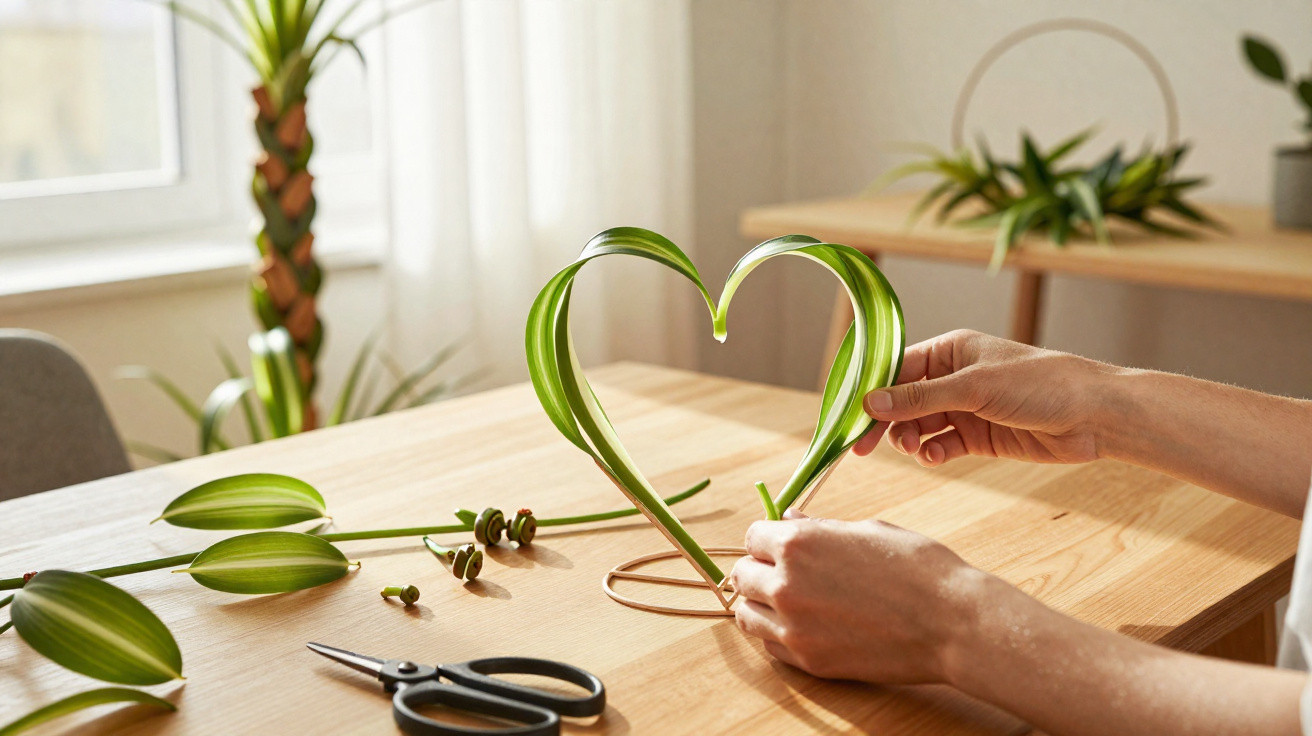
The spider plant is regarded as an indestructible classic: easy to care for, pet-friendly and found almost everywhere – yet rarely a real showstopper. Anyone who sees it merely as air-purifying background greenery is underestimating its potential. With a little dexterity, this plant can become a living work of art that takes over any table or shelf.
Why the spider plant is secret decorative gold
Known botanically as Chlorophytum comosum, the spider plant originally comes from South Africa. In British homes, it is usually seen spilling from a hanging pot or growing out of a planter placed on top of a cupboard. Its defining features are green-and-white striped foliage and long, slender shoots tipped with small rosettes – the well-known plantlets.
Those plantlets are precisely what makes the transformation possible. Usually, they simply dangle downwards. Yet if they are guided intentionally rather than left to hang at random, they become a kind of green crafting material that can be shaped, woven and displayed.
“Anyone who does not simply let spider plant shoots grow, but guides them, gets a living sculpture rather than an everyday plant.”
The shoots are remarkably flexible. Given a little patience, they can be bent without snapping. This makes the plant particularly suitable for graphic shapes – from hearts and wreaths to a true green column.
Turning trailing shoots into a green sculpture
A lightweight metal frame: heart, ring or crown
The simplest approach uses a slim framework. Thick aluminium craft wire is ideal: it is sturdy enough to retain its shape while remaining easy to bend by hand.
- Bend the wire into a ring, heart or oval shape.
- Push the wire into the pot or secure it so that it stands firmly.
- Choose several strong shoots with plantlets and loosely arrange them around the frame.
- Attach them with soft plant clips, craft tape or small silicone rings.
Aluminium hardly rusts and is extremely lightweight, so the plant can support the structure without difficulty. Over time, the delicate rosettes become dense little clumps that visually conceal almost all of the wire frame. The result is a green heart or ring sculpture with the appearance of a finished designer piece.
A braided column as a living totem pole
For those who prefer to work upwards, several shoots can be braided into a column. This technique is particularly suited to larger plants with plenty of long runners.
Method:
- Select three to five longer shoots, ideally with healthy plantlets.
- Place a sturdy wooden stake in the pot as an upright support.
- Gather the shoots loosely at the base and braid them like hair.
- Secure the braided length to the wooden stake at regular intervals, without crushing it.
This creates a green column that resembles a totem pole. It uses very little floor space and is ideal for narrow living-room corners, beside the television or at the edge of a bookcase.
“A braided column can turn even a narrow strip of space into a striking green stage.”
Preparing the spider plant: observe, select and thin out
Before shaping the plant, it is worth examining it closely. Not every shoot is equally suitable for creating a sculpture.
- Choose strong shoots: Long, vigorous runners with several plantlets are best.
- Remove surplus plantlets: Too many rosettes can quickly look untidy. Some can be cut away without any issue.
- Reuse the plantlets: The removed young plants can be placed straight into a new pot or around the edge of the existing one. After a few weeks, they will create a denser base.
The key is to guide the shoots rather than force them. If they are kinked too sharply or bent too tightly, they may split. It is better to acclimatise them gradually to the intended shape, moving them a little further every few days. A gentle adjustment every few days is usually enough.
Where a green sculpture looks especially effective
Hearts and wreaths as table-centre focal points
A densely covered wreath quickly becomes the natural centrepiece of a table setting. The plantlets drape gently outwards without obstructing the view between people seated at the table. Add candles in the centre and it becomes a type of green frame.
A spider plant heart suits celebrations, romantic dinners or simply an unexpected focal point in the hallway. On a narrow console table, the shape looks almost like an art object – except that it is alive.
A braided column for small rooms
Every square centimetre matters in a small room. A tall, slim spider plant column on a bedside table or beside an armchair has far more presence than a broad clump at floor level. Its height allows more light to reach the leaves, while making the entire plant appear more elegant.
Where surface space is limited, the column can also be placed in a tall, narrow decorative pot. This intensifies the sculptural effect while also concealing the actual growing pot.
Care after shaping: support rather than stress
After bending and braiding, the spider plant needs a little extra care to cope well with its new look. A straightforward liquid fertiliser containing two main components – nitrogen and potassium – is enough to support growth and keep the leaves resilient.
Important: do not shape the plant immediately before or during a heatwave; choose a relatively mild day instead. It will cope better with mechanical stress in these conditions. Waterlogging is far more harmful to spider plants than brief dryness, so water moderately.
In very mild areas roughly equivalent to climate zone 10 or 11, a spider plant may also spend the summer outdoors, provided temperatures do not fall below about 13 degrees. On a balcony, a braided column becomes a small garden feature that naturally extends the interior planting scheme outside.
Common mistakes and easy ways to avoid them
| Problem | Cause | Solution |
|---|---|---|
| Shoot snaps while being shaped | Bending it too quickly or too harshly | Position it gently, then adjust it a little every few days |
| Shape looks sparse | Too few plantlets or a weak plant | Plant more plantlets and wait before securing the final form |
| Plant leaves droop | Stress from repotting, shaping and moving location at the same time | Space out the changes, place it in shade and water consistently |
| Wire remains visible | Not enough growth yet | Be patient, fertilise and gently direct new shoots into gaps |
Why the effort is genuinely worthwhile
The spider plant is non-toxic to dogs and cats, filters pollutants from the air and is considered almost foolproof. That very resilience makes it ideal for shaping and experimenting. Even if one attempt goes wrong, the plant will grow again in most cases.
Anyone who gives plantlets away can pass on the plant-sculpture trend as well: a small pot, a bent piece of wire and a young shoot secured to it are all that is needed to create a personal living gift. Over time, it grows into an individual figure that continues developing in the recipient’s living room.
It also becomes especially interesting when combined with other houseplants. A trained spider plant column beside a large-leaved monstera or compact fern creates strong contrasts. Even familiar classics then look like part of a considered design scheme rather than a random collection of pots.
Anyone who previously knew the spider plant only as an undemanding trailing houseplant will have a revelation with wire, a little courage and a few hours of patience: an “always works” plant becomes a small living artwork that surprises every visitor.











Comments
No comments yet. Be the first to comment!
Leave a Comment