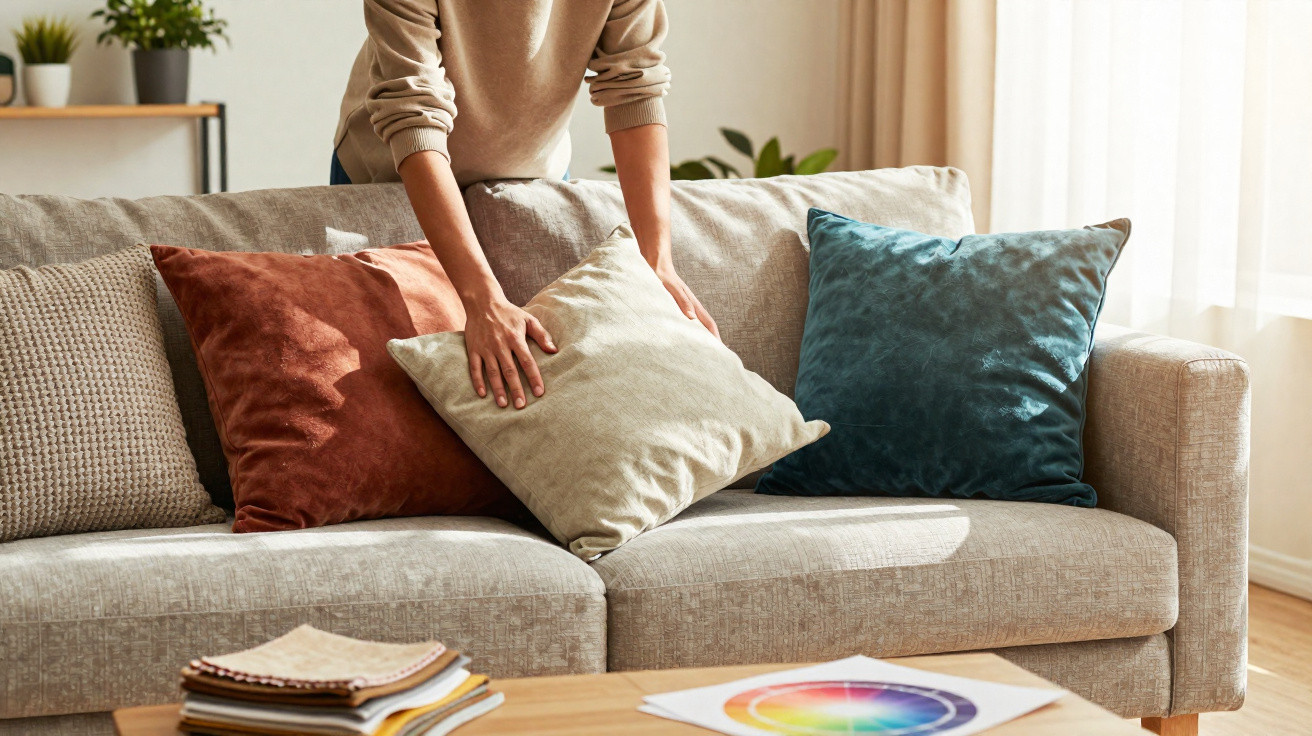
With one simple rule, everything can suddenly look as though it belongs in an interiors magazine.
Many people invest in a high-quality, comfortable classic sofa, yet still feel disappointed. Something appears unfinished, unsettled or simply dull. The fabric is refined and the colours ought to work, but the overall effect falls somewhere between cluttered and bland. A straightforward, almost mathematical decorating formula can bridge precisely this gap: the 3-2-1 rule for cushions.
Why so many sofas look unfinished despite beautiful cushions
When a seating area feels “bare” or uninspiring, the most common response is to buy more. Another cushion here, a trendy motif there, perhaps an impulse sale purchase. Gradually, this creates a colourful collection with no real plan behind it.
The issue is rarely the quality of the cushions themselves, but the way they are combined. Colours, patterns and sizes compete rather than complement one another. The result is visual noise instead of calm.
“When cushions are simply piled on, the sofa soon looks unsettled, more like a leftovers box than a carefully designed display.”
The opposite mistake is equally common: worried about having “too much”, people arrange three identical cushions in a row. It all looks correct, but stiff, lacking personality and visual interest. This is exactly where a small professional rule can bring structure - without requiring another shopping trip.
The 3-2-1 rule: how interior designers style cushions
The 3-2-1 rule establishes a clear hierarchy, showing which type of cushion should fulfil each role. It works on sofas, but just as well on beds, window seats or in a reading nook.
The formula is:
- 3 plain cushions for a calm foundation
- 2 patterned cushions to add movement
- 1 striking or heavily textured cushion as a focal point
The three plain cushions occupy the largest share of the arrangement. Ideally, they pick up the sofa colour or sit within related neutral shades such as beige, grey, greige or sand. They settle the overall look and create a backdrop for everything else.
The two patterned cushions introduce a sense of movement. Suitable options include, for example:
- delicate stripes or checks
- graphic prints
- small floral patterns
- understated ethnic or boho motifs
The key point is that patterns should remain in the minority. This keeps the arrangement interesting without making it feel overloaded.
The final cushion is the star of the show. It can stand out through a distinctive texture or a bold colour: bouclé, chunky wool, wide corduroy, crinkled linen or an especially rich shade. This one special piece provides the accent that some living rooms have been missing.
“3 cushions create calm, 2 bring life, 1 delivers wow - a sofa often needs no more.”
Layer cushions rather than lining them up: mix sizes cleverly
Once the 3-2-1 rule is in place, the next tool is the interplay of sizes and proportions. Choosing every cushion in the same format can quickly create a rigid, almost bureaucratic line-up.
True depth comes from varying the formats. A reliable arrangement is:
- Large squares (for example, 60 × 60 or 65 × 65 cm) at the back to create height
- Medium squares (around 45 × 45 or 50 × 50 cm) in front as the central layer
- One small rectangle (for example, 30 × 50 cm) at the front for a relaxed, inviting touch
This makes the sofa appear softly layered without looking bulky. The cushions seem to step forward in layers rather than merely sit side by side.
Textures: even the best colour scheme looks flat without mixed materials
Colour alone is seldom enough. Fabrics instantly convey a feeling: cool, cosy, elegant or rustic. Using at least two different materials brings this interplay to life.
Popular pairings include:
- linen with velvet for relaxed elegance
- cotton with chunky wool for a cosy Scandinavian feel
- smooth canvas with bouclé for a modern, subtly luxurious look
“Even entirely neutral shades feel exciting when linen, velvet and wool appear together.”
If the sofa itself is very plain, it is possible to deliberately use a stronger contrast, such as a chunky knitted cushion beside a smooth cotton cover. Where the sofa fabric is already eye-catching, a more restrained choice of materials is worthwhile.
Plan colours: the 60-30-10 formula for a balanced overall look
Alongside the 3-2-1 rule, there is another decorating aid frequently used by designers: the 60-30-10 distribution. It structures the colour scheme of the entire room.
| Percentage | Role | Examples |
|---|---|---|
| 60% | Base colour | Sofa, wall and rug in beige, grey, greige or off-white |
| 30% | Accent colour | Warm terracotta, soft sage green, smoky blue |
| 10% | Contrast | Deep green, black, dark navy in small doses |
Applied to cushions, this means the three base cushions should sit close to the dominant colour, while the two patterned cushions pick up the accent colour. The one standout cushion can play within the contrast range. In this way, the sofa area automatically connects with the rest of the room.
Let go of symmetry: why slight irregularity feels so inviting
Many people position cushions in neat ranks like soldiers because they fear creating “too much chaos”. The outcome is a sofa that feels awkward to actually use, as everything looks too perfect.
A small break from symmetry makes the living room feel more spontaneous and homely. Practical ideas include:
- placing one focal-point cushion on just one side
- grouping cushions in the corner of a corner sofa, rather than distributing them with equal weight everywhere
- positioning a rectangular cushion slightly at an angle to make it feel like an invitation to lie down
“The look should feel more like ‘just got up’ than ‘showroom, please do not touch’.”
Common mistakes - and how to correct them in minutes
Anyone wanting to use the 3-2-1 rule often does not need to buy anything new. A look through cupboards and other rooms is often enough.
Common problems and quick fixes:
- Too many patterns: Replace several patterned covers with plain ones, creating a foundation of three calm cushions.
- Everything identical: Swap two covers for textured fabrics and add a smaller rectangular cushion.
- Colour chaos: Define one main colour group, then remove anything that differs too widely or move it into another room.
- Too little volume: Invest in fuller cushion pads and stop reusing old, flattened inners.
How to adapt the style to different interior trends
The 3-2-1 rule remains unchanged; only the cushion selection varies according to the desired style:
- Scandinavian: plenty of linen and cotton, pale tones, fine stripes and subtle checks
- Boho: macramé details, tassels, ethnic patterns, warm earth tones and, ideally, one bold patterned cushion
- Modern minimalist: clean lines, a small number of high-quality cushions with strongly tactile textures in muted colours
- Glamorous: velvet, fabrics with a silky sheen, deep dark green or midnight blue, plus one small cushion with a metallic effect
What is interesting is that the underlying rule still applies even when the style changes. Simply swapping the covers allows the look of the living room to be updated regularly without touching the sofa itself.
Why small rules like this noticeably change the everyday atmosphere
A thoughtfully styled sofa changes more than photographs for social media. A seating area that is calm yet interesting influences how easily you switch off in the evening, whether you enjoy welcoming guests and how tidy a room appears - even when there is still a stack of magazines on the coffee table.
The 3-2-1 rule removes uncertainty from decorating decisions. Instead of buying new items at random, a few purposeful adjustments can make more of what is already available. Once you understand how numerical proportions, textures and colours work together, you will choose cushions very differently in future - and be surprised by the impact of six small squares and one rectangle.





Comments
No comments yet. Be the first to comment!
Leave a Comment