For people travelling between Santos and Guarujá on Brazil’s São Paulo coast, a very short distance can turn into a frustratingly long trip. Ferry queues, port traffic and the road diversion around the channel can make a crossing that looks simple on a map take far longer than expected.
The proposed answer is an immersed road tunnel beneath the Santos port channel. Rather than interrupting shipping with a bridge, the plan is to place prefabricated concrete sections in a trench on the channel bed. The often-quoted five-minute journey refers to the crossing itself in favourable conditions, not necessarily the whole door-to-door trip.
Why the crossing is difficult now
Santos and Guarujá face one another across a busy navigation channel serving the Port of Santos. The waterway is central to the region’s freight activity, so any permanent connection has to allow large commercial vessels to continue moving through it.
People travelling between the two cities currently use ferries or longer road routes. Both can be affected by peak-time congestion, port operations, holidays on the coast and incidents on surrounding roads.
A direct fixed link could be used by:
- cars, motorbikes and buses;
- port-related freight and service vehicles;
- pedestrians and cyclists, if the proposed separate routes are delivered;
- public transport in a later phase, if the space reserved for it is used.
The purpose is not simply to shorten a journey. It is to create a reliable link without closing a working shipping channel.
What an immersed tunnel is
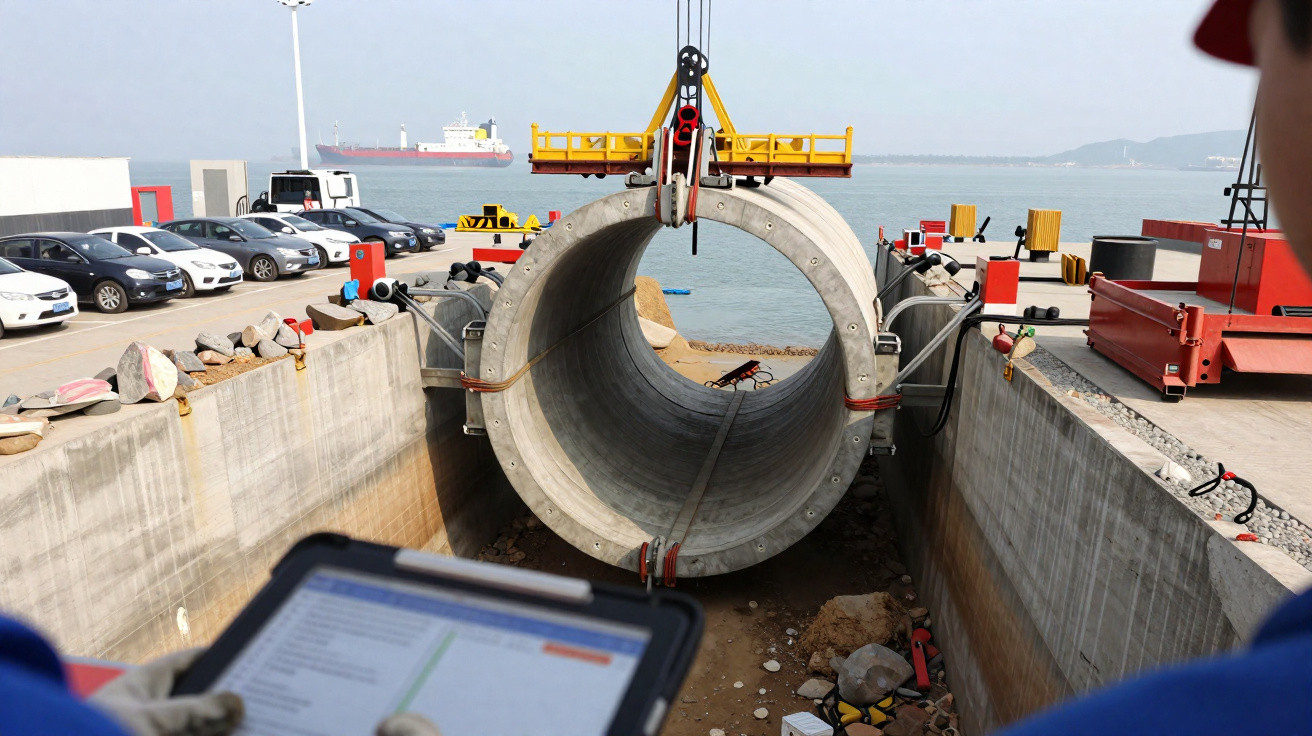
An immersed tunnel is made from separate watertight concrete sections, often called elements. These are built in a dry dock or fabrication basin, floated into position and lowered into a prepared trench beneath the waterway.
The elements are joined together underwater, sealed and then covered with carefully designed protective material. Once complete, the tunnel sits below the channel bed rather than hanging beneath a bridge or being bored far below ground.
This is different from the Channel Tunnel, which was excavated through geology using tunnelling methods. An immersed tunnel is generally chosen where water depth, ground conditions, navigation needs and the available construction space make it a suitable option.
Plans published for the Santos–Guarujá scheme have described an immersed section of roughly 870 metres, with longer approach roads required to bring traffic down to tunnel level and back to the surface.
How the sections are installed
The work is highly controlled. It is not a case of dropping large concrete boxes into the sea: positioning, weather, marine traffic and the condition of the channel bed all need close management.
1. Construct the concrete elements
The tunnel sections are cast in a protected basin or dry dock. Reinforcement, internal walls, waterproofing, mechanical openings and the joints that will connect each element are installed before the unit is moved.
Temporary bulkheads seal both ends, allowing the element to float once the basin is flooded.
2. Dredge and prepare the trench
Contractors dredge a precisely surveyed trench along the route. A prepared foundation layer helps ensure that each element reaches the correct height, line and gradient.
This stage has to be coordinated with harbour operations. Dredging and survey vessels require controlled working areas, while shipping movements must remain safe.
3. Float, tow and lower each element
Tugs guide the floating element into place. It is held using cables, pontoons or specialised positioning equipment, then slowly lowered by admitting water into ballast tanks.
Survey teams continually check its location. Divers and remotely operated equipment may be used for inspection, depending on the conditions and the construction method.
4. Connect, seal and protect the tunnel
Each new section is brought against the previous one and joined with a watertight connection system. Once the connection is tested, the trench is backfilled with engineered layers of sand, gravel or rock protection.
The protective cover helps resist scour from water movement, protects against accidental anchor damage and provides a stable channel bed for future port operations.
What is proposed for Santos–Guarujá
Published project material has described a road tunnel with three lanes in each direction, alongside dedicated provision for walking and cycling. One part of the layout has also been presented as capable of accommodating light rail in the future.
Those details matter because a new crossing can shift congestion rather than solve it if its entrances, junctions and public-transport links are poorly planned. A fast tunnel is of limited use if traffic simply queues at either end.
The scheme has been presented as a way to improve local journeys and support port logistics. Its eventual value will depend on practical matters beyond the underwater structure, including bus connections, safe cycle access, traffic management and maintenance over many decades.
Why a bridge is not the straightforward alternative
A bridge across a major shipping channel would need enough height and width for vessels to pass below and between its supports. That can mean very tall structures and long approach ramps.
In densely developed coastal areas, those ramps can take up land, affect local streets and create substantial visual and noise impacts. Piers in the channel can also introduce navigational constraints and collision risks.
An immersed tunnel avoids the need for overhead clearance because ships pass above it. That does not make it simple: it introduces demanding marine construction, waterproofing, drainage and emergency-planning requirements instead.
A harbour tunnel is a road scheme, but it is also a port-operation, marine-engineering and safety project.
Common mistakes when discussing underwater tunnels
Assuming every tunnel under water is bored through rock
Many tunnels beneath rivers and harbours are immersed structures assembled from separate sections. Others are bored or constructed using cut-and-cover methods. The right approach depends on local conditions.
Treating five minutes as a guaranteed journey time
A headline figure usually describes the time spent on the direct link under good traffic conditions. Delays at junctions, queues, incidents, toll arrangements and seasonal demand can still affect the total journey.
Forgetting the approaches
The underwater section is only one part of the route. Connections to existing roads, walking routes, cycle infrastructure and public transport will determine whether the project benefits the wider area.
Assuming shipping will be unaffected during construction
The aim is to keep the port functioning, but dredging, towing and installation work can require exclusion zones, revised shipping arrangements and carefully timed operations.
Treating target dates as firm promises
Major infrastructure schemes can change during design, licensing, procurement, funding and construction. Announced opening dates should be understood as targets, not certainties.
Safety systems matter as much as the concrete
Road tunnels need robust operating systems because an incident underground can be harder to manage than one on an open road. Final arrangements are set by the project design and local rules, but usually include:
- ventilation and air-quality monitoring;
- emergency lighting, signs and communications;
- fire detection and equipment designed for the tunnel;
- drainage, pumps and flood-management measures;
- CCTV and a control-room response system;
- emergency exits or protected escape arrangements;
- inspection and maintenance of joints, waterproofing and electrical equipment.
There are also construction safety issues. Marine works should only be carried out by properly qualified teams under approved port and diving procedures. Members of the public should never enter fenced-off work areas, approach marine plant by boat or rely on unofficial information about ferry changes and road closures.
The real measure of success
The Santos–Guarujá tunnel could transform a difficult short crossing if it is completed as planned and integrated well with the streets and transport networks around it. The engineering is striking, but everyday usefulness will come down to reliability, affordability, safe access and sensible connections at both ends.
For regular travellers, the practical advice is to follow official transport and port announcements as the project develops. A five-minute tunnel crossing would be a major change, but the full journey will still depend on what happens before reaching the entrance and after leaving the exit.















Comments
No comments yet. Be the first to comment!
Leave a Comment