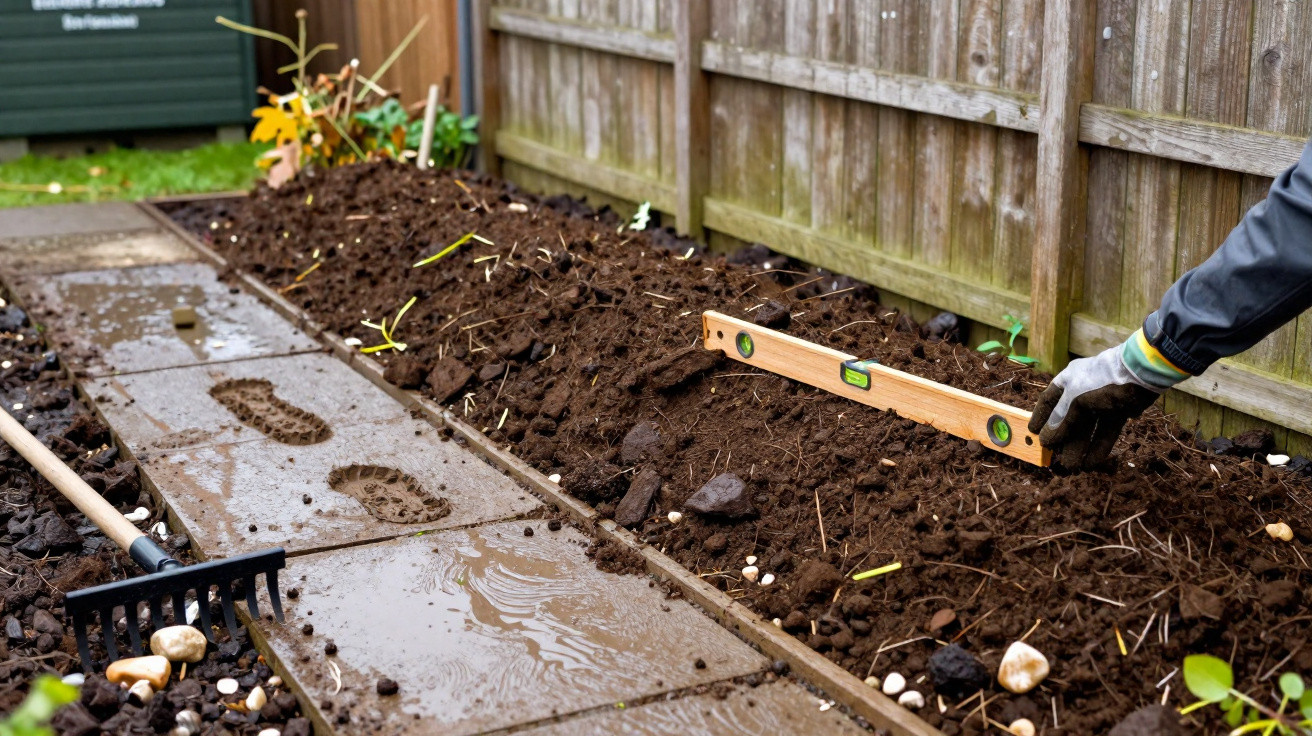
A sloping garden, a nearby building project and several lorry loads of ‘free’ excavated soil can sound like a useful autumn arrangement. The contractor avoids paying to remove it, while you level a dip, raise a wet patch or make more of the lawn.
But imported soil is not simply a gardening freebie. The crucial point is that changing levels can change where rainwater travels, while unknown material may be unsuitable for growing or contain waste, rubble or invasive plant fragments. The real problems often emerge only after a few wet UK seasons.
Free soil can become costly if no one has checked where it came from, what it contains and where water will go afterwards.
Why excavated soil is not always a bargain
Construction projects often produce surplus material from foundations, drainage trenches or landscaping. It may be topsoil, but it could just as easily be clay subsoil, made ground or mixed spoil.
That distinction matters. Material dug from below the surface is rarely ready for planting. It may contain stones, brick, concrete, timber, plastic, old pipes or compacted lumps. It can also settle unevenly once it has been spread.
A smooth lawn immediately after the work is not proof that the ground is stable. Voids can close, fill can slump and water can begin collecting in places that were previously dry.
Before accepting any load, ask for:
- the site address and its previous use;
- a clear description of the material: topsoil, subsoil or mixed excavated spoil;
- the proposed volume and number of vehicle movements;
- details of any screening or soil testing;
- written confirmation of who is responsible if unsuitable material is delivered;
- delivery tickets showing the origin, date and quantity.
If the response is simply, ‘It’s clean earth’, treat that as a reason to stop and investigate rather than reassurance.
Risks hidden beneath a new lawn
Some concerns are obvious in a tipped heap. Others cannot be identified by looking at the soil.
Contamination and waste
Soil from land with an industrial, commercial or uncertain history can contain substances requiring proper assessment. Fuel residues, ash, metals and demolition debris may not be visible.
Excavated material may also be regulated as waste, depending on its origin and intended use. It should not be informally passed on just because someone does not want it. If you are unsure, seek advice from your local council or an appropriately qualified environmental or soil professional before accepting it.
Do not use questionable material for vegetable beds, children’s play areas, or close to ponds, ditches and drains. Wear gloves when inspecting soil, and wash hands and footwear afterwards.
Invasive plants
Soil can transport seeds, roots and rhizomes. Japanese knotweed is the best-known example, but it is not the only persistent plant that can spread through moved soil.
Inspect each load as it arrives and photograph anything unusual. Do not redistribute suspect material around the garden, compost it or take it to a household recycling centre without checking the facility’s rules and getting specialist advice where needed.
Poor drainage and poor growing conditions
Heavy clay and compacted fill may support turf for a while, but can leave shrubs struggling, cause puddling and restrict root growth. A thin layer of bought-in topsoil over poor fill does not automatically create healthy garden ground.
Raising levels changes the route of rainwater
This is often the most important issue, especially where one garden falls towards another. Water will naturally travel downhill, but a raised lawn edge, bank, patio or retaining feature can concentrate it in a new direction.
During prolonged rain, saturated soil has limited capacity to absorb more water. A relatively small change next to a boundary can send runoff towards a neighbour’s wall, garage, paving or planting beds.
Natural runoff from higher ground is not the same as runoff made worse by landscaping or drainage works. The legal position depends on the facts and differs across the UK, so do not assume that an existing slope gives you a free hand to increase or redirect water flowing downhill.
If your project makes water arrive faster, in greater volume or at a new point along the boundary, alter the design before the first load is spread.
Check permissions and drainage before delivery
Requirements vary between England, Scotland, Wales and Northern Ireland. Local planning policies, flood risk, conservation areas, listed buildings and estate covenants may also be relevant. Substantial engineering works to raise land, build retaining structures or alter levels can require planning permission or other approvals.
Contact your local planning authority before starting, particularly if the work is extensive, close to a boundary or near a building. Explain the existing and proposed levels, area, amount of material and intended drainage arrangements. If a contractor says consent is unnecessary, verify that advice yourself.
A drainage plan may include:
- preserving the existing natural fall where possible;
- permeable surfaces rather than large areas of impermeable paving;
- a shallow planted swale to slow surface water;
- land drainage designed for the particular soil and site;
- retaining walls with proper drainage behind them;
- finished levels kept safely below damp-proof courses and air bricks.
Never direct a pipe, channel or drain onto a neighbouring property. Do not connect new drainage to a public sewer without the relevant permissions and professional advice.
A practical pre-delivery checklist
1. Record the garden as it stands
Take dated photographs of boundaries, gullies, walls, air bricks and low spots. After rain, note where puddles form and which way water runs. For larger work, a measured level survey can prevent expensive guesswork.
2. Speak to the neighbour downhill
A calm conversation before work is much easier than a dispute after a wet winter. Show the intended finished level and explain how surface water will be managed. Make a written note of anything agreed, but remember that neighbourly agreement does not replace permissions or sound drainage design.
3. Keep a paper trail for the material
Retain emails, delivery tickets, photographs and any test information. Refuse loads containing obvious rubbish, strong odours, staining or unexpected plant material.
4. Use suitable help for substantial works
For major level changes, slopes, retaining walls or work near buildings, consult a competent drainage specialist, civil engineer, surveyor or experienced landscaper. Fill should be placed and compacted in appropriate layers, not pushed into a mound and covered with turf.
Why trouble can appear years later
The first season can be misleading. Grass grows, the surface looks level and the work seems finished. Then repeated rain reveals settlement, shallow hollows, waterlogged clay or a new route beneath a fence.
The neighbour below may notice flooded paving, saturated beds, damp around an outbuilding or water collecting close to a wall. Finding the cause can then involve drainage inspections, level surveys, photographs and delivery records.
Keeping records from the beginning helps everyone understand what changed and makes a practical solution easier if concerns arise.
Common mistakes to avoid
- Accepting ‘clean fill’ without confirming its source and type.
- Treating rubble-rich spoil as planting soil.
- Assuming a grassed surface means the ground is stable.
- Raising soil against walls, over air bricks or too close to a damp-proof course.
- Creating a fresh slope towards a boundary without checking where runoff will end up.
- Ignoring possible invasive plant material because no leaves are visible.
- Starting major earthworks before checking local planning requirements.
- Relying on a verbal promise that drainage will be dealt with later.
If the soil is already in place
Do not panic, but act before the next sustained wet spell. Photograph the layout, locate delivery paperwork and inspect the garden during rainfall. Look for water collecting against walls, flowing beneath gates, escaping under fences or pooling near neighbouring structures.
If you see settlement or runoff, stop adding material and seek advice. A drainage professional can assess practical options, while the local planning authority can clarify whether the work needs approval. If a neighbour raises concerns, respond promptly, keep communications factual and avoid making changes that could worsen the problem.
Imported soil can be useful where its origin is known, its condition is suitable and final levels have been designed around water. In a British garden, the important test is not how it looks on delivery day, but how it behaves after several seasons of rain.










Comments
No comments yet. Be the first to comment!
Leave a Comment