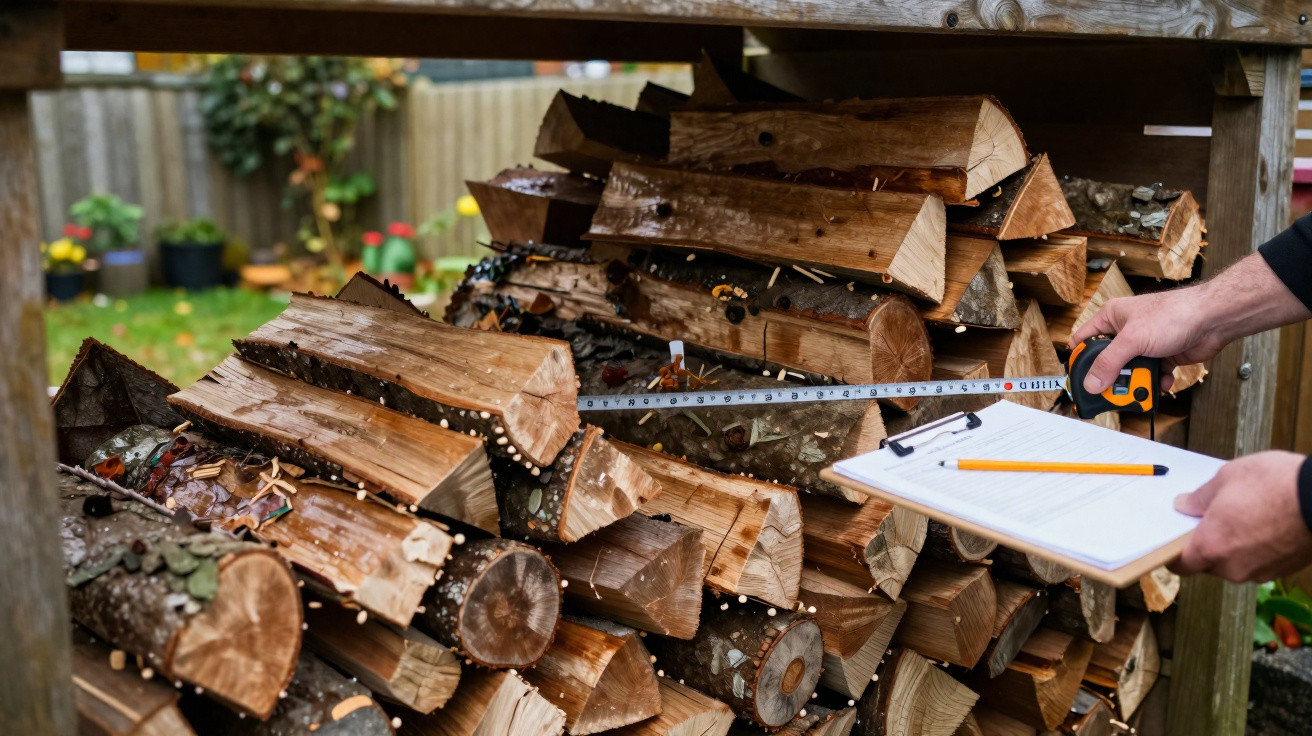
A firewood delivery can look surprisingly small once it has been stacked neatly in a log store. But a smaller-looking pile is not, by itself, evidence that a third of the order has disappeared. The essential point is to compare like with like: a loose heap, a tidy stack, a bag and a so-called “load” are not interchangeable measures.
Cutting long timber into 33cm logs does not make the wood itself vanish. However, the air spaces between pieces can change according to the log length, split size, shape and the way it is stacked. Before challenging a supplier, check exactly what was sold, record the delivery promptly and measure it on the same basis as the advertised quantity.
The useful comparison is not what the pile looks like, but whether the delivered volume matches the unit stated on the order.
Why a neatly stacked pile may look smaller
A tipped delivery is full of gaps. Once the logs are arranged in rows, those gaps reduce and the outside dimensions of the pile become smaller. That is normal.
Log length can influence how efficiently a stack settles, particularly where pieces are irregular. Shorter logs may sit more closely together than long, uneven lengths, but there is no reliable rule that 33cm logs should occupy exactly 30 per cent less space than one-metre lengths. The difference varies too much to use as proof of a shortage.
The key distinction is between:
- the solid volume of wood;
- the external volume of a stacked pile, including gaps; and
- the external volume of a loose, tipped pile, which usually includes more air.
If a supplier promised two loose cubic metres and you later build a very tidy stack, the stack will not necessarily measure two cubic metres. Equally, if you paid for a stacked volume, a loose heap is not a fair direct comparison.
Start with the wording on the order
In the UK, firewood is often sold by loose cubic metre, stacked cubic metre, bulk bag, crate, trailer load or a named quantity such as a “large load”. These descriptions do not all mean the same thing.
The word cord is particularly worth checking. It is used more commonly in North America than in UK retail firewood sales, and it should not be treated as a clear measure unless the supplier has defined it in writing.
Look at the order confirmation, invoice, website description and delivery note. A clear description should state:
- the quantity bought;
- the unit used, preferably cubic metres;
- whether the volume is loose or stacked;
- the approximate log length;
- whether the logs are described as seasoned, kiln-dried or unseasoned;
- any wood species or mix promised as part of the sale.
A bulk bag can be convenient, but “one bag” is not a standard amount. The bag dimensions, how fully it is filled and how much the logs have settled all matter. The same applies to a trailer load.
Do not compare two prices per bag until you know the bag’s approximate volume, the log length and whether the volume is loose or stacked.
What loose and stacked cubic metres mean
A loose cubic metre is wood occupying a space one metre long by one metre wide by one metre high when it has been tipped or loosely placed. It includes the air around the logs.
A stacked cubic metre is a reasonably orderly stack with outside dimensions of one metre by one metre by one metre. It also includes air gaps, but normally fewer than a loose pile.
Neither measure tells you precisely how much solid timber is present. They are practical trading measures, which is why the method needs to be clear before delivery.
Where fuel is sold for domestic burning, check that its moisture information and sales description meet the relevant rules for your part of the UK. Schemes and requirements can differ between nations and may change. Moisture claims are separate from quantity: dry logs may burn more effectively, but they do not automatically mean you have received the volume ordered.
How to record a delivery fairly
Measure as soon as possible, ideally before moving or burning any logs. You will not obtain laboratory-level precision from an uneven heap, but sensible records make a later conversation much easier.
1. Photograph everything first
Take wide photographs of the full load where it was tipped, along with any bags, crates or vehicle markings that are relevant. Photograph the delivery note and keep digital copies of the order confirmation and invoice.
Include a tape measure or another familiar object in a few pictures for scale. Avoid relying on close-ups alone, as they rarely show the actual size of a heap.
2. Estimate a loose pile
If the heap is roughly rectangular, measure its length, width and several points across its height. Use an average height, then calculate:
length × width × average height = approximate loose cubic metres
For a mound-shaped pile, this is only an estimate. Do not present it as an exact figure to the nearest litre. Note its irregular shape in your records and take extra photographs from different sides.
3. Measure a stack separately
Once stacked, measure the outside length, height and depth of the finished pile. Multiply the measurements.
For example, a stack measuring 3m long, 1.2m high and 0.9m deep has an external volume of:
3 × 1.2 × 0.9 = 3.24 cubic metres
That is a stacked volume. It should not automatically be compared with a loose-volume order, because stacking alters the amount of air within the overall dimensions.
Keep the stack sensible rather than forcing small pieces into every void. Overly compact stacking can make the result unrepresentative, while a deliberately loose stack can make a delivery look larger than it is.
4. Check log length and general condition
Measure a sample from different parts of the load. Small variations are normal with cut firewood, but note whether most pieces are broadly close to the advertised 33cm length.
Also record obvious issues such as excessive soil, large amounts of sawdust, or a substantial proportion of pieces too small for the description. Do not use a chainsaw to trim or alter logs before you have documented a possible problem. If you do cut wood later, use appropriate equipment and training, and never work alone.
When it is reasonable to query the supplier
If the paperwork promised a specific volume and your prompt, well-recorded estimate appears substantially lower on the same basis, contact the trader in writing. Keep the tone factual: ask how the load was measured and loaded rather than beginning with an accusation.
Include:
- the order number and delivery date;
- the wording used on the listing and invoice;
- the dimensions you recorded;
- whether you measured the logs loose or stacked;
- photographs taken before moving the wood;
- a sample of measured log lengths.
Ask the supplier to explain its stated volume, loading method and any conversion it has applied. A good local supplier should be able to describe whether it sells loose cubic metres, stacked cubic metres or bags of a stated size.
If you cannot resolve a dispute, retain all correspondence and paperwork. Citizens Advice, Consumer Advice Scotland or Consumerline in Northern Ireland can point consumers towards appropriate general guidance. This is not a substitute for advice on the details of an individual claim.
Common mistakes that make a load seem short
- Comparing a tidy stack with a loose delivery. These are different volume measures.
- Treating a cord as self-explanatory. Ask for a defined cubic volume in writing.
- Using a fixed 33cm conversion factor. Packing varies with log shape, split size and stacking.
- Measuring after using some of the wood. Photograph and measure the full delivery first.
- Comparing weight rather than volume. Fresh or damp wood can weigh more without providing more usable dry fuel.
- Assuming every bulk bag is the same. Bag sizes and fill levels differ between suppliers.
- Ignoring the delivery description. A vague “large load” is difficult to assess after the event.
Store the logs without creating new problems
Once you are satisfied with the delivery, keep logs raised off bare ground on bearers, pallets or a purpose-built base. Use a roof to shed rain, but leave the sides reasonably open for airflow. Avoid wrapping a full stack in plastic, which can trap moisture.
Keep the store away from open flames, flues and appliance vents. Avoid piling logs directly against the house where possible, as sheltered stacks can harbour insects and hold dampness against walls. Follow the instructions for your stove or fireplace, and use fuel suitable for the appliance.
Make the next order easier to check
For the next winter delivery, ask for a written price based on a stated loose or stacked cubic metre, plus the intended log length. If the seller uses bags or crates, ask for their dimensions and whether the quoted capacity refers to loose or stacked logs.
Photograph the load before it is put away, keep the paperwork and compare only equivalent measures. That preparation will not make every pile look bigger, but it will tell you whether there is a genuine quantity issue or simply less empty air in a well-stacked store.















Comments
No comments yet. Be the first to comment!
Leave a Comment