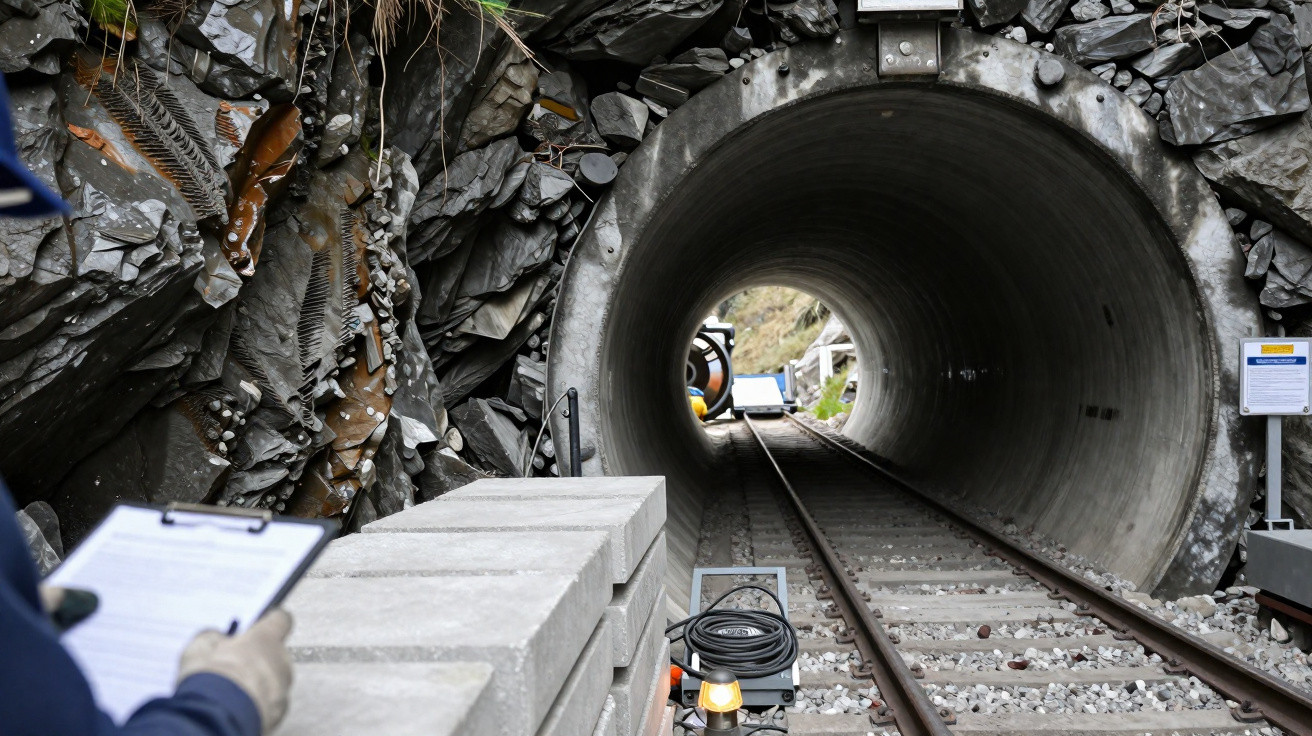
A tunnel breakthrough can look like the end of the job: the final rock is removed, two underground sections meet and a route exists from one end to the other. In reality, a railway tunnel is only beginning its next phase at that point.
The western running tube of the Brenner Base Tunnel is now continuously excavated for around 55 kilometres between Innsbruck in Austria and Fortezza (Franzensfeste) in South Tyrol, Italy. That is a major engineering milestone. It should not, however, be confused with a fully fitted, tested and operational railway tunnel.
A continuous bore is a significant construction achievement, but it is not the same as a railway ready to carry trains.
What the milestone actually means
The Brenner Base Tunnel, generally known as the BBT, is a twin-tube railway tunnel being built beneath the Alps along the Brenner corridor. In normal operation, each of its two main tubes is intended to carry trains in one direction.
The newly connected route is the western main tube. Its final breakthrough took place in the Pfons–Brenner construction section in Tyrol, where the tunnel boring machine (TBM) Wilma met an already excavated section.
This is important because the BBT has not been driven from a single entrance by one machine. Construction has progressed through multiple contracts, portals and access tunnels in Austria and Italy. Sections excavated from different points had to meet precisely underground.
A continuous excavation route of this length depends on more than steering a TBM accurately. It requires dependable surveying, ground monitoring, ventilation, power, materials handling, spoil removal and site communications throughout the build.
Wilma and the final breakthrough
According to information issued by the project, Wilma began its drive in the Pfons–Brenner section in September 2024. The machine is about 180 metres long, weighs roughly 2,700 tonnes and has a cutting diameter of 10.37 metres.
Calling a TBM a giant drill is understandable, but incomplete. A hard-rock machine is better thought of as a mobile underground production line. Its cutterhead breaks the rock at the face; conveyors and transport systems remove the excavated material; and equipment behind the cutterhead supports the installation of the tunnel lining.
The lining consists of precast concrete segments, sometimes called tubbing segments. These are assembled into rings as the machine moves forward, creating the permanent circular profile of the tunnel.
Why the last few metres need extra care
A breakthrough is carefully managed rather than simply pushed through at speed. As the machine approaches an existing underground opening, teams check its position, the condition of the ground and the required support arrangements.
Alpine geology can vary over short distances. A fault zone may affect the rock strength, water conditions or the support needed, which can change the pace of a drive. Such variation is a normal challenge in major underground works, even where extensive ground investigation has been undertaken.
The achievement, then, is not only the distance excavated. It is the controlled joining of separate drives into one aligned route.
The logistics behind a long tunnel
The machines attract attention, but logistics often determine how efficiently a tunnel can be driven. Each metre requires a constant flow of people, energy, water, equipment and materials in, as well as excavated rock out.
For the BBT, lining segments have been moved by rail within the construction operation rather than relying only on road haulage. The project company has said this avoided approximately 45,000 lorry journeys. That figure relates to its construction logistics and should not be taken as a measure of the project’s overall environmental impact.
Using rail for heavy materials can reduce pressure on constrained mountain roads and make deliveries more predictable. It also illustrates a wider lesson: a TBM can only keep advancing if the systems around it continue to work reliably.
Practical lessons from the breakthrough
The western tube offers several useful reminders for major underground projects:
- Plan access well in advance. Extra portals, shafts and adits can shorten individual drives, but each creates construction interfaces to manage.
- Treat lining supply as a live production process. Delayed or inconsistent segments can slow the whole operation.
- Expect changing ground conditions. Site investigations reduce uncertainty but do not eliminate it.
- Protect survey accuracy. Minor alignment errors can become significant over many kilometres.
- Keep spoil moving. If excavated material cannot be removed promptly, work at the tunnel face can be delayed.
- Build safety works into the programme. Cross-passages, drainage, ventilation and emergency provisions are not late-stage extras.
On a long tunnel project, the TBM is only as productive as the people, transport and support systems behind it.
What still has to be done
The BBT has two main running tubes. While the western tube is now continuously excavated, work on the eastern tube and on associated underground structures continues.
Even after both bores are connected, substantial work remains before railway services can begin. A clear passage through rock is only the structural shell of a railway. The remaining stages include:
- final lining and finishing works where needed;
- cross-passages and emergency installations;
- trackbed construction and track installation;
- overhead-line equipment and electrical systems;
- signalling, communications and operational control systems;
- drainage, lighting, ventilation and fire-safety systems;
- testing, integration and formal commissioning.
The BBT is currently scheduled to enter service in 2032. Timetables for projects of this complexity can change, so the target should be treated as a programme date rather than a guarantee.
Why the lines outside the tunnel matter
A base tunnel reduces gradients and can make rail journeys through mountainous terrain more efficient. Its value, however, depends on the railway routes leading to and from both portals.
Austria and Italy are progressing related approach-line schemes and planning work. Those connections are needed if passenger and freight trains are to use the tunnel’s capacity effectively, without encountering bottlenecks before or after it.
For freight, the objective is not simply a shorter section below ground. It is a more capable rail corridor from end to end, potentially making rail a more practical option for suitable long-distance traffic.
The northern approach through Germany remains particularly important. Major rail routes can take years to develop because route selection, environmental assessment, local consultation, funding and approvals all need to be resolved. A tunnel may be well advanced while the full benefit of the wider corridor still depends on separate projects.
Common mistakes when reading tunnel news
1. Saying the whole tunnel is finished
The western bore is continuously excavated, but it still needs railway equipment, safety systems, testing and commissioning before trains can run.
2. Confusing one tube with the complete railway
The BBT includes two principal running tubes, as well as cross-connections and other underground works. Completing one bore does not complete the twin-tube route.
3. Assuming excavation moves at one steady rate
Advance rates can change because of geology, maintenance, logistics, water conditions and the support required at the tunnel face.
4. Forgetting the approach lines
A high-capacity tunnel needs suitable routes beyond its portals. Network integration will shape much of its eventual usefulness.
5. Treating the TBM as a stand-alone solution
The machine is central, but it relies on trained crews, monitoring, transport, segment manufacture, maintenance and emergency arrangements.
Safety remains central underground
Tunnel construction brings specific risks, including moving machinery, restricted escape routes, dust, noise, water ingress, high-voltage equipment and changing ground conditions. Access, ventilation, communications and emergency procedures need close control at all times.
Anyone visiting a construction site professionally should follow the principal contractor’s induction and instructions, wear the specified personal protective equipment and never enter a restricted underground area without authorisation. A public breakthrough event does not make an active construction site safe for unsupervised access.
An important step, with more work ahead
The continuous western tube between Innsbruck and South Tyrol is a notable milestone in European rail construction. It demonstrates the precision needed to connect several underground construction sections across difficult Alpine ground.
The focus will now increasingly move from excavation to completing the second tube, installing railway systems and delivering the approach infrastructure. The breakthrough is the visible moment; the detailed work that follows is what will eventually make the route safe, reliable and usable.











Comments
No comments yet. Be the first to comment!
Leave a Comment