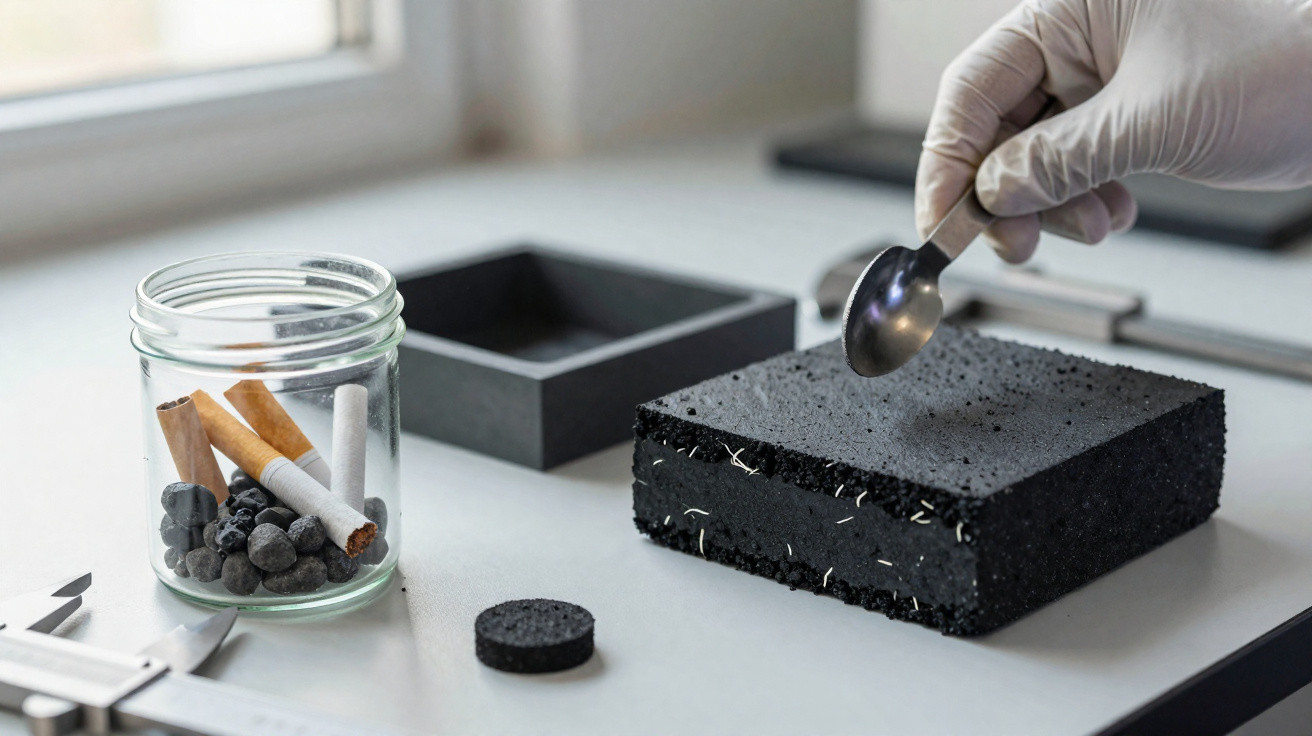
Discarded cigarette ends are a familiar sight outside shops, stations and pubs, yet the small filters create a stubborn litter problem. Most are made from cellulose acetate, a plastic-like material that does not simply disappear when it reaches a gutter, drain or waterway.
A 2017 laboratory project in Australia examined an unusual possible use for this waste: incorporating treated cigarette butts into asphalt. The crucial word is treated. The work did not suggest putting loose litter into road surfacing. It tested filters sealed with bitumen or paraffin wax, then added to carefully designed asphalt mixes under laboratory conditions.
The useful idea is not to build roads from litter, but to investigate whether difficult waste can be safely contained in a tested construction material.
Why cigarette filters are difficult to deal with
Cigarette filters can look like cotton, but they are usually made from cellulose acetate. They may persist in the environment for a long time and, once used, can retain residues from tobacco smoke.
That combination makes conventional recycling difficult. Filters are generally collected in small amounts from public spaces, often mixed with dirt, food waste, grit and other litter. Any proposed reuse must deal with hygiene, consistency and possible pollutant release.
Questions that need answering include:
- Can the material be collected and processed safely?
- Can residues be reliably contained?
- Does the added material affect strength, drainage or durability?
- Are there emissions or leaching risks during manufacture and use?
- Is there an environmental gain after transport, treatment and energy use are considered?
The work by engineers at RMIT University in Melbourne was a laboratory-scale contribution to these questions. It was not a road-building specification for councils, contractors or householders.
What the engineers tested
The researchers encapsulated cigarette filters before incorporating them into asphalt concrete. They used either bitumen, the binder already used in asphalt, or paraffin wax. The coating was intended to reduce direct contact between the cigarette waste and surrounding water or other fluids.
The treated material was added to mixes at different rates. In the reported laboratory tests, asphalt containing 10kg or 15kg of bitumen-encapsulated cigarette butts per cubic metre met the study’s stated requirements for light, medium and heavy traffic. The paraffin-encapsulated material was suitable only for light-traffic conditions in those tests.
That difference matters. The findings do not mean that any asphalt containing cigarette filters is fit for busy roads, bus routes or lorry traffic. Material quantity, coating method, aggregate blend, binder content and compaction all influence the result.
Why encapsulation matters
Bitumen is a familiar component of asphalt, so using it to coat the filters gave the treated waste a closer relationship with the surrounding material than paraffin wax did in this particular study.
The process in principle
- Collect and separate the waste
Filters would need to come from controlled collection systems, rather than mixed street sweepings. Glass, food waste, metal and other contaminants would make processing harder and less predictable.
- Treat the filters in a suitable facility
The research involved coating the filters with a sealing material. This was intended to form a barrier around the waste, not leave smoking residues exposed throughout the mix.
- Design the asphalt mixture properly
Asphalt is an engineered material, not a simple blend of stones and black binder. Aggregate grading, air voids, binder content, expected traffic and compaction all affect how it performs.
- Test the finished product
Any real-world proposal would require testing for load performance, water damage, durability, possible contaminant release and manufacturing emissions.
Encapsulation is the central engineering step: it aims to contain an awkward waste component within a stable, tested material.
The possible heat benefit - and its limits
The study found that asphalt containing encapsulated cigarette butts had lower thermal conductivity than the conventional comparison mix. Put simply, it transferred heat less readily in laboratory measurements.
This is of interest because dark asphalt absorbs solar energy, while extensive hard surfacing can contribute to the urban heat island effect. Built-up areas may stay warmer than greener, less developed places, especially during hot and still conditions.
In the tests, adding the treated filters reduced the mix’s bulk density and increased its porosity. Those changes can affect how heat moves through a material. But lower thermal conductivity does not, on its own, show that a road surface will be cooler or that a neighbourhood will experience lower temperatures.
Surface colour, shade, tree cover, building layout, wind, traffic, moisture and the layers beneath the asphalt all affect outdoor heat. Long-term field trials would be needed before making claims about a meaningful urban-cooling effect.
For UK projects, local conditions would matter greatly. An exposed retail car park in the South East has different heat, rainfall and drainage demands from a shaded residential street in northern England.
What would need proving before road use
A road has to cope with far more than its first day of traffic. It may face repeated loading, standing water, winter freezing, summer softening, maintenance works and years of surface wear.
The modified asphalt in the study had different density and porosity from standard mixes. These characteristics may help explain the thermal result, but they also need close scrutiny. Greater porosity, for example, can alter how water moves through a surface and may affect moisture damage depending on the asphalt design.
A credible move from laboratory research to a public road would require:
- reliable collection and processing methods;
- quality control for the treated filter material;
- independent assessment of leaching and emissions;
- trials in realistic weather and traffic conditions;
- whole-life environmental assessment, including transport and energy use;
- approval from the relevant highway authority and compliance with applicable UK specifications.
Why this is not a DIY recycling project
Used cigarette ends should not be collected for home-made paving, driveway repairs, garden paths or craft experiments. They can contain unwanted residues, while hot bitumen, asphalt and waxes present risks of burns, fumes and fire.
Do not burn filters, melt them into plastics or put them in household recycling. Dispose of them in a suitable litter bin or follow local council guidance. Businesses producing significant quantities should use an appropriately licensed waste contractor.
Safety notes
- Hot asphalt, bitumen and wax should be handled only by trained people using appropriate equipment and controls.
- Keep cigarette waste away from children, pets, drains and food-preparation areas.
- Never use household chemicals to try to “clean” cigarette waste.
- Never mix bleach with acids, ammonia or other cleaning products, as dangerous gases can be released.
Common mistakes when discussing recycled-content roads
Assuming a laboratory result means immediate adoption
Laboratory testing is important, but it cannot replicate every effect of years of rain, frost, UV exposure, heavy traffic and maintenance.
Treating all coatings as equivalent
The Australian tests gave different results for bitumen and paraffin wax encapsulation. The treatment method was part of the result.
Confusing heat transfer with surface cooling
Thermal conductivity is one material property. It is not a complete measure of road-surface temperature or urban heat island performance.
Ignoring contaminants because the material is recycled
Recycling does not remove the need for careful management. Encapsulation and testing are intended to limit potential release, not to assume residues are harmless.
Forgetting the collection challenge
A material is not automatically sustainable simply because it reuses waste. Collection, sorting, transport and processing all have environmental and practical consequences.
A useful idea, but not a shortcut
The most interesting lesson is broader than cigarette filters. Roads use very large quantities of material, so a safely managed recycled component could be worth investigating. But road surfacing is safety-critical, and novel ingredients must be tested thoroughly before they are used at scale.
For now, the most practical action is still prevention: dispose of cigarette ends responsibly and keep them out of pavements, gullies and waterways. If future surfacing products safely use this waste, they will depend on controlled collection, robust testing and careful engineering - not on adding litter to asphalt.







Comments
No comments yet. Be the first to comment!
Leave a Comment