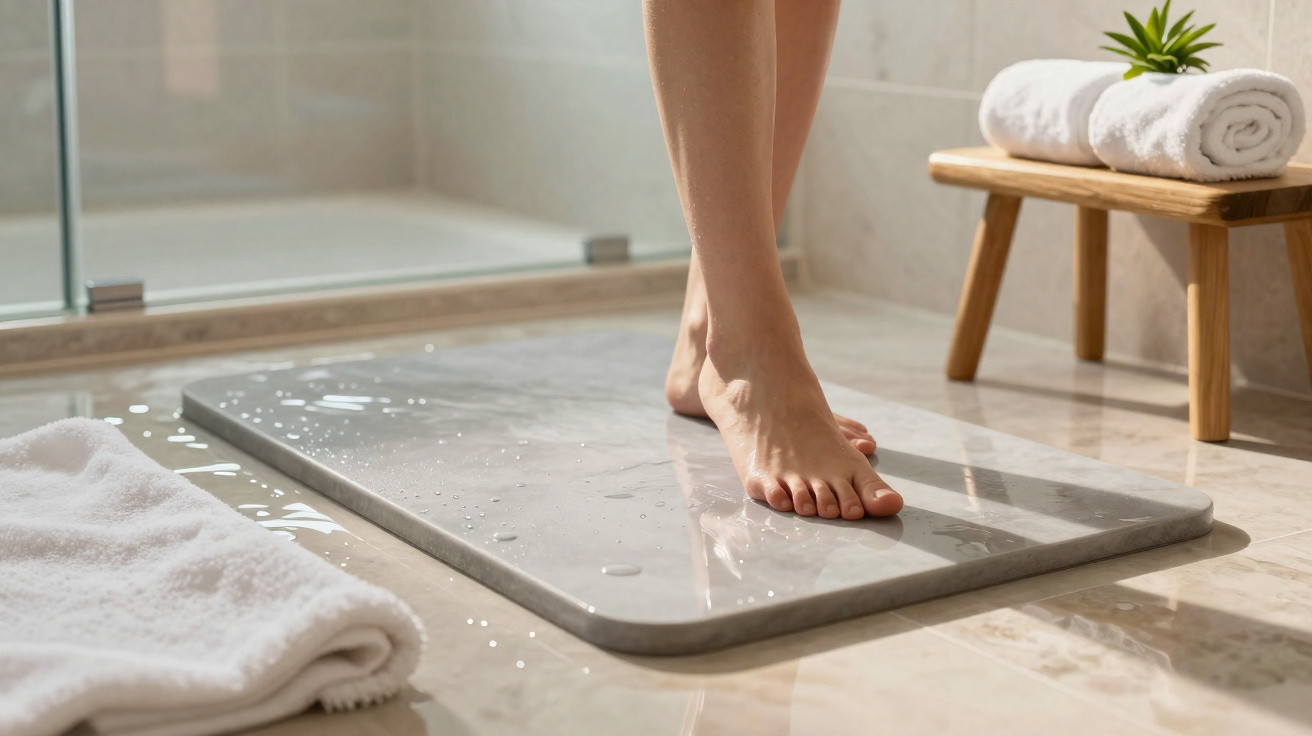
A new trend accessory promises to deal with this problem once and for all.
Anyone who regularly steps onto a wet mat after showering will suspect that it cannot be particularly hygienic. That is why modern bathrooms are increasingly featuring an alternative that looks more like a spa feature than a pile of towels: the stone bath mat, made from diatomite, also known as diatomaceous earth. It is designed to absorb water within seconds, dry out on its own and almost never need to go in the washing machine.
Why conventional bath mats fall short in everyday life
At first glance, a traditional bath rug seems inviting. It is fluffy, soft and often available in attractive colours – but that is precisely where the issue lies. Its fibres absorb water, retain it and release it only slowly.
After every shower, the mat remains damp. Moisture penetrates deep into the fabric, collects there and, in the worst cases, can even soak through to the floor underneath. In a warm bathroom, this creates ideal conditions for germs, mould spores and unpleasant smells.
“A damp fabric mat often stays wet for hours – an open buffet for bacteria and mould.”
To combat this, the mat needs regular washing. That uses electricity, water, detergent and patience. Many households know the routine: despite being cared for, the rug looks faded after only a few months, its backing begins to crumble, and it has to be replaced.
The fundamental issue with fabric in the bathroom
This is not an isolated problem; it is inherent to the material itself. Textiles are designed to absorb moisture. Cotton, microfibre and similar materials work like a sponge: they take in water extremely quickly but hold on to it just as stubbornly.
Even particularly thick or “quick-drying” versions do not solve the underlying problem. They may dry somewhat faster, but they still remain damp for long enough to encourage unpleasant odours and germs. This is exactly where stone bath mats use an entirely different approach.
How a stone bath mat works
These modern mats are generally made from diatomite, also called diatomaceous earth. Fine mineral components, wood fibres and sometimes lime are compressed together to create a solid, slightly porous board.
At a glance, it resembles smooth stone. Inside, however, there is a network of microscopic channels. This structure means water does not simply sit on the surface: it is drawn into the board and distributed throughout it.
“In everyday use, the effect is this: after just one or two seconds, your own footprints already feel dry again.”
The process after showering can be broadly outlined as follows:
- Water from your feet reaches the surface.
- The pores absorb the moisture immediately.
- Inside the mat, the water spreads through numerous tiny channels.
- From there, it gradually evaporates into the room air.
As a result, the surface dries remarkably quickly. Unlike fabric, it does not develop a permanently wet layer in which germs can thrive. The mat sits securely, feels pleasantly cool and provides grip rather than becoming slippery.
The main benefits at a glance
Compared with a conventional bath rug, the stone version offers several features that make a noticeable difference in daily life:
- Exceptionally fast absorption: Wet feet do not leave puddles, only brief footprints that quickly disappear.
- No clammy sensation: The surface feels damp only briefly before becoming dry again.
- Less odour: Because moisture vanishes more quickly, the basis for unpleasant smells is removed.
- Improved hygiene: Dry surfaces provide much less favourable conditions for germs.
- More secure footing: The subtly textured finish offers grip, even under wet feet.
- Floor protection: A non-slip underside helps prevent scratches on tiles or parquet flooring.
Care: no more piles of bathroom laundry
One major advantage of a stone bath mat is the minimal maintenance it requires. While fabric mats must be put through the washing machine regularly, the stone board simply stays in place.
For everyday care, it is enough to stand it upright occasionally, around once a week, so that any residual moisture can evaporate completely. If limescale marks or soap residue become visible, a damp cloth or a very fine sanding pad will help; the latter is often supplied with the mat.
“No wash cycle, no spin cycle, no tumble dryer – the stone mat saves time, money and energy.”
Households with children or pets benefit twice over: there are fewer trip hazards caused by curled-up rug edges, and the bathroom is far less likely to become a wet, trampled mess.
Choosing the right stone bath mat
The selection online is now extensive. There are plain light-grey boards as well as versions with understated patterns. A few practical criteria are particularly important.
Size, shape and thickness: what matters
Stone bath mats are rigid rather than flexible. They cannot be rolled up or folded. Before purchasing, it is therefore worth checking the layout of your bathroom: if the shower enclosure is set into a recess, you may need a narrower size, while the space in front of a bath can accommodate a larger mat.
| Criterion | What should you look for? |
|---|---|
| Size | It should be at least as wide as the shower or bath area. |
| Thickness | Thicker models seem more robust, but are slightly heavier. |
| Surface | It should be lightly textured for better grip, rather than highly polished and smooth. |
| Colour | Light shades can make the bathroom appear larger, while darker tones look elegant. |
| Underside | Non-slip pads or silicone feet are essential. |
Many buyers also look at customer reviews: How hard does the surface feel under bare feet? Does the mat dry reliably in an internal bathroom without a window? Does the colour remain stable over time? These everyday observations are far more useful when choosing than marketing copy alone.
Design: a small stone mat with a big effect
Function is not the only consideration; appearance matters too. In contemporary interiors, stone mats are increasingly used as a deliberate contrast: a smooth, calm element between the tiles and shower screen, almost like a small platform for your feet.
Bathrooms with a minimalist or Scandinavian-inspired style particularly suit their restrained, natural shades. Those who prefer a warmer look can choose slightly beige or sandy versions. Some models even feature fine lines, geometric patterns or a subtle marble effect.
Price, durability and possible disadvantages
Depending on their size and brand, stone bath mats generally cost around €40 to €180. Small standard formats sit at the lower end of the range, whereas large designer pieces with specialist coatings are considerably more expensive.
In return, these boards usually last much longer than fabric mats, provided they are not dropped or struck hard. Anyone who treats the mat like a tile – setting it down carefully and avoiding knocks – can often expect it to last for several years.
However, the trend is not entirely without drawbacks:
- A firmer feel underfoot: Anyone used to soft rugs may find the solid surface unfamiliar at first.
- Risk of breakage if dropped: If the board lands badly on a corner, it may chip or crack.
- Weight: Depending on the size, stone mats are slightly harder to move than textile mats.
Many users report becoming accustomed to the new sensation after just a few days. For particularly sensitive feet, it may be worth placing a small washable rug some distance away as an additional option – not as a replacement.
Who benefits most from switching to a stone bath mat
The greatest benefit goes to people who use their bathroom frequently: families with several showers a day, house shares or couples sharing a small bathroom. In these situations, a fabric rug is almost constantly wet, while the stone bath mat can fully demonstrate its strengths.
Allergy sufferers and those especially conscious about hygiene also often choose one, as there is less textile surface in the bathroom for dust, hair or mould spores to settle on. Anyone watching household spending should not underestimate the electricity and water costs of repeated wash cycles – over a year, the one-off purchase price may pay for itself faster than expected.
The trend is also particularly useful for small bathrooms with poor ventilation. Where steam lingers in the air for a long time after showering, rapid drying times are crucial to prevent the room from staying persistently humid.
Practical everyday tips for a stone bath mat
A few simple habits will help keep the mat in good condition for a long time:
- After heavy use, occasionally stand the mat upright against the wall.
- Clean significant marks using a lightly dampened cloth and, if included, the supplied sanding pad.
- Do not use aggressive cleaning products or abrasive sponges, as these may damage the surface.
- Ensure the underside stays clean and dry so that the non-slip pads continue to grip properly.
If you wish, the stone bath mat can also be used for other purposes. Many people place smaller versions in front of the washbasin or a guest toilet to absorb splashes quickly. Combined with plants, wooden accessories and warm lighting, it can make the bathroom feel almost like a small spa area – with very little effort.


Comments
No comments yet. Be the first to comment!
Leave a Comment