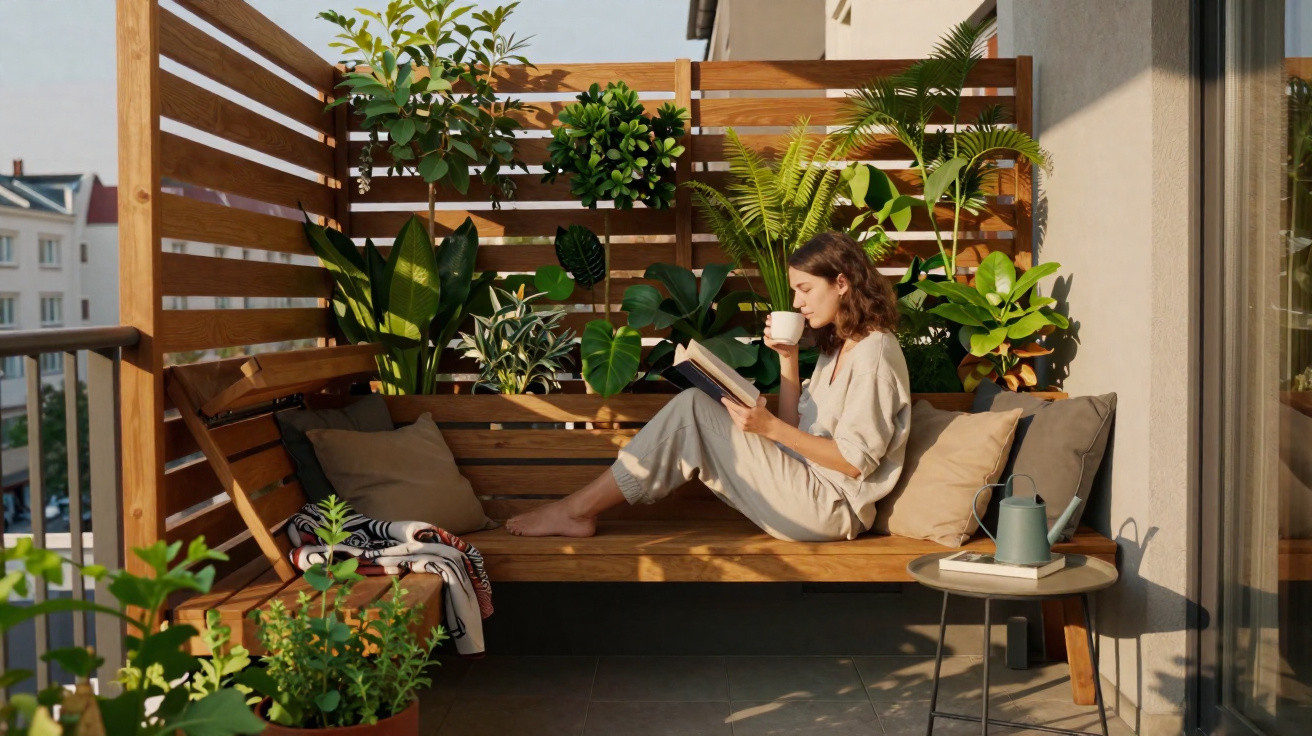
Living in a city means knowing the feeling all too well: you sit down on the balcony with a coffee or an after-work beer, only to sense inquisitive eyes from opposite staring at you. Major alterations are often prohibited or too costly, while privacy-screen walls take up valuable room. This is where a modular IKEA privacy screen comes in, combining three purposes in one piece of furniture and transforming compact outdoor areas.
Why privacy matters so much on balconies and in tiny gardens
Cities are becoming more densely built, balconies are shrinking and the gaps between buildings are getting narrower. At the same time, many people want an outdoor retreat that feels like “their own room” rather than a stage for the entire neighbourhood.
Market research indicates that the global market for privacy screens and fencing is already worth almost $19 billion. That is a clear sign that outdoor privacy is increasingly sought after, much as living space in general is becoming more expensive. Every square metre matters, particularly in major cities.
People who feel unobserved use their balcony or garden far more often - for eating, working, sunbathing or simply taking a breather.
Many traditional options prove impractical in everyday life: permanent fences or palisades require permission, planters take up a great deal of space, and hedges grow slowly while needing maintenance. Tenants are often not allowed to drill holes or install anything permanently. The need, therefore, is for something flexible, movable and space-saving.
The IKEA solution: a mobile privacy screen that does much more
This is precisely where IKEA’s NÄMMARÖ range comes in. At its centre is a freestanding screen module that can be positioned without screws or wall fixings. The basic version consists of a privacy-screen panel made from solid acacia wood. This timber is considered sturdy and weather-resistant, while also creating a homely look rather than the feel of an industrial fence.
Its wooden slats are arranged to allow light and air through while disrupting direct lines of sight. Anyone looking from a window opposite will only see indistinct shapes, immediately making the balcony feel more sheltered.
3-in-1 function: privacy screen, bench and storage in one
The extended version is where it becomes especially interesting, as this piece of furniture combines three functions at once:
- Privacy screen to shield you from nosy neighbours
- Small bench for sitting and relaxing
- Large storage space for cushions, throws and odds and ends
The modular arrangement places the screen at the top and a bench unit with an integrated storage box beneath it. Measuring approximately 80 × 68 × 140 centimetres, it is compact enough for typical city balconies yet substantial enough to make a noticeable difference.
The box can hold seat pads, blankets, children’s toys or gardening equipment. This helps keep a balcony or terrace from looking permanently cluttered. One user review sums it up neatly: “Great product, easy to assemble and finally room for all the seat cushions.” It is this combination of tidiness, comfort and privacy that makes the concept appealing.
A single privacy-screen element costs around €75. Depending on promotions, the bench-and-storage version is likely to cost between €170 and €220. It is not a bargain, but it is reasonably priced when compared with permanently installed screening systems or bespoke joinery.
How the NÄMMARÖ module changes daily life in small outdoor spaces
One key detail is that the furniture is freestanding. Nothing is screwed down or attached to the exterior wall, so it can simply be moved or repositioned completely.
That creates a surprisingly wide range of day-to-day options:
- In the morning, move the privacy screen in front of low sunlight.
- In the evening, turn the element so the view from a neighbouring balcony remains blocked.
- At weekends, push two modules together to create a small lounge area.
On a narrow balcony, the element can stand parallel to the balustrade. Views upwards from the courtyard below are screened off, while the outlook ahead remains open. A tall planter or potted grasses extending above the 140-centimetre height can enhance the protection, giving the corner the character of a small urban garden.
In a miniature city garden, the unit works as a room divider: the bench box can separate a dining area with a table from a lounging area with a sun lounger. It can also conceal less attractive items such as wheelie bins or an outdoor air-conditioning unit. Positioning two elements in an L shape creates a cocoon-like setting, ideal for a reading nook or a sheltered children’s play area.
Vertical planting: turning the privacy screen into a green wall
Another advantage is that the slatted design is highly suitable for vertical planting. Lightweight hanging pots, plant supports and strings can easily be secured to it. This produces a kind of miniature green wall without sacrificing ground space for flower beds.
Vertical gardening is regarded as one of the most effective ways to make the most of limited space, especially in cities.
Small trailing herbs such as thyme or oregano, flowering seasonal plants, or climbing varieties including nasturtiums bring colour and fragrance to the privacy screen. Those who prefer a minimalist look can choose evergreen plants or grasses in simple pots, so the balcony remains reasonably attractive during the colder months too.
Everyday care and durability
As it is made of acacia wood, the furniture needs a little care to retain its appearance over time. Refreshing it once a year with wood oil or stain is recommended. Dirt can be removed with water and a little soap. Covering the box over winter, or moving it under cover where possible, will significantly extend its lifespan.
This is particularly important for rented homes: because nothing is permanently fixed, the module can be taken with you easily when you move. That lowers the barrier to investing in a better-used balcony in the first place.
What to consider before buying
Before making a purchase, it is worth checking a few practical points:
- Balcony load capacity: Wood, storage and plants all add weight. This is generally not a problem, but a quick check never hurts.
- Wind conditions: In particularly exposed locations, an open privacy screen may wobble. In such cases, weight in the storage compartment or non-slip pads can help.
- How you use the space: Anyone who mainly uses their balcony for meals may place the module alongside the table. Those who work or read there can create a more secluded corner with the bench and a side table.
A quick floor plan drawn on paper is often enough to establish how many elements make sense. Sometimes a single module creates a noticeable improvement, for example when one particular neighbouring window is the issue.
How the furniture can be combined with other ideas
The IKEA privacy screen works particularly well alongside other simple measures. A small outdoor rug visually separates the “living area” from the rest, while string lights or solar lamps provide a cosy evening glow without harsh floodlight-style brightness.
In extremely tight spaces, such as those with a depth of only one metre, folding chairs or stools can replace conventional balcony furniture. They can be stored away after use in the storage box, keeping the area adaptable while retaining its sheltered feel.
Its psychological effect should not be underestimated either: people who consciously design their outdoor area view it differently - as their own space rather than a passageway. A mobile privacy screen such as NÄMMARÖ makes it easier to use that space in practice, whether for home working during a lunch break or a quick power nap in the fresh air.
Ultimately, it is less about the piece of furniture itself than the principle behind it: in a small space, multifunctional solutions can turn an anonymous balcony into a personal retreat. An element that brings together screening, seating and organisation fits this logic perfectly - ensuring that nosy neighbours may still be there, but matter far less in everyday life.






Comments
No comments yet. Be the first to comment!
Leave a Comment