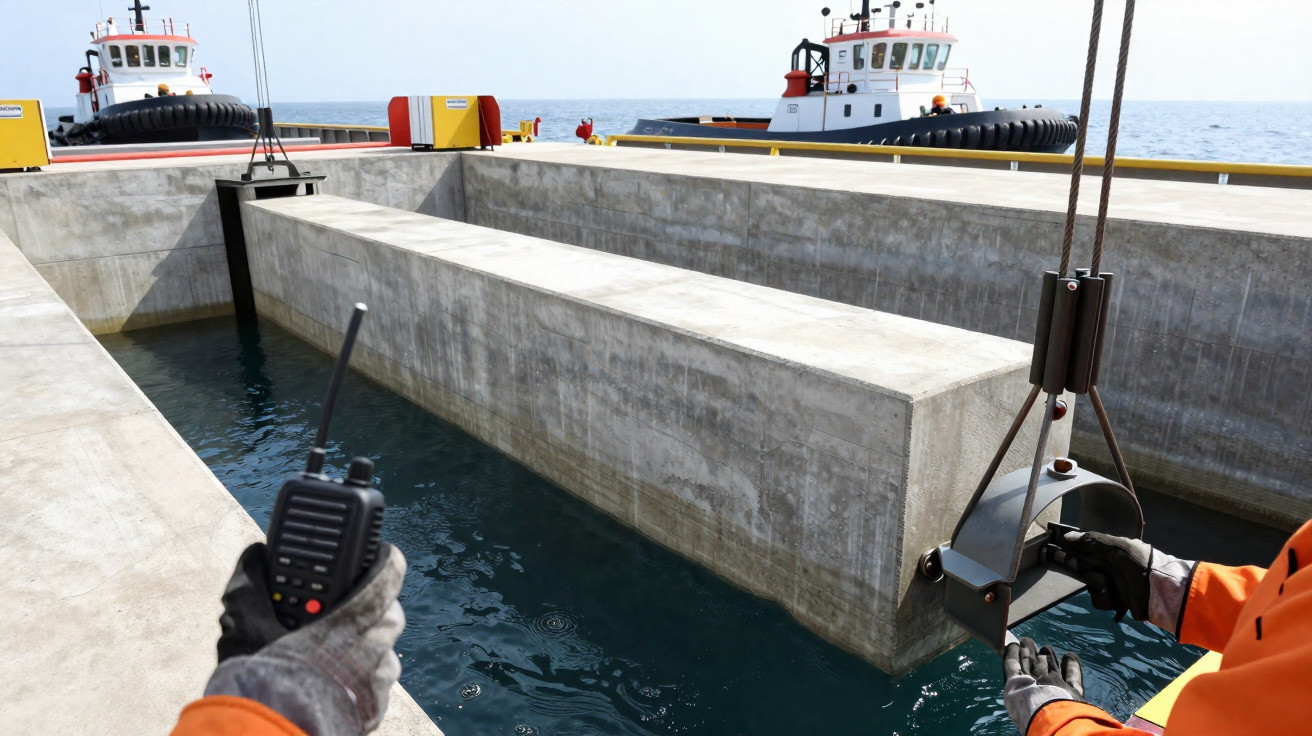
It is easy to assume that every major undersea tunnel begins with a giant boring machine cutting through rock. The Fehmarnbelt Fixed Link between Denmark and Germany uses a very different method: vast concrete sections are cast on land, made watertight so that they float, then lowered one by one into a prepared trench on the Baltic seabed.
The central idea is surprisingly straightforward, even if the execution is anything but. Rather than building a tunnel in open water, engineers turn each completed tunnel element into a temporary floating structure, tow it into position, immerse it with specialist equipment and seal it to the previous section.
The engineering is immense, but the sequence is repeatable: cast, float, tow, immerse, join and protect.
What is being built beneath the Fehmarnbelt?
The planned fixed link will run between Rødbyhavn on the Danish island of Lolland and Puttgarden on the German island of Fehmarn. At roughly 18 kilometres (11 miles), it is expected to be the world’s longest immersed tunnel when complete.
Its design includes:
- a four-lane road, with two lanes in each direction;
- two electrified railway tracks;
- technical areas for tunnel systems;
- access and safety arrangements for maintenance and emergencies.
This is an immersed tunnel, not a conventional bored tunnel. Instead of driving a circular tunnel deep through rock, the project uses rectangular concrete elements laid end to end in a dredged trench on the seabed.
That explains the remarkable sight at the construction harbour: structures that look like enormous concrete boxes floating on water before being taken offshore.
Why a concrete tunnel element can float
A standard Fehmarnbelt tunnel element is about 217 metres long, 42 metres wide and weighs about 73,500 tonnes. In imperial measurements, that is around 712 feet long and roughly 81,000 US tons.
Although each element is extraordinarily heavy, it can float while sealed because the enclosed air-filled volume displaces enough water to support its weight. The principle is the same as for a ship, applied to a structure with several transport and technical compartments inside.
The elements are produced at a purpose-built facility at Rødbyhavn. Casting them on land makes it possible to carry out construction and checks in relatively controlled conditions before the weather-sensitive marine operation begins.
This approach also allows different teams to focus on different tasks:
- factory crews can cast and prepare elements on land;
- harbour teams can manage floating-out operations;
- dredging teams can prepare the trench;
- marine specialists can handle towing, positioning and immersion.
The element is not simply dropped onto the sea floor. It requires carefully designed bulkheads, seals, ballast arrangements and connection systems before it can be floated, transported and joined to the growing tunnel.
How an element reaches the seabed
Moving a structure of this size is a closely controlled marine operation. Tugboats guide the floating element from the construction harbour, while a purpose-built immersion vessel supports it during the most precise stage of the journey.
The vessel, known as IVY, grips the tunnel element at both ends. Its role is more than towing: it provides controlled support while the element is aligned and lowered into the trench.
1. The completed section is floated out
After the concrete has cured and the element has been prepared, water is admitted to the dock around it. Because its openings are sealed, the unit floats and can be moved into the harbour.
2. Tugboats escort it offshore
The journey to the installation point is carefully planned. Wind, currents, visibility and sea conditions all matter, particularly when a broad floating structure must remain stable and accurately controlled.
Even a comparatively sheltered stretch of the Baltic can become unsuitable for precision work. Marine operations are scheduled around approved weather limits rather than a fixed daily timetable.
3. The immersion vessel positions it
IVY takes the element in hand at both ends. Survey equipment and positioning systems are used to bring the new section into line with the tunnel already installed on the seabed.
4. It is gradually submerged
The element is lowered into the prepared trench using controlled support and ballast procedures. This is not a free fall or a simple vertical lowering operation: level, position and approach must be managed continuously.
5. The new and existing elements are sealed together
When the element reaches the previous section, specialist gaskets form a watertight joint. Water is removed from the connection space, allowing external water pressure to help press the elements together.
Water is not merely an obstacle in this method. It provides buoyancy during transport, then external pressure assists the sealed joint once the elements meet.
Why the fourth installation was significant
The installation of the fourth standard element extended the assembled tunnel on the seabed to about 900 metres, or 2,950 feet. That is a small proportion of the eventual route, but early immersions are important because they test the whole construction sequence in real offshore conditions.
A successful installation confirms that several complex systems can work together, including:
- harbour and towing procedures;
- the immersion vessel and its support equipment;
- survey and positioning methods;
- preparation of the seabed trench;
- jointing and sealing processes;
- communication between marine, engineering and safety teams.
At that stage, 85 further elements remained to be installed. The completed tunnel is planned to comprise 89 elements: 79 standard elements and 10 special elements.
The special elements are not simply longer boxes
Most of the tunnel is made up of standard elements, but 10 special elements have a different internal arrangement. They are shorter and include an additional lower level for technical equipment.
These sections are intended to accommodate systems needed for the operation of the tunnel, while also supporting practical needs such as maintenance access and incident management. In a long road and rail crossing, those details need to be built into the structure rather than added as an afterthought.
A different internal layout also changes the way an element behaves while floating and being immersed. The project therefore has to account for its weight distribution, stability and the loads transferred through the immersion equipment.
Common mistakes when picturing an immersed tunnel
Assuming the whole route is mined underground
The seabed has to be dredged and prepared, but the main tunnel sections are made above water. They are then lowered into the trench and covered with protective material.
Thinking the elements sink under their own weight
They are controlled throughout the immersion process. Specialist equipment, surveying, ballast management and experienced marine crews are required to achieve the necessary alignment.
Treating all 89 elements as identical
Most are standard elements, but the special sections have different dimensions and technical spaces. Their handling and installation require their own planning.
Looking only at the concrete
The concrete structure is only one part of the project. The completed link also depends on seals, drainage, power, communications, railway equipment, road systems, monitoring and safety infrastructure.
Safety and environmental controls are central
Marine construction carries obvious risks. Heavy floating structures can be affected by wind, waves and currents, and offshore lifting or immersion work must be stopped if conditions fall outside approved limits.
Strict exclusion zones, vessel controls and lifting procedures are essential. Footage of a calm-looking immersion should not be mistaken for a routine activity: the apparent smoothness depends on extensive preparation, specialist equipment and close monitoring.
Seabed work can also disturb sediment and affect local water conditions. Projects of this scale are subject to environmental requirements, monitoring and mitigation measures, which can influence both the order and timing of construction.
These operations are not public viewing areas. People should follow harbour restrictions, keep clear of controlled marine zones and never attempt to approach work vessels or floating structures.
What happens once an element is installed?
Placing an element is a major milestone, but it does not make a finished tunnel. Once the elements are connected, the structure needs protection with material placed over and around it. Internal works then include road surfaces, railway systems, electrical installations, drainage, communications, ventilation and safety equipment.
Meanwhile, production on land can continue as offshore installation proceeds. Having completed elements ready in the harbour can help the project take advantage of suitable weather windows when they arise.
The most useful way to follow progress is not simply to count metres of tunnel on the seabed. It is to watch whether element production, trench preparation, marine installation and internal fit-out remain coordinated. The Fehmarnbelt project shows how a huge engineering challenge can be divided into repeatable pieces - provided every stage is planned with exceptional care.















Comments
No comments yet. Be the first to comment!
Leave a Comment