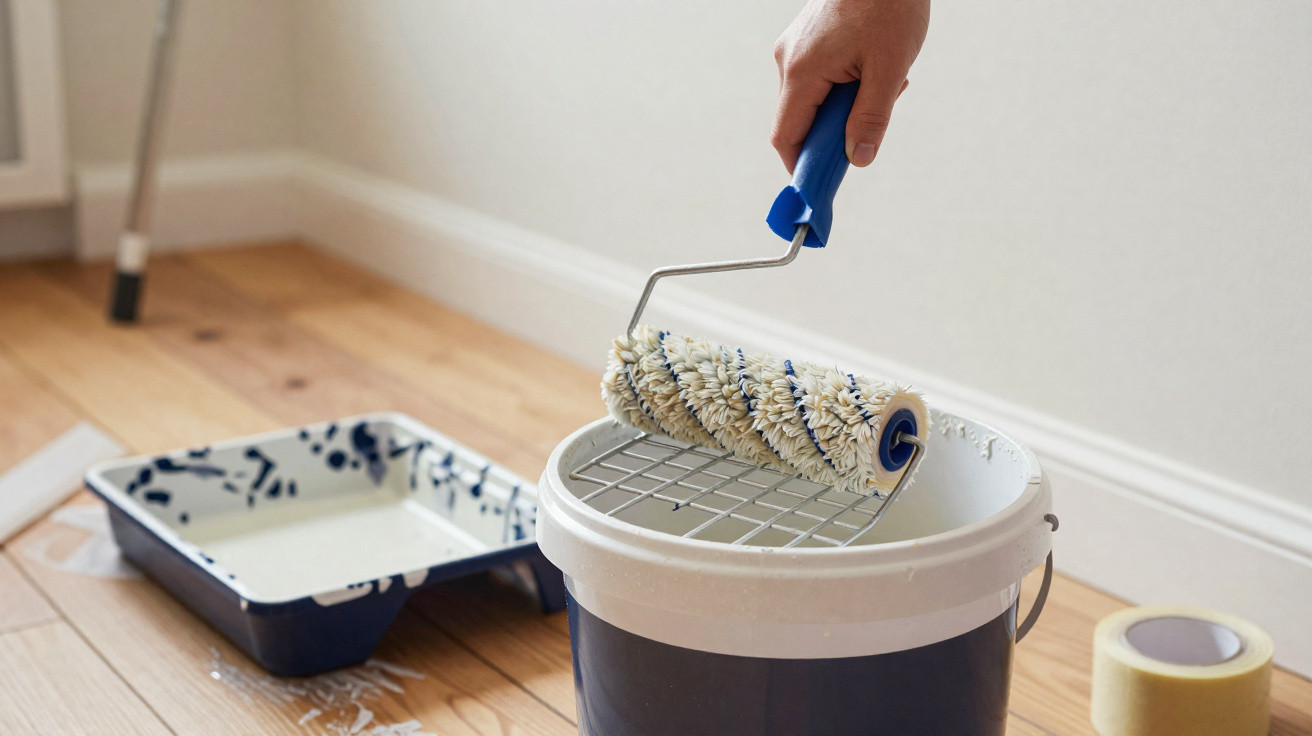
A paint tray is cheap, familiar and perfectly suitable for many small decorating jobs. But for a ceiling, a hallway or several full walls, professional painters often reach for a bucket and roller grid instead. The simple switch helps with the everyday frustrations of painting: constant refilling, an over-loaded roller, splatter and the chance of treading in or knocking over a shallow tray.
The method is straightforward. Paint sits in the bottom of a bucket, and the roller is dipped into it before being worked up and down a grid hanging inside the rim. The grid spreads paint through the sleeve and removes the surplus. For room-sized jobs, that usually means steadier loading and fewer drips.
What a bucket and roller grid does
A roller grid is a rigid metal or plastic screen with hooks that sit over the edge of a suitable bucket. Its ribbed or mesh section hangs down inside the bucket, above the paint level.
Instead of pouring paint into a shallow well, you pour a manageable amount into the bucket. Dip the roller sleeve part-way into the paint, then roll it over the grid a few times. This coats the sleeve evenly while taking off excess paint.
An overloaded roller is a common cause of splashes, drips and heavy lines at the ends of each roller pass. A correctly loaded sleeve should look evenly covered, but not glossy, swollen or dripping.
The point is not to squeeze the roller dry. It is to load it evenly enough to cover the wall without flicking paint around the room.
Why painters often prefer it for larger jobs
A bucket holds more paint than a tray, so there is less stopping to top it up. Its high sides also leave less paint exposed and can make accidental splashes less likely while you work.
The main benefits are practical:
- More capacity: helpful for ceilings, stairwells and several walls.
- More consistent loading: the grid gives you room to work paint into the full width of the sleeve.
- Less frequent pouring: useful when you are trying to keep a wet edge on a large wall.
- A smaller floor footprint: a bucket can be easier to position than a wide tray in a narrow room.
- Convenient use with an extension pole: you can reload from floor level rather than taking a tray up a ladder.
- Simpler short pauses: the roller can rest on the grid briefly while you cut in or move dust sheets.
A bucket is not spill-proof, however. Keep it on a stable, protected surface and do not carry it while it is full. If you need to move paint between rooms, fit the proper lid securely first and carry it carefully by the handle.
Choosing a bucket, grid and roller
The three parts need to work together. A grid that is too small may shift on the rim; one that is too wide may not hang securely. Check the stated bucket and roller width before buying.
For many interior walls, a 9-inch roller is a practical all-round choice. A decorator’s bucket of roughly 10 to 15 litres, paired with a matching 9-inch grid, is commonly useful for room painting. Mini rollers and smaller grids are better for cupboards, narrow sections and other awkward areas.
Choose the sleeve pile to suit the surface:
- Short pile: smooth plaster, previously painted smooth walls and some woodwork.
- Medium pile: most interior emulsion on plaster walls and ceilings.
- Long pile: textured walls, masonry and rough render.
Longer-pile sleeves hold more paint, which makes the grid particularly useful. It helps prevent the roller becoming saturated and leaving thick ridges or spatters.
If you are working on an old textured coating, take care. Some older textured finishes may contain asbestos. Do not sand, drill, scrape or otherwise disturb a suspect surface; seek appropriate professional advice before preparing it.
Before you start
- Cover floors with dust sheets and protect skirting boards, sockets and fittings where needed.
- Stir the paint thoroughly, following the instructions on the tin.
- Pour only enough paint into a clean bucket to cover the lower part of the roller sleeve. Leave plenty of dry grid above the paint level.
- Hang the grid over the rim and make sure it is stable before you begin.
- Keep a damp cloth to hand for water-based paint spills, and a small brush or paint kettle for cutting in.
How to load a roller from a grid
It takes only a few minutes to get the feel of the method. The key is to load slowly and avoid forcing paint onto the wall.
The loading method
- Dip, rather than submerge. Put around the lower third to half of the sleeve into the paint. Try not to dip the roller frame or handle.
- Roll steadily over the grid. Move the roller upwards, then back down. Two or three passes will often be enough.
- Check the sleeve. Paint should cover its full width, with no dry bands, but should not be running off the edges.
- Start slightly away from corners. Put the roller on the wall a short distance from the edge, then spread the paint out using overlapping W or M-shaped strokes.
- Lay off gently. Before the paint begins to dry, finish with light strokes in one direction to even out the texture.
Work in sections you can complete while the paint is still wet. Water-based emulsions can dry quickly in a warm, centrally heated room, so avoid overworking one patch. Very strong draughts may also dry paint too fast or blow dust onto a fresh surface.
When a paint tray is the better choice
A grid is useful, not compulsory. For a small repair, a single narrow wall, window reveals or a quick touch-up, a tray is often faster to set up and easier to clean.
A tray may be the better option when:
- you are using a mini roller and only a small amount of paint;
- you have a compact job where a bucket would be awkward;
- you are working with a roller width that does not suit your bucket and grid;
- you are applying a specialist coating and want to decant only a small amount;
- you prefer using disposable tray liners for a short job.
There is nothing inferior about using a tray. Surface preparation, paint choice, the correct roller sleeve and careful application have far more effect on the finish than the container you load from.
Use a bucket and grid for capacity and controlled loading; use a tray when its smaller size makes the task simpler.
Common mistakes that cause splatter and uneven coverage
The bucket-and-grid method works best when the roller is loaded with restraint. Avoid these common errors:
- Overfilling the bucket: the upper section of the grid must remain clear to remove excess paint.
- Using a dirty bucket or grid: dried flakes and dust can spoil a fresh finish.
- Rolling too fast: vigorous loading can flick paint onto floors, clothing and nearby walls.
- Pressing hard on the wall: let the roller release paint naturally; pressure can create ridges and splatter.
- Ignoring paint build-up at the ends: run the roller lightly over the grid again if paint gathers there.
- Using the wrong pile length: long pile can leave too much texture on smooth plaster, while short pile may not reach into a rough surface.
- Stopping mid-section: where possible, finish a natural area while the paint remains wet to reduce lap marks.
Cleaning, storage and safety
Clean the grid promptly after use, as dried paint is difficult to remove from its mesh or ribs. First scrape or roll as much surplus paint as possible back into the bucket or tin. For water-based paint, clean the roller frame, grid and reusable sleeve according to the paint and tool manufacturers’ instructions.
Do not wash large amounts of leftover paint into sinks, outdoor drains or gutters. Let residue dry where appropriate, use a paint-hardening product if recommended for the material, and check your local council’s guidance on disposing of leftover paint and empty containers.
For solvent-based coatings, use only the cleaner specified on the tin, keep the room well ventilated and keep solvents away from flames, heaters and other ignition sources. Wear gloves if your skin is sensitive, and use eye protection when painting overhead.
Never mix paint residues or household cleaning products. In particular, never mix bleach with acids, ammonia or other cleaners, as hazardous fumes can result.
A worthwhile upgrade for room-sized painting
For a whole room, a bucket and roller grid can make painting feel calmer and more manageable. It gives you more paint capacity, helps prevent an over-loaded roller and reduces the constant interruption of topping up a tray.
Choose a grid that fits securely, start with a clean bucket and practise the loading motion on a spare board or an inconspicuous area. Keep a tray for smaller tasks, but for ceilings, hallways and several full walls, a bucket and grid is a useful addition to a decorating kit.






Comments
No comments yet. Be the first to comment!
Leave a Comment