Saving for a plot can take years, but buying the land is often only the beginning. The cost of foundations, drainage, a roof, insulation and services can make a conventional build feel out of reach long after the purchase is complete.
That is why Cindy Mora’s story has attracted attention. However, the headline needs an important correction: her home was not made entirely from recycled plastic. Recycled-plastic interlocking blocks were used for the walls within a wider building system that still required conventional foundations, roofing, windows, plumbing and electrical work.
A long route to having a home
Accounts of the project say Mora saved for nine years to buy land in Alajuelita, near San José, Costa Rica. Owning a plot did not automatically make a house affordable, so the eventual build depended on a collaborative housing project, technical support and volunteer labour.
That gap between buying land and funding a home will be familiar to many people in the UK. A site may be a major milestone, but it is only one part of the budget. Surveys, planning, design fees, groundworks, drainage connections, structural work and weatherproofing can all add substantially to the final cost.
The useful lesson is not that plastic can replace every familiar construction material. It is that recovered material can sometimes be turned into a purpose-made product for one part of a properly designed building.
A recycled building product is only as useful as the system around it: design, testing, installation and long-term maintenance all matter.
What the recycled-plastic blocks did
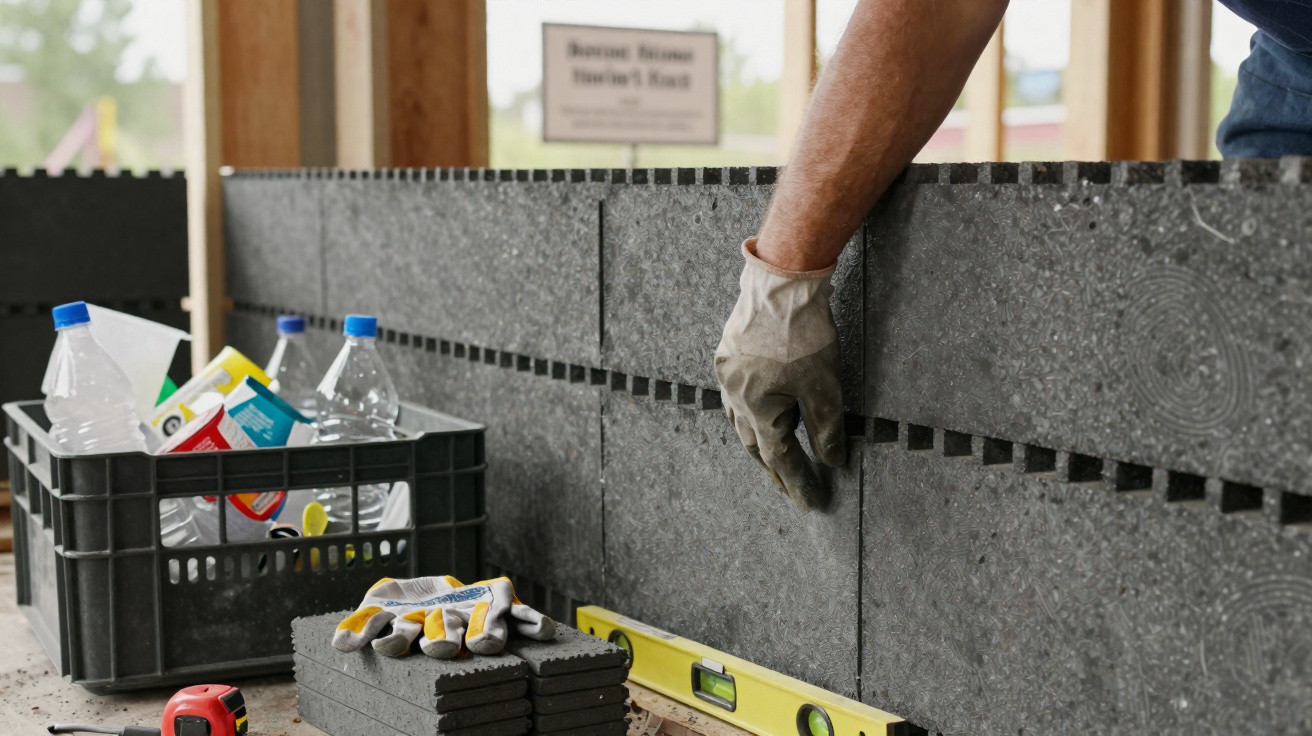
The project used interlocking wall blocks manufactured from processed recycled plastic. These blocks were made to fit together in sequence, rather than being treated as loose waste plastic or improvised building material.
Interlocking systems can simplify parts of wall assembly, particularly where components are consistently manufactured and installers follow an established method. But they do not remove the need for a safe structure or careful construction.
A habitable home still needs:
- foundations designed for the site and ground conditions;
- a roof that deals with sun, wind and heavy rain;
- doors, windows and weather seals;
- safe plumbing, drainage and electrical installations;
- finishes that make the building durable and usable.
The plastic content was therefore concentrated in the wall-block system, rather than in the whole house. That distinction is especially important when describing unusual construction projects, as a striking headline can make a specialist method sound more universal than it is.
Why interlocking systems attract interest
Purpose-made interlocking blocks can appeal to community and self-build projects for practical reasons. Depending on the product and design, they may reduce the amount of wet mortar used during wall assembly and make repeated installation tasks easier to organise.
Potential advantages may include:
- putting recovered material to productive use;
- consistent block dimensions from factory production;
- less cutting and site waste in some designs;
- a construction sequence that trained volunteers can support;
- potentially lighter components than certain masonry products.
None of these points should be assumed, though. Plastic-based products vary widely. Their performance can be affected by ultraviolet light, high temperatures, impact, movement, moisture and fire. A product suitable for a non-structural partition may be wholly unsuitable for an external or loadbearing wall.
Why this cannot simply be copied in the UK
A wall system used in Costa Rica cannot automatically be transferred to a British building site. The climate, regulations, construction standards and local availability of materials are different.
In the UK, a home must be designed to manage persistent rain, wind-driven water, cold weather, condensation risk and heat loss. Building Regulations also differ across England, Wales, Scotland and Northern Ireland, so requirements should be checked for the nation where the work is taking place.
Recycled content already appears in a range of UK construction products, including some insulation, drainage components, aggregates, boards and composite materials. But the percentage of recycled material is not, by itself, a measure of safety, durability or environmental benefit.
Before choosing an unfamiliar system, speak to an architect, structural engineer, building-control body or other appropriately qualified professional. They can help establish whether the proposed use is supported by suitable technical information.
Questions to ask before specifying a product
What job is it designed to do?
Establish whether it is structural, non-structural, insulating, decorative or intended only for external landscaping.What technical evidence is available?
Ask for installation instructions, performance data and independent assessment information where relevant.How does the complete wall perform in fire?
Fire performance concerns the whole construction, including linings, insulation, cavities, fixings and finishes - not just one block or panel.How will moisture be controlled?
Check details for rain penetration, ventilation, condensation and vapour control, particularly in exposed locations.Who is responsible for installation?
Some products require trained installers, specified fixings or site supervision for their stated performance to apply.Will building control accept the proposal?
Ask early, before placing an order or finalising drawings.
Common mistakes when discussing recycled-plastic homes
Innovative housing stories can encourage useful conversations, but they also invite misleading shortcuts. These are the mistakes worth avoiding.
- Saying the entire house is plastic. In Mora’s case, recycled plastic was used in the wall blocks, not in every building element.
- Treating household packaging as building stock. Loose bottles, wrappers and containers are not a safe substitute for a tested construction product.
- Assuming recycled means low-carbon. Manufacturing, transport, service life, repairability and eventual disposal all affect a material’s overall impact.
- Overlooking insulation and airtightness. A wall’s appearance does not reveal how well it manages heat loss or condensation.
- Ignoring the site. Foundations, drainage and wind exposure must be designed for the actual plot, not copied from an online project.
- Forgetting future repairs. Check how a system can be altered, repaired or replaced if damage occurs.
A low-waste house still has to be safe, dry, warm and maintainable for many years.
Safety and approval come first
Do not use unapproved recycled-plastic blocks, panels, bottles or containers as structural parts of a home. Materials intended for packaging, storage or landscaping may not have been tested for structural loads, fire exposure or long-term weathering.
Avoid cutting, melting or burning unknown plastics. Heating plastic can create hazardous fumes, while its fire behaviour may be very different from brick, blockwork or timber. Follow the manufacturer’s handling guidance and use appropriate protective equipment where cutting or drilling is required.
For UK building work, electrical installations should be designed and carried out by competent people. Structural alterations, drainage work and new buildings may need Building Regulations approval, while planning permission may also be required depending on the proposal and site.
A practical takeaway
Cindy Mora’s experience illustrates the persistence often needed to secure a home, as well as the value of cooperation when conventional building routes are unaffordable. The recycled-plastic wall blocks are the interesting part of the story, but they are not a magic material or a blueprint for every site.
For renovators and self-builders, the sensible next step is not to collect plastic packaging. It is to ask informed questions: what is the product designed for, what evidence supports it, how will it perform in the British climate, and who can install it safely? That is how an eye-catching idea becomes a responsible building decision.





Comments
No comments yet. Be the first to comment!
Leave a Comment