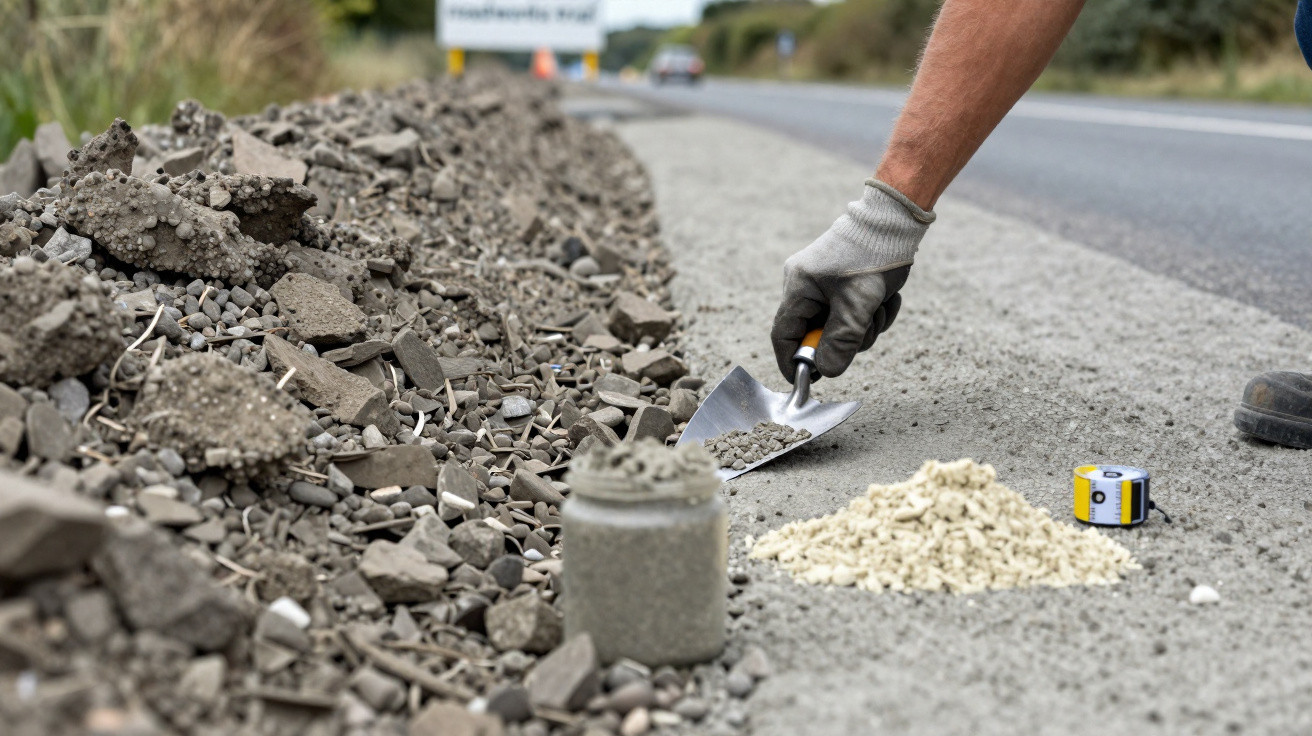
A road can look sound from above while the layers beneath are doing the hard work. When a base course loses strength or drainage is poor, water and traffic can lead to rutting, cracking and potholes - a familiar problem after a wet British winter.
A small Kentucky road trial from the late 1980s offers a useful reminder: unusual materials are not made safe or reliable merely by being described as recycled. The reported success of a fly-ash road base depended on controlled proportions, lime stabilisation, compaction, pavement cover and monitoring.
What the Kentucky trial involved
A Kentucky Transportation Center report, published in 1989, described an experimental road base installed in May 1988. The 750-foot section used about 80 tons of ponded fly ash: coal-combustion ash recovered from wet storage.
The ash was not used as loose fill. It was mixed into a stabilised aggregate base beneath the finished pavement, alongside a conventional control section for comparison.
The reported mix was:
- 84% dense-graded aggregate;
- 11% ponded fly ash; and
- 5% hydrated lime.
It was laid as an 8-inch-thick base layer. The report described the trial section as performing very well in its initial comparison with the conventional section.
The important point is not that ash was used, but that it formed one measured component of an engineered pavement layer.
That finding should be kept in proportion. It concerned one relatively short test section, with a particular ash source, mix design, site and construction process. It is not a recipe that can be copied without project-specific assessment.
Why lime and fly ash can affect a road base
Fly ash is a fine mineral residue from burning coal. Its properties can vary substantially, depending on the fuel source, combustion method, collection process and storage history. Ponded fly ash has been stored wet, which makes its moisture content and consistency especially important.
In suitable conditions, lime can react with reactive constituents in ash and aggregate. This may help a stabilised layer gain strength as it cures. A stronger, well-compacted base can spread traffic loads more effectively before they reach the subgrade beneath.
Potential reasons for considering a recovered material in a road scheme include:
- reducing demand for some virgin aggregate or binder;
- using material that might otherwise need long-term management;
- achieving the required engineering properties in a specified layer; and
- supporting resource-efficient construction where environmental controls are appropriate.
These are possibilities, not guarantees. Strength, durability, drainage, contamination risks, groundwater conditions and the proposed traffic loading all need consideration.
How the 11% mix was selected
The Kentucky report said that laboratory work was carried out on three alternative mixes. The 84/11/5 aggregate, fly ash and lime blend achieved the highest compressive strength of those tested and was selected for the field trial.
That approach remains more useful than the exact percentage. Materials described by the same broad name are not automatically interchangeable. A different stockpile of ash, grading of aggregate, binder dosage or moisture condition could give a very different result.
A sensible engineering sequence
- Characterise the material
Test representative samples for physical properties, moisture condition and relevant chemical characteristics. The sample should reflect the material that will actually arrive on site.
- Develop and test trial mixes
Assess more than compressive strength. Workability, compaction, curing behaviour, water sensitivity and durability are also relevant.
- Specify construction controls
Set requirements for mixing, moisture range, layer thickness, density, curing and protection from traffic before construction starts.
- Use a trial area where warranted
A controlled test strip can expose issues such as uneven mixing, segregation or unexpected wetness that laboratory specimens may not reveal.
- Inspect performance after construction
Monitor the pavement and drainage arrangements in service. The appropriate level of testing depends on the scheme and adopting authority.
What monitoring was reported
During construction, the Kentucky team used nuclear density gauges to check compaction and moisture. Subsequent work included cores and deflection testing, which can help assess how a pavement structure responds under load.
The report’s favourable initial finding is useful evidence from a real installation, but it is not a lifetime performance guarantee. Road foundations are affected by workmanship, freeze-thaw conditions, water movement, maintenance, traffic and changes to drainage over time.
For UK projects, materials and designs must meet the relevant specification and the requirements of the organisation adopting the road. Depending on the project, this could involve a local highway authority, National Highways, a consulting engineer and environmental regulators.
Encapsulation needs careful definition
The term “encapsulated use” is often used where a secondary material is incorporated into a designed product or construction layer rather than left as exposed bulk waste. In this case, the ash was mixed into a compacted base and covered by pavement layers.
That does not remove the need for environmental assessment. Pavements can be excavated, damaged or altered, and water can move through road structures. The suitability of a material depends on its properties, the local environment and the design details, including drainage and future maintenance.
It is also different from storing large volumes of wet ash in ponds or lagoons. Those are separate engineering situations with different containment and failure risks.
Reuse is not a shortcut around testing. It requires clear specification, traceability, construction checks and a plan for the material’s whole life.
Where the idea fits in Britain
Coal fly ash has historically been used in the UK construction sector, particularly in cementitious products, where it is often called pulverised fuel ash, or PFA. Availability has changed as coal-fired generation has declined, and materials from stockpiles may require particularly careful assessment for consistency and storage condition.
UK road projects already use recycled and secondary materials where they are suitable and permitted, including recycled aggregates, reclaimed asphalt and ground granulated blast-furnace slag. The right question is not whether a material sounds sustainable, but whether it is demonstrably suitable for the intended layer and site.
A robust proposal should cover:
- source, quantity and traceability;
- applicable specifications, standards and testing;
- environmental and leaching assessments where required;
- drainage, groundwater, watercourses and sensitive habitats;
- quality assurance during delivery, mixing and compaction; and
- arrangements for future excavation, repair and disposal.
Common mistakes when discussing recovered road materials
Treating every ash as identical
Ash can differ greatly between sources and storage conditions. Results from one trial cannot be transferred automatically to another site.
Assuming recycled means risk-free
Using a secondary material may save resources, but it does not remove the need for environmental controls or competent design.
Overlooking drainage
A strong base layer cannot compensate for blocked gullies, poor edge drainage or unsuitable ground beneath the road.
Treating laboratory strength as a full-life promise
Laboratory tests are essential, but construction quality, weather and in-service conditions determine how a pavement performs.
Confusing engineered use with bulk storage
Both require scrutiny, but loose wet ash storage and ash within a designed pavement layer are not the same scenario.
Safety and environmental checks
Fly ash and hydrated lime should be handled only within a suitable risk-assessed work system. Fine dust can irritate the eyes and respiratory system. Hydrated lime is strongly alkaline and can cause skin burns and serious eye injury.
Controls may include dust suppression, suitable respiratory and eye protection, protective clothing, washing facilities, training and clearly planned spill procedures. Follow the material safety data and site rules. Keep powders, washings and runoff out of drains, ditches and watercourses.
Never improvise with industrial residues, ash or lime on a driveway, garden path or domestic repair. Do not mix construction binders without competent advice. In particular, never mix bleach with acids, ammonia or other cleaners when cleaning tools or work areas.
The practical lesson
The Kentucky test strip is interesting because its message is unglamorous but important. Its reported result followed trial mixes, defined proportions, lime stabilisation, compaction checks and later inspection - not a miracle material or a quick fix.
For clients, contractors and specifiers, the useful questions are straightforward: What exactly is the material? Has it been tested for this application? How will it be contained and drained? Who verifies the work? And what happens when the road is repaired or excavated years later?
Those questions help turn a potential industrial residue into a properly managed construction material rather than an avoidable long-term problem.










Comments
No comments yet. Be the first to comment!
Leave a Comment