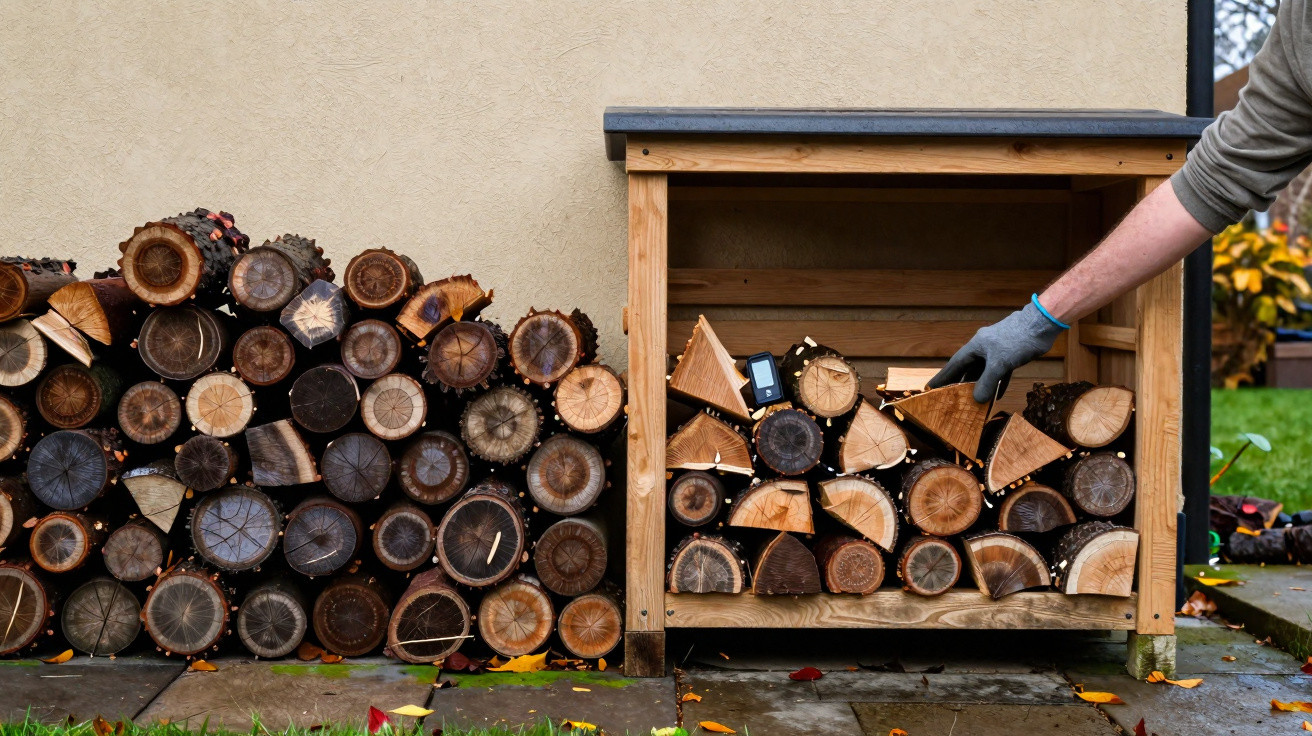
A stack of firewood beside the back door is convenient when it is raining and you want to refill the stove quickly. Yet storing a large pile directly against an outside wall can keep that part of the building shaded and damp, while also making it harder for the logs themselves to dry.
The practical fix is to make the store free-standing: lift it clear of the ground, keep an open gap behind it and protect the top from persistent rain without wrapping the whole stack. Moving the wood will not solve every damp problem, but it removes one avoidable source of trapped moisture and makes the wall easier to inspect.
Why a woodpile against a wall is a problem
External walls get wet. Rain, wind-driven spray, overflowing gutters and splashback from paving can all add moisture. A wall should then have a chance to dry, whether through its outer surface, a cavity or a breathable finish.
A deep stack of logs changes the conditions immediately behind it. It shades the wall, catches leaves and debris, and creates a sheltered gap where damp air can linger. The effect is often most noticeable during a wet British autumn or winter, when low sun and short days give the area little chance to dry.
This arrangement is particularly unhelpful where there is already a weakness, such as:
- a north-facing or heavily shaded wall;
- cracked render, open mortar joints or flaking paint;
- an older solid-wall property;
- a downpipe, leaking gutter or overflowing hopper nearby;
- paving, decking or soil sitting too high against the wall;
- persistently wet ground or poor drainage.
A log store should keep rain off the fuel, not create a shaded pocket that keeps the wall wet.
What three stere means in real terms
A stere is a measure of stacked firewood, broadly equivalent to one cubic metre of logs arranged in a stack. It is not a common measure in the UK, but three stere represents a substantial quantity of timber.
The issue is less about the exact volume than the size and depth of the pile against the house. A large stack can cover several metres of wall and make it impossible to see whether rainwater is running behind it, render is failing or air bricks have become blocked.
Freshly cut wood, logs delivered in wet weather and timber stored on bare ground all add to the problem. Even dry logs can take on surface moisture when they sit in a close, damp and poorly ventilated position.
That does not mean every woodpile beside a house will cause indoor damp. Damp marks can result from many faults, including plumbing leaks, defective gutters, poor ventilation indoors or problems in the building fabric. But a pile against the wall is a simple thing to remove from the equation.
Good storage helps the logs as well
Firewood dries through moving air. It does not need to be sealed in plastic. When logs are tightly wrapped, placed directly on wet ground or pushed against a wall, moisture is slower to escape.
For a stove or open fire, use properly seasoned or kiln-dried wood. A moisture meter can be helpful, but test a freshly split surface at the centre of a log, rather than the bark. Wood at 20% moisture content or below is generally regarded as suitable for burning; wetter logs tend to give less heat and create more smoke and deposits in the stove and flue.
A damp store may also encourage surface mould on bark and make the lowest logs soft or unusable. Rotate older stock forwards, and do not assume a waterproof cover alone will season wet timber.
Create a clear gap around the store
The best approach is to site the woodpile away from the building altogether. If space is limited, leave a visible, accessible gap between the back of the stack and the wall. Around 10–30cm can be a workable minimum, although a larger gap is better if your garden layout allows it.
A practical way to set up a log store
Choose a free-standing position. Pick a spot with reasonable airflow and access, but not directly beneath a leaking gutter or where a downpipe discharges.
Raise the bottom layer. Use a purpose-made log store, stable metal rack, timber bearers or solid blocks. Keep the base level and avoid supports that may sink into soft ground.
Keep the sides open. Air needs to move through the stack. A sloping roof or cover over the top is useful, but the sides should remain ventilated.
Keep the wall accessible. You should be able to clear leaves, inspect pointing and render, and check nearby vents without moving a season’s worth of fuel.
Stack safely. Build a stable pile, avoid overhanging logs and do not make it tall enough to topple in strong winds.
If the only possible location is near the house, use a shallow, free-standing rack rather than a deep stack pressed against the wall.
Cover the top, not every side
It is tempting to wrap the entire pile in a tarpaulin before a cold spell. In practice, a tightly fitted sheet can trap humid air and condensation around the logs.
Use a fixed roof, breathable fitted cover or a securely fastened sheet that protects the top and allows rain to run off. Leave the sides open. After high winds, check that the cover has not slipped down and sealed the stack.
Avoid covers that can collect pools of water or blow loose. Keep them away from boiler flues, air bricks, extractor outlets and any other vents. Do not lean a store against a flue or use it to conceal external pipework.
If damp has appeared indoors
Once the logs have been moved, allow time for the wall to respond. Brickwork, render and plaster do not dry immediately, especially in colder, wetter months. Take dated photographs of any internal marks and note whether they become worse after rainfall.
At the same time, inspect the exterior for obvious defects:
- blocked or leaking gutters;
- damaged downpipes and joints;
- cracked render or missing mortar;
- blocked air bricks;
- vegetation touching the wall;
- standing water or poor drainage at the base of the building.
If marks persist, plaster is loose, timber feels soft, or there is a continuing strong musty smell, arrange an assessment by a suitably qualified building or damp professional. A proper inspection should consider drainage, gutters, ventilation and the construction of the wall, rather than assuming the nearest visible woodpile is the sole cause.
Moving the logs is sensible housekeeping, not proof of a single diagnosis.
Common mistakes when storing firewood
These storage errors can look tidy at first but tend to create trouble over time:
- Stacking directly on soil or grass: the lowest logs absorb ground moisture and receive little airflow.
- Pressing logs against brickwork or render: this hides defects and delays drying after rain.
- Wrapping the pile completely in plastic: it can trap moist air around the timber.
- Blocking air bricks or vents: this may interfere with sub-floor or other building ventilation.
- Storing wood beneath a gutter leak: no cover can compensate for a constant drip.
- Ignoring green or dark staining: algae may be mainly cosmetic, but it indicates that the surface stays wet.
- Burning wet logs to clear space: keep them drying instead, rather than using fuel that will perform poorly.
Safety, cleaning and neighbourly checks
A large stack of logs is combustible. Keep it away from barbecues, fire pits and other likely ignition sources, and leave paths clear for access. Check that a store is stable, particularly in exposed gardens where strong winds are common.
If you rent, live in a flat, share a boundary or plan a substantial permanent structure, check your tenancy agreement, lease and any relevant local requirements first. Avoid creating a pile that overhangs a neighbour’s boundary or makes maintenance access difficult.
Do not reach for bleach or acidic cleaners to remove green staining without considering the surface and where the runoff will go. Never mix bleach with acids, ammonia or other cleaning products. For fragile render, historic masonry or widespread staining, seek appropriate advice before cleaning.
A straightforward autumn check
Before the wetter months settle in, walk around the outside of the house. If logs are touching a wall, move them into a raised store with an open gap and a top cover. Clear leaves from the exposed area, inspect the gutter above and make sure air bricks remain clear.
It is a modest weekend task, but one that supports better firewood storage and gives the outside wall a fair chance to dry between wet spells.










Comments
No comments yet. Be the first to comment!
Leave a Comment