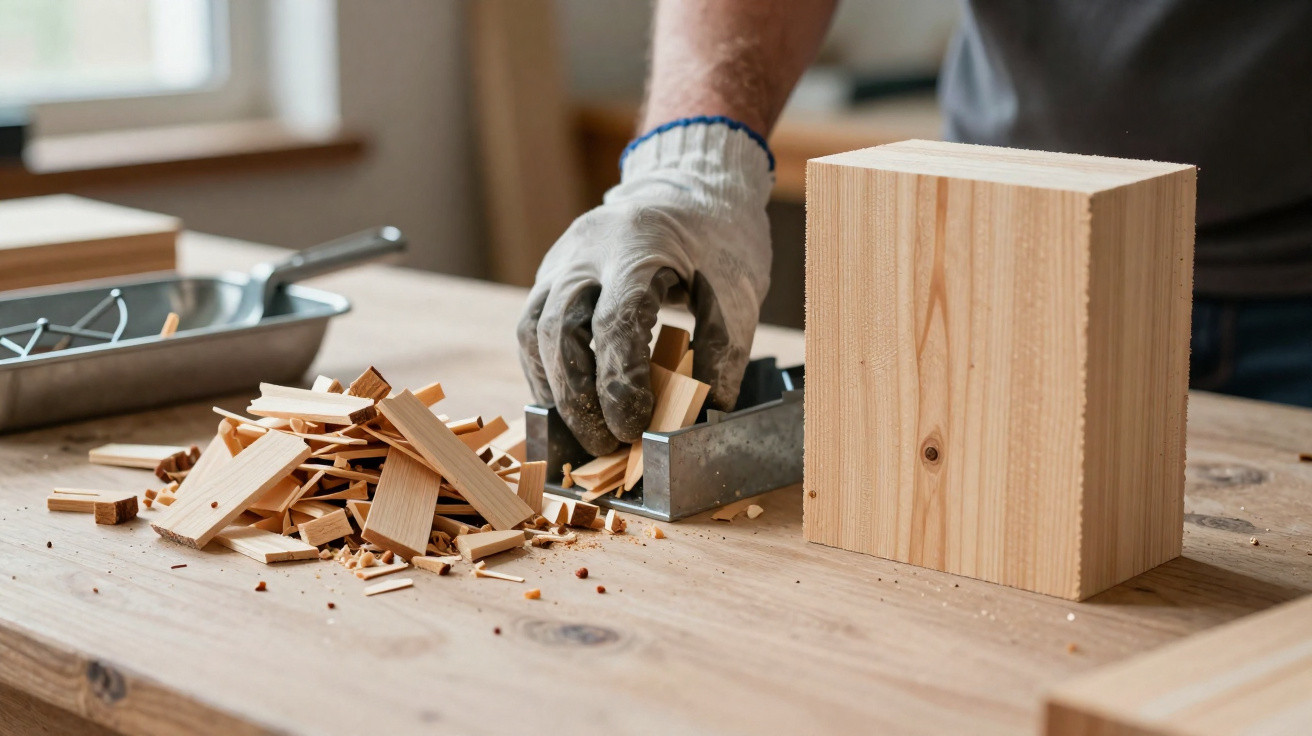
Offcuts, shavings and timber chips are inevitable wherever furniture, pallets, joinery or timber components are made. The useful idea is straightforward: clean, known wood residues can sometimes be processed into new construction products instead of being treated as mixed waste.
But a skip full of old timber cannot simply be turned into a wall block. For wood residues to become a dependable building material, they must be sorted, checked for contamination, prepared to a consistent size and combined in a product designed and tested for a specific use.
What is meant by industrial wood?
In this context, industrial wood usually means residues from manufacturing processes, rather than timber removed from an old house or building site. It may include:
- untreated softwood offcuts from a joinery workshop;
- sawdust and planer shavings from timber processing;
- clean trim waste from pallet or packaging production;
- rejected factory-made components with a known composition;
- chips produced when timber is cut to size.
These materials are not interchangeable. Fresh offcuts from a known source are usually easier to process than demolition timber, which may contain paint, preservatives, nails, sealants or hidden damage.
MDF, chipboard, plywood and laminated products also need particular care. They contain adhesives and, in some cases, coatings or treatments that may make them unsuitable for a given manufacturing process.
The valuable material is not simply “waste wood”, but clean, consistent wood with a known origin.
Why use timber residues in building products?
Small pieces of timber are often too short or irregular for joinery, yet may still be useful as a raw material. Processing them into particles, fibres or chips can create feedstock for products such as boards, insulation materials and some lightweight mineral-bound units.
Wood-containing blocks and panels can be designed for different roles. Some are intended for internal partitions; others form part of a more complex external wall system. A product’s suitability depends on its declared performance, not solely on the fact that it contains recycled material.
That distinction matters. A non-loadbearing block cannot be assumed suitable for supporting floors, roofs or other structural loads. Equally, a lightweight unit may offer useful handling or thermal properties, but it will need the right finishes, fixings and moisture protection.
Preparing residues for manufacture
Before wood enters a controlled product line, it needs preparation. The exact process varies by manufacturer, but the main principles are consistent.
1. Separate waste at the point it is created
Keeping clean untreated timber apart from general workshop waste is the simplest safeguard. Dedicated bins for softwood offcuts, shavings and clean chips can prevent contamination by food packaging, plastic film, metal, plasterboard or other site debris.
Clear rules are important too. A container intended for clean timber should not become the convenient place for painted boards or broken sheet materials.
2. Check for contaminants
Larger pieces may be inspected before processing, while magnets and metal-detection equipment can help identify nails, screws and staples. Screening can remove oversized pieces and unwanted debris.
Paints, preservatives, adhesives and fire-retardant treatments require careful control. They may affect worker safety, equipment, emissions and the performance of the finished product. Timber should not be accepted simply because it looks clean.
3. Produce a consistent particle size
Suitable wood may be chipped, shredded, milled or screened to a chosen size range. This helps it mix evenly with the binder and allows the manufacturer to achieve a more consistent density and finish.
Fine dust, coarse chips and long fibres all behave differently. The chosen material has to suit the formulation and the equipment used; it is not a case of adding any available sawdust to a mix.
4. Control moisture
Timber absorbs and releases moisture according to its surroundings. In the UK, especially through wet autumn and winter weather, residues stored outdoors can become damp quickly.
Too much moisture can make mixing less predictable and slow down curing or drying. Covered storage, raised pallets and moisture checks are sensible controls. Some processes may require drying, which also has an energy and cost implication.
How wood particles become a block
Wood-containing masonry-like units are generally composite products. The wood particles provide bulk and may reduce weight, while a binder holds the unit together. The binder, recipe and manufacturing method vary significantly between products.
A typical production sequence may include:
- Measuring the ingredients. Wood particles, binder, water and permitted additives are batched to a set formulation.
- Mixing. The aim is to distribute the binder evenly without leaving dry pockets or damaging the wood particles.
- Forming. The mixture is placed into moulds for blocks, panels or other components.
- Compacting. Pressure or vibration may be used, depending on the product, to establish its shape and density.
- Curing and drying. Products using mineral binders need controlled time and conditions to achieve their intended properties.
- Quality checks. Manufacturers may assess dimensions, density, appearance and other relevant characteristics before supply.
A lighter block is not automatically a better block. Strength, thermal performance, sound insulation, moisture behaviour, fire performance and the ability to take fixings must all be considered in the finished wall build-up.
Specify the wall system, not just the block
Do not assume that a wood-based block can replace conventional concrete blockwork on a like-for-like basis. Ask the supplier, designer or installer what the unit is intended to do and how it should be used.
Useful questions include:
- Is the product loadbearing or non-loadbearing?
- Is it designed for internal use, external use, or both?
- Which renders, plasters, claddings or membranes are compatible?
- What protection does it need during construction?
- What fire performance is declared, and for which wall construction?
- Which fixings are approved for shelves, cupboards or heavy radiators?
- Which mortar, adhesive or jointing method should be used?
- What technical documentation and installation instructions are available?
Building regulations and standards are administered differently across England, Wales, Scotland and Northern Ireland. For structural work, external walls, alterations affecting fire safety, or an unfamiliar product system, use a competent designer and speak to the relevant building control body before work begins.
A recycled ingredient is only one part of the decision. The finished wall must suit the building, the climate and the intended use.
Moisture, fire and on-site safety
Wood in a composite product does not perform in exactly the same way as a timber stud, but it remains an organic material. Good detailing is therefore essential.
Keep units dry in storage unless the manufacturer specifically says otherwise. Store packs off the ground, protect them from prolonged rain and avoid installing visibly saturated materials. Follow the specified details for damp-proof courses, cavities, renders, roof overhangs and cladding: an external wall works as a system.
Take fire information from the product’s declared documentation and from the tested or specified wall construction. Do not judge fire performance from appearance, weight or the presence of a mineral binder.
When cutting or drilling, follow the manufacturer’s instructions. Wear suitable eye protection and respiratory protective equipment where dust is generated, use dust extraction where possible, and ventilate enclosed work areas. Never burn offcuts, sweepings or dust from composite or treated timber products; burning can release harmful pollutants.
Common mistakes to avoid
- Treating all old timber as clean feedstock. Demolition wood may contain coatings, preservatives and concealed metal.
- Mixing solid timber with MDF, chipboard and plywood without a verified process. Their resins and compositions differ.
- Choosing on insulation claims alone. Joints, thermal bridges, finishes and workmanship affect whole-wall performance.
- Using a non-loadbearing unit structurally. Always check its intended application.
- Leaving packs exposed on a wet building site. Damp materials can be harder to handle and install correctly.
- Using unapproved render, plaster or fixings. These can affect durability and performance.
- Assuming recycled content automatically means lower overall impact. Transport, drying, binder choice and service life also matter.
A practical checklist before ordering
If you are considering blocks made with manufacturing wood residues, start with the building requirement rather than the environmental claim.
- Define whether the wall is internal, external, loadbearing or a simple partition.
- Obtain the technical data sheet and installation guidance before placing an order.
- Confirm dimensions, tolerances, jointing materials and cutting requirements.
- Check storage arrangements and weather protection on site.
- Ask about compatible finishes, services and fixings.
- Ensure the complete wall design is appropriate for building control requirements.
- Consider a sample panel or mock-up if the system is new to the contractor.
Clean timber residues can be a useful construction resource when they are properly controlled and made into products designed for the job. The strongest projects combine sensible material recovery with clear technical information, careful installation and a wall detail that can cope with everyday use and British weather.










Comments
No comments yet. Be the first to comment!
Leave a Comment