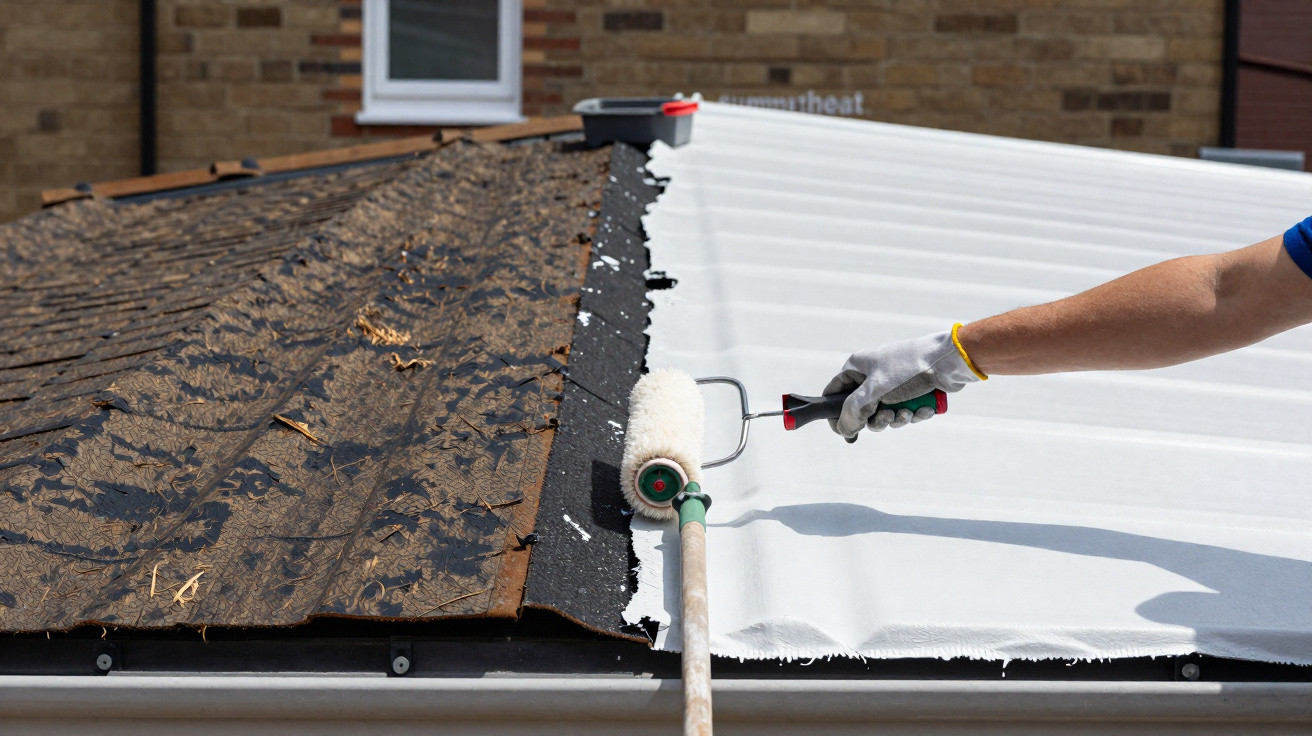
Hot upstairs rooms, sleepless nights and a loft that seems to store the day’s heat can make a heatwave feel much worse indoors. Before buying another fan, it is worth looking at the part of the house that receives the strongest sun for hours: the roof.
The principle behind a reflective, or ‘cool’, roof is straightforward. A surface that reflects more sunlight absorbs less heat, so the roof itself should not become as hot in direct sun. That can reduce heat passing into the rooms below, particularly beneath flat roofs and poorly insulated loft spaces. It is not a stand-alone cure for overheating, but it can be a sensible option when roof work is already needed.
Why roof colour can affect indoor heat
Dark roofing materials absorb more of the sun’s energy than pale or specially reflective finishes. The roof covering warms up, then some of that heat moves through the roof structure into the loft or top-floor rooms below.
Reflective surfaces send a larger proportion of sunlight back rather than absorbing it. This is described as solar reflectance, sometimes called albedo:
- A value of 0 means a surface absorbs nearly all incoming sunlight.
- A value of 1 means it reflects nearly all incoming sunlight.
- A surface with a reflectance of 0.9 reflects roughly 90% of the solar energy reaching it.
A useful roof finish also needs to release any heat it does absorb rather than holding on to it. Product data sheets may refer to this as thermal emittance.
Preventing heat from entering the building is usually easier than trying to remove it later.
What a reflective roof can - and cannot - do
A lighter roof surface can be noticeably cooler than a dark one in strong sunshine. Whether that translates into a cooler bedroom depends on the whole building, including:
- the amount and condition of loft insulation;
- the roof construction and any existing moisture problems;
- windows, glazing and external shading;
- whether the space is exposed to afternoon sun;
- the level of air movement through the home;
- the outdoor temperature, especially overnight.
The effect is often more relevant for top-floor flats, loft conversions and rooms below large flat roofs. A dark flat roof exposed all day, with little shade from neighbouring buildings or trees, has more potential to contribute to overheating than a small shaded pitched roof.
Do not expect results from hot parts of the United States or southern Europe to translate directly to a house in the UK. Our climate, building stock and heating needs are different. A reflective roof should be treated as one part of an overheating plan, not as an alternative to proper insulation, shading or ventilation.
Is it worthwhile in the UK?
The UK still has a heating-led climate for much of the year, but hot spells can make homes uncomfortable, particularly in dense urban areas where buildings and paving release stored heat after sunset. Bedrooms directly under a roof can be difficult to cool if the outside temperature remains high overnight.
A reflective roof may be worth exploring if:
- a flat roof covering is approaching the end of its serviceable life;
- a loft conversion or top-floor room regularly overheats in sunshine;
- the roof gets long periods of direct sun;
- you are replacing a roof and can specify insulation, drainage and finish together;
- portable cooling is frequently used in summer;
- the home is in a built-up location that stays warm into the evening.
Loft insulation remains an important starting point. It slows heat transfer in both directions: heat escaping from the home in winter and heat entering from a hot roof in summer. Check that insulation is dry, continuous and not compressed around the eaves or loft hatch.
A wider benefit in built-up areas
Dark roofs, roads and paving absorb solar heat during the day and release it slowly afterwards. This contributes to the urban heat-island effect, in which towns and cities can remain warmer than nearby rural areas, especially overnight.
A single pale roof will not change a neighbourhood’s temperature, but widespread use of reflective roofs can reduce the amount of heat absorbed by roof surfaces. It is only one part of the picture. Trees, green space, external shutters or awnings, well-designed homes and less heat-absorbing paving can all help too.
A bright roof does not remove carbon dioxide from the atmosphere. Its practical purpose is to reduce unwanted solar heat gain and, where mechanical cooling is used, potentially reduce the need to run it.
Your options: coating, membrane or replacement
A cool roof does not have to be brilliant white. Some roof membranes and specialist coatings are available in pale greys and other muted shades, although reflectance varies by product. Ask for the actual performance information rather than choosing by colour alone.
1. Apply a coating to a suitable flat roof
Liquid-applied reflective systems can work on some existing flat roofs, but compatibility is essential. A coating cannot fix failed seams, trapped moisture, cracked felt, ponding water or structural movement.
Before agreeing to the work, ask a competent roofer to assess:
- the existing roof material and its age;
- cracks, blisters, leaks and damp beneath the covering;
- falls, outlets and rainwater drainage;
- compatibility between the proposed coating and the existing surface;
- preparation, curing conditions and future maintenance.
2. Specify a reflective membrane during replacement
If a flat roof needs replacing, this is often the most straightforward time to consider a reflective finish. A light-coloured single-ply membrane or suitable cap sheet can be specified alongside insulation, vapour control layers and drainage.
The design needs to work as a complete system. Changing only the visible finish while ignoring wet insulation or poor drainage is a false economy.
3. Be cautious with pitched roofs
Painting ordinary roof tiles is not automatically a good idea. The coating must be suitable for the tile material and roof pitch, and should not interfere with drainage or moisture management.
A major visible change to a pitched roof may need checking with the local planning authority, especially for listed buildings or homes in conservation areas. If you are a leaseholder, you may also need the freeholder’s written consent. Roof replacement can trigger Building Regulations requirements, so ask the contractor what applies to the proposed work.
Winter, glare and upkeep
Reflective roofs have trade-offs. A darker roof can absorb a little solar warmth in winter, while a reflective one reduces that gain. In a well-insulated UK home this is usually less important than controlling summer heat, but it is still part of the whole-year calculation.
Bright surfaces can become less reflective as dirt, moss, algae, leaves and pollution build up. Follow the manufacturer’s cleaning and maintenance guidance rather than assuming a coating will stay bright indefinitely.
Consider glare as well. A highly glossy surface may reflect light towards neighbouring windows or nearby homes. Matte finishes designed for roofing are often less troublesome, but it is worth discussing the location and finish before work begins.
A reflective coating is a roof system component, not a tin of paint that can solve every overheating problem.
Common mistakes to avoid
- Coating over leaks or damaged felt. Repair water ingress and drainage faults first.
- Using ordinary exterior paint. Wall paint is not necessarily weatherproof, flexible or compatible with roof materials.
- Choosing by colour alone. Ask for technical information on solar reflectance, application and expected maintenance.
- Ignoring insulation and windows. Solar gain through unshaded glazing can be a larger problem than the roof.
- Applying coatings in unsuitable weather. Rain, damp surfaces, low temperatures and poor curing conditions can cause failure.
- Assuming a white roof is always best. Appearance, glare, planning constraints and the existing roof system all matter.
Safety and specification checks
Roof work has serious fall risks. Do not attempt to inspect, clean or coat a roof from an unsecured ladder. Most householders should use an insured, competent roofing contractor with suitable access equipment and fall protection.
Request the product data sheet and written confirmation that the proposed system is compatible with your roof. Check the warranty terms, fire classification, drainage requirements and whether the work affects rooflights, solar panels, gutters or rainwater pipes.
Never use bleach or acidic cleaners unless the roof-system manufacturer specifically permits them. Never mix bleach with acids, ammonia or other cleaning products: hazardous gases can form.
A practical way to decide
Start by working out when and where the home overheats. Note whether the hottest room is below the roof, exposed to direct sun through windows, or warmest only after the rest of the house has heated up. Check the loft hatch, insulation depth and roof condition before focusing on colour.
If roofing work is already planned, ask for a comparison between a conventional finish and a reflective alternative. Consider the full cost of preparation, maintenance and eventual replacement, not just the initial quote.
Combine the decision with measures that tackle heat at other points: close blinds before direct sun reaches the glass, consider external shading where appropriate, ventilate at night only when outside air is cooler and secure enough to do so, and keep insulation in good condition. A reflective roof will not make every British home comfortable during a heatwave, but the right finish on the right roof can reduce the heat arriving from above.











Comments
No comments yet. Be the first to comment!
Leave a Comment