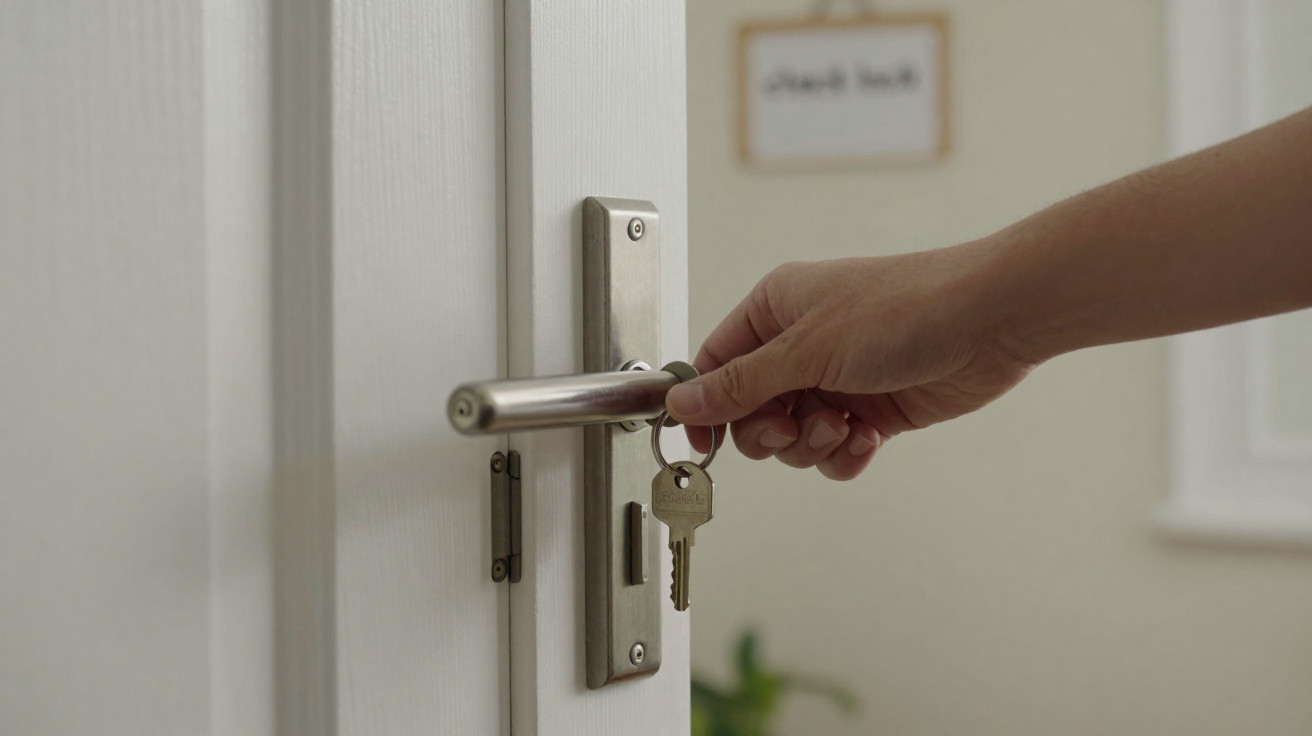
Shutting the front door and giving the key one quick turn is a familiar routine. But on some doors, that may not complete the locking sequence. A multi-point mechanism, for example, can need the handle raised before the key is turned fully to deadlock it.
The useful rule is not “always turn twice”. It is: use the sequence your own door requires, and turn the key only as far as it moves smoothly. Never force a lock in the hope that another turn will make it safer.
A second turn may matter on some doors, but there is no universal number of turns for every lock.
Why every door has a different locking sequence
UK homes have a wide range of door and lock types. A traditional timber door may have a mortice deadlock with one bolt. A uPVC, composite or modern timber door may have a multi-point mechanism, with several locking points running up and down the opening edge.
Those locking points can include:
- hooks;
- rollers;
- deadbolts;
- mushroom cams;
- latch bolts.
On many multi-point doors, lifting the handle engages these points with the frame. Turning the key then locks the handle in place and deadlocks the mechanism. The key may have more than one distinct movement before it reaches its natural stopping point.
Other doors may have a rim nightlatch, often called a Yale-type lock, a separate mortice lock, a cylinder-operated lock, or a smart lock with its own instructions. The number of key turns alone does not tell you whether a door is properly locked.
Check how your own lock works
The safest time to understand a lock is when you are at home and not rushing out. Inspect the mechanism with the door open, but remember to unlock it again before attempting to close the door if bolts or hooks have extended.
1. Keep the key with you
Open the door fully and hold on to the key while checking the mechanism. Keep children and pets away from the door so it cannot be shut unexpectedly while you are testing it.
2. Look at the opening edge
Find the metal strip along the edge of the door. On a multi-point lock, you should see several locking points spaced along it. These may look like small hooks, round rollers, rectangular bolts or mushroom-shaped pieces of metal.
A mortice deadlock will normally have one larger bolt, usually around handle height.
3. Follow your normal sequence
If the handle lifts upwards, raise it fully and watch for movement along the door edge. Keep fingers clear of hooks, bolts and the hinge side.
Then turn the key gently towards the locked position. Notice whether it reaches a clear, firm stop without resistance. Once you have checked the action, return the lock to its unlocked position before closing the door.
4. Test it with the door shut
Close the door properly, making sure the latch has caught. Then lock it using the correct sequence. The key should turn smoothly, the handle should not feel unusually loose, and the door should sit squarely in the frame.
If you have to pull, push or shoulder the door hard to turn the key, do not treat it as normal. The door may be out of alignment, its keeps may need adjustment, or the lock could be developing a fault.
What an extra turn can actually do
A further key movement does not automatically make every lock more secure. On the right type of door, however, it may fully extend a deadbolt, deadlock the latch, or prevent the outside handle from operating the multi-point mechanism.
The cylinder and handle are only part of the system. For a door to work properly, the locking points must engage cleanly with the frame-side fittings, usually called keeps or striking plates.
Think of a door lock as a system: the lock, door, hinges, keeps and frame all need to be in sound condition.
A good cylinder cannot compensate for:
- a loose keep or damaged screws;
- decayed, split or cracked timber around the frame;
- a warped or dropped door that no longer lines up;
- locking points that do not extend fully;
- damage to the door leaf, hinges or frame.
Give the frame and keeps a quick inspection
You do not need to dismantle a door to spot obvious problems. With it open, look at the metal plates or boxes in the frame where the bolts and hooks enter.
Look for loose fixings, rust, movement, damaged timber or scrape marks showing that the bolts are catching rather than entering cleanly. On uPVC and composite doors, signs of poor alignment can include rubbing at the threshold, draughts around one edge, or a handle that has become increasingly difficult to lift.
Avoid adjusting hinges, keeps or multi-point lock components at random. Small alterations can affect the seal, alignment and operation of the door. If the mechanism is stiff or unreliable, a locksmith or competent door repair specialist can identify whether it needs adjustment, repair or replacement.
If you rent your home, report a faulty lock, damaged frame or loose hardware to the landlord or letting agent in writing. Do not alter shared entrances, communal doors or fire-door hardware without permission.
Security must not compromise escape
A secure front door must still be possible to open quickly from inside in an emergency. This matters particularly in flats, shared homes and properties with only one practical escape route.
If a key is needed to unlock the door from inside, make sure it is readily available whenever the home is occupied. Keep it somewhere known to everyone who may need it, but not where it is visible or easily reached through glazing, a letter plate or an open window.
Do not add bolts, chains or other security devices that could delay escape without considering the consequences. If a door is difficult to unlock from the inside, arrange for the problem to be dealt with promptly.
For fire doors, communal entrances or rented properties, check requirements with the managing agent, landlord or an appropriately qualified professional before changing any hardware.
Common mistakes when locking a front door
Assuming every lock works like a neighbour’s
Some locks turn once, others have more than one stage. Forcing a further turn after the mechanism has reached its stop can damage the cylinder or internal parts.
Forgetting to lift the handle
On many multi-point doors, the handle must be lifted before all available locking points can engage. Turning the key first may not complete the intended sequence.
Locking a door that is not fully shut
If the door is only resting against the frame, bolts may not enter their keeps correctly. Pull it closed, check the latch has engaged, then lock it.
Ignoring a stiff key or sticky handle
A lock should not require brute force. Do not use cooking oil or heavy household lubricants in a cylinder; they can leave residue that attracts dirt. Use a product intended for locks only where the manufacturer permits it, or seek professional advice.
Focusing only on the keyhole
A new-looking handle or cylinder does not solve problems with a damaged frame, loose keep, worn hinge or badly aligned door. Check the whole assembly.
When to call a professional
Arrange an inspection if the key starts catching, spinning, sticking or refusing to come out. Other warning signs include a handle that will not lift fully, locking points that fail to move, a door that no longer closes squarely, or visible damage around the cylinder, frame or keeps.
Choose a local locksmith or door repair specialist who will explain the issue and provide clear costs before work begins. Your local police force may also publish general home-security guidance, while a qualified locksmith can assess the door hardware itself.
Make locking up a simple routine
When locking the door, close it firmly, use the handle in the sequence your door needs, and turn the key smoothly to its intended locked position. That may mean one turn, two stages or a different action entirely. The important point is not to force it.
Check the door occasionally when you are not in a hurry, and deal with stiffness or misalignment early. A correctly operated lock, sound frame and sensible escape plan will help your entrance door do its job properly.










Comments
No comments yet. Be the first to comment!
Leave a Comment